
Lewis Hamilton data reveals all after bruising Las Vegas GP qualifying


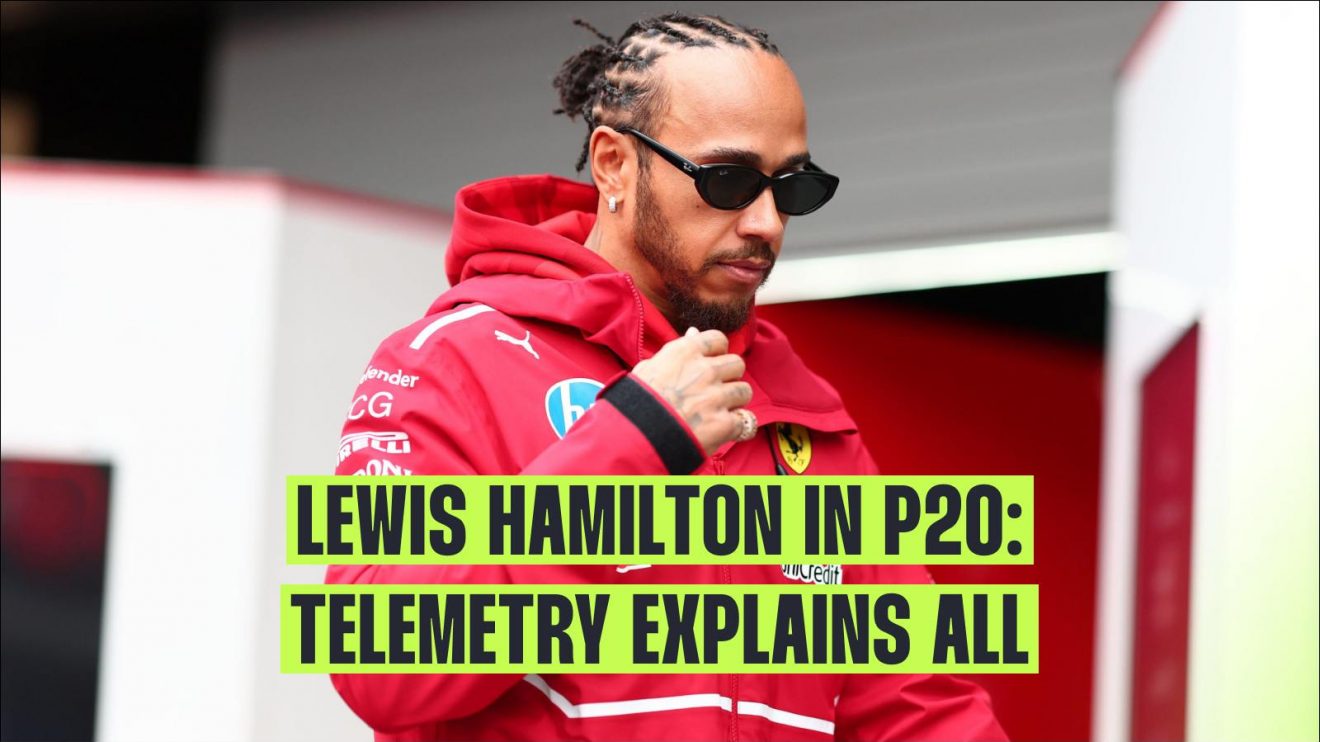
Lewis Hamilton will start on the back row of the grid in Las Vegas.
A seven-time world champion with a well-earned reputation for brilliance in wet conditions, this time delivered the worst qualifying result of Lewis Hamilton’s entire career under very similar circumstances.
How did Hamilton end up last on the grid after a promising FP3, and would his uncompleted final attempt have changed anything? Telemetry data helps us find out.
The toughest qualifying session of Lewis Hamilton’s career
After a strong impression in the third practice session, it seemed that Ferrari could be in a position to achieve a good result in Las Vegas – one that might help them in their battle for P2 in the Constructors’ Championship. In fact, the nature of this circuit should theoretically suit their current car.
However, the heavy rain and extremely difficult conditions wiped all of that away, leaving only raw driver skill to determine who could put together the fastest lap and secure a decent starting position.
So why did Lewis struggle so much to find grip in Q1?
A closer look at how qualifying unfolded in Las Vegas
? Winners and losers from the 2025 Las Vegas Grand Prix qualifying
? F1 2025: Head-to-head qualifying statistics between team-mates
On the chart below, we can see a comparison between Hamilton’s and Charles Leclerc’s best laps from Q1. Even at first glance, the speed differences in several parts of the lap are striking.

Hamilton’s lap actually began well, with only a small deficit through Turn 3, where Leclerc managed to find traction earlier on corner exit. The difference wasn’t large at that point and remained fairly stable through Turn 5 – a braking zone made more challenging by the preceding straight.
Lewis was quicker through the next corner and briefly recovered some of the time he had lost – but only briefly, as the corners that followed proved decisive in the wrong way.
On the exit of Turn 9, Leclerc once again managed to find traction earlier on the rear tyres, this time with an even bigger advantage. That gave him superior speed heading into Turn 10, where he was significantly faster.
Hamilton, meanwhile, was forced to momentarily hit the brakes at the apex of Turn 10 – something Leclerc did not do. The speed difference between the two drivers at this point of the lap is more than obvious.
By the end of the middle sector, Leclerc’s advantage had grown to around 2.5 seconds – an enormous margin even in difficult conditions.

Hamilton’s lack of confidence in the faster corners of the Las Vegas circuit was once again apparent in the final corner, where he again had to brake momentarily, while his team-mate did not.
In the end, Lewis could do no better than P20 – for the first time in his long and illustrious career.
The main explanation for such a poor performance likely lies in the aerodynamic package chosen for qualifying. Hamilton ran the Monza-spec rear wing, while Leclerc used a step more aggressive wing, which can offer a considerable advantage in conditions like these.
Telemetry supports this. The first indicator is the top speed on the long Las Vegas straight – the graph clearly shows Hamilton’s significant advantage there. The difference in top speed also appears on the run from Turn 4 to Turn 5. While this helped him on the many straights around this circuit, the story was very different in the corners, where the Briton simply lacked grip.
As Hamilton himself said after qualifying, he was unable to generate enough tyre temperature, and this aerodynamic choice likely played a major role in that. The Ferrari driver, on the other hand, battled persistent understeer – particularly in the slow corners.
Another telling sign lies in the fast corners such as Turn 10 and Turn 17, where Hamilton briefly braked to maintain control – moments that cost him crucial time.
Of course, things are never that simple, and this certainly wasn’t the only factor – but it was probably the most influential one.


Would the final attempt have changed anything?
Unfortunately, even if Hamilton had completed his final attempt, the chances of drastically changing the outcome were slim. He needed to find 0.9 seconds to progress to the next session – possible in theory, but based on his previous Q1 lap times, highly unlikely.
Crucially, it wouldn’t have changed the fundamental problem: the behaviour of the car in low-grip conditions.
More concerning for the team – and for Ferrari fans – is the fact that Leclerc’s more heavily-loaded rear wing could be a major liability in the race. In Las Vegas, if your straight-line speed isn’t good enough, you can easily lose two to three tenths per lap unless you are within DRS range.
With Leclerc starting from P9, his path to a strong points finish will be exceptionally difficult, which could further impact the battle in the Constructors’ Championship.
Read next: Oscar Piastri responds as Leclerc and Hadjar deal championship blow