

F1 2026 uncovered: McLaren makes a number of changes for the Australian Grand Prix


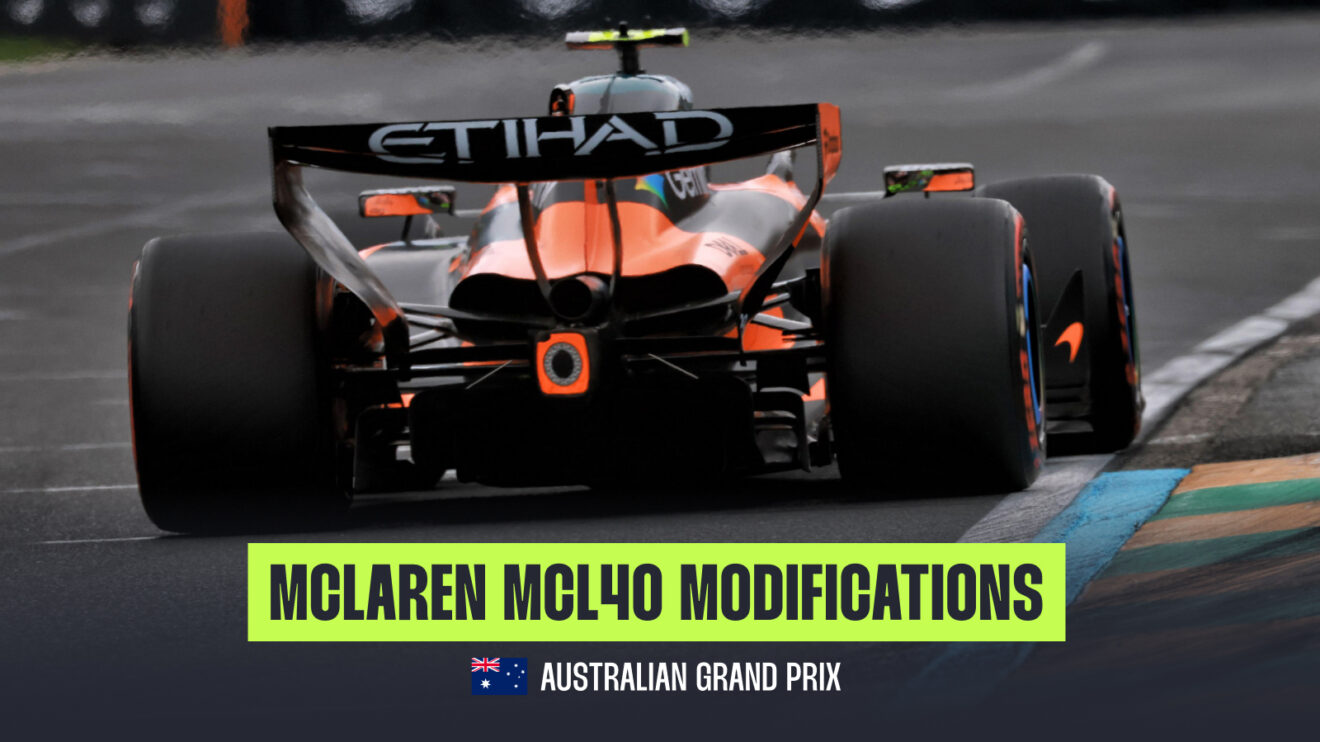
McLaren arrived at the Australian Grand Prix as defending champions and with their sights set on a repeat of that feat in 2026.
The Woking based outfit has a number of new parts for the MCL40, as they looked to improve its performance at the season opener too.
McLaren makes rear end revisions
Want more PlanetF1.com coverage? Add us as a preferred source on Google to your favourites list for news you can trust.
At the rear of the car we find a new rear wing solution, which was tested by Oscar Piastri on Friday but was installed on both cars for qualifying, as it obviously provided the expected performance boost shown in their simulations.

In the comparison (new specification at the top) it’s clear to see the different flap ratio between the two rear wings, with the new specification furnished with a taller chorded upper flap, whilst the lower flap and mainplane have a smaller chord distribution.
Given the smaller allowable box region for these elements in this regulation set, it’s also clear that the overall height of the elements within the box region remains largely untouched, which is not how teams have previously set about designing wings with different downforce characteristics.
More from qualifying at the Australian Grand Prix
F1 starting grid: What is the grid order for the 2026 Australian Grand Prix?
Max Verstappen Melbourne crash explained as Red Bull driver blasts ‘not correct’ F1 regulations
Of course, the other factor at play here is the delta between both wings in terms of how much drag will be shed when active aero is deployed in straight mode, with a larger gap exposed on the newer variant.
Whilst it’s easy to get drawn to the shape and chord height characteristic differences it’s also worth noting that the shape of the mainplane has also been altered, with a less abrupt spoon-style shaping applied across the leading edge.

McLaren have also been busy with the region ahead of the rear tyre, making quite a substantial change that not only alters the shape and design of the slots but also incorporates a vane on the floor’s outer edge (green arrow).
This region is going to be a hotbed for development during the early phase of these regulations as teams battle to find a way to best employ the freedoms that are available to them, whilst also meshing those ideas with the behaviour of the surfaces that are impacted downstream.
This section of the floor is especially important in that respect, as it’s a touch point for the airflow before it reaches the rear tyre, which itself can be problematic from a turbulence point of view, as the airflow cast off the tyre can be chaotic.
This is due to the unpredictability of both the rotational speed of the tyre and how it deforms under load, which means there’s no one answer to the problem, only solutions that help to mitigate the negative effects that can be created.
The biggest issue that’s caused is a phenomenon known as ‘tyre squirt’, whereby the airflow pushed off the tyre is squirted laterally into the diffuser’s path.
And, whilst teams have battled this issue in various ways over the years, mainly based around what they’ve been allowed to do within the regulations, what they’ve learnt during that period is sort of reset again for 2026, as the tyres are different construction wise to what they’ve seen before and we now have the winglet mounted to the side of the diffuser, rather than the rear brake duct.
It won’t take long for the designers to get more of a handle on how all of these flow mechanisms can be controlled more effectively but, what it will do is lead to is an ongoing battle between the redesign of this rear section of the floor, the diffuser’s sidewall, the floor winglet and the remaining furniture hung from the rear brake duct.
McLaren also announced via the car presentation document that the MCL40’s rear suspension fairings have been modified for the Australian Grand Prix, noting that the changes around the mounting points will result in improved flow conditioning around the rear impact structure and improve diffuser performance.
Want to be the first to know exclusive information from the F1 paddock? Join our broadcast channel on WhatsApp to get the scoop on the latest developments from our team of accredited journalists.
You can also subscribe to the PlanetF1 YouTube channel for exclusive features, hear from our paddock journalists with stories from the heart of Formula 1 and much more!
Read next: Adrian Newey claims AMR26 is ‘fifth-best’ chassis despite Melbourne woes