

Australian GP conclusions: Formula Net Zero, Russell’s main threat, Aston Martin-Honda mistake


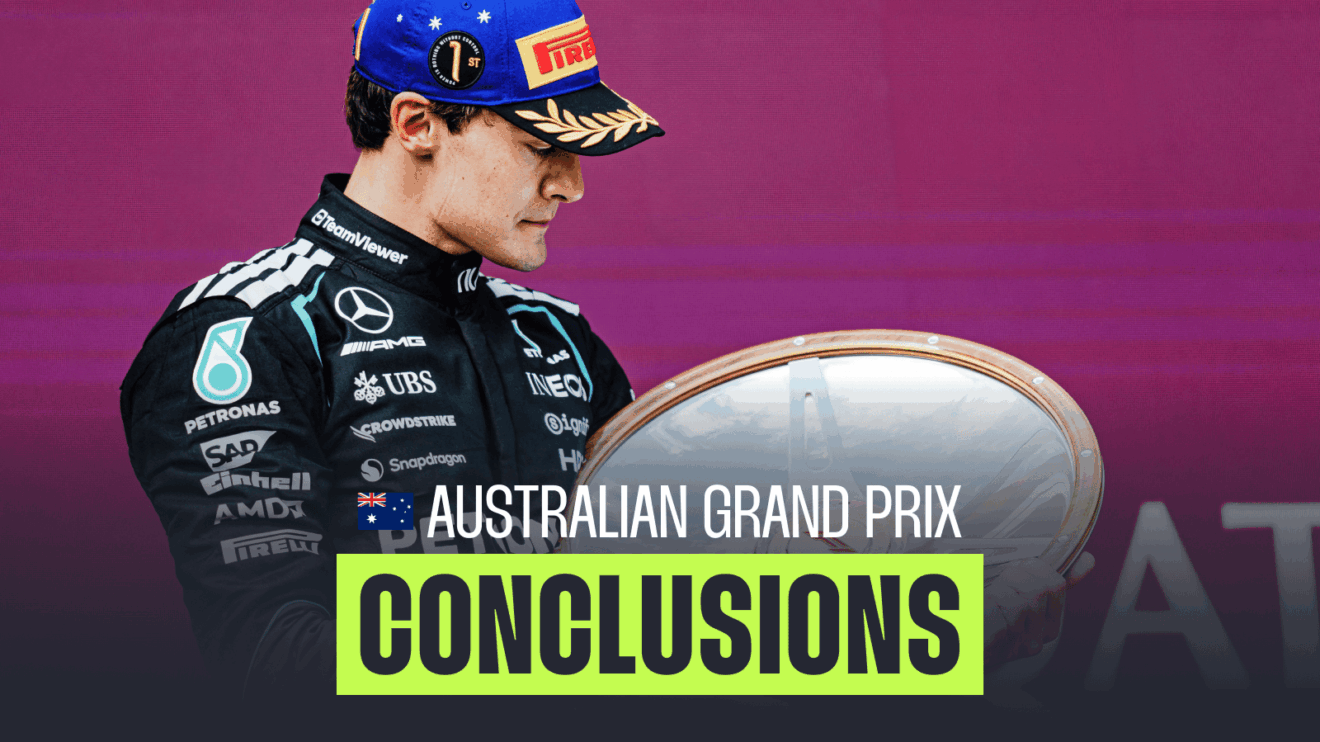
George Russell: 2026 title favourite?
Mercedes driver George Russell opened the F1 2026 season with a win at the Australian Grand Prix at Albert Park.
Russell converted pole position into victory to top the drivers’ standings for the first time in his career, with Mercedes teammate Kimi Antonelli second and Charles Leclerc third for Ferrari. Here are our conclusions from Melbourne…
Will Kimi Antonelli be George Russell’s main threat in F1 2026?
Want more PlanetF1.com coverage? Add us as a preferred source on Google to your favourites list for news you can trust
Whenever Mercedes has provided a car capable of winning, George Russell has delivered.
It was ever thus, stretching all the way back to his short-notice debut with the team at Sakhir 2020, a race only lost through no fault of his own.
So it should be considered no surprise that, at last presented with the car (and engine, compression ratio ‘n’ all) of his dreams at the start of 2026, Russell managed to make it look so effortless at the Australian Grand Prix.
This is what he does, what he’s always done, when he has the right equipment.
There is a reason why Russell was almost immediately installed as the title favourite for 2026 the moment he signed his new Mercedes contract following his victory in Singapore last year.
There have been times in his Mercedes career when he has been his own worst enemy, overreaching and allowing himself to be drawn into mistakes attempting to bridge the gap back when the car beneath him wasn’t quite good enough.
Ever since he finally received one he could truly work with at the start of last year, though, he has become more relaxed and restrained, not quite as desperate to impress and, as a result, more complete.
And now, with Mercedes stepping out of the darkness and back into the light in 2026, be in no doubt that Russell’s moment has arrived and that he is ready – more convincingly so than last year’s first-time world champion – to seize it.
What we witnessed in Australia was the natural result of a driver approaching his peak finally getting hold of the tools he’s spent his entire career waiting for.
It makes for a lethal, and quite likely unbeatable, combination for this season.
Yet who might be Russell’s main threat in the title race in 2026? Step forward Kimi Antonelli.
Recap: Conclusions from F1 2026 pre-season testing
F1 testing conclusions: Bring back V10s, fresh Aston Martin hope, secret Ferrari weapon
Shakedown conclusions: Mercedes back in the light, Red Bull finds peace, key Newey question
There was a touch of his mid-2025 crisis about the boy wonder’s crash in the closing stages of FP3 on Saturday, the worst possible time to tear a corner or two off the car with qualifying a couple of hours away.
As ever with Antonelli, however, it is not so much the mistake itself but what follows: the composure of the response, the completeness of the recovery.
No time to set up the car before jumping in for qualifying? No problem.
If he fell only 0.293s short of Russell’s time for pole position after a confidence-sapping accident and a frantic repair job, how much closer would he have been with a normal buildup to the session and a Mercedes set up to his liking?
Only three seconds behind Russell at the finish on Sunday, too, despite falling as low as seventh on the first lap and stacking behind him under VSC conditions.
Like his previous highs – this race last year (16th to fourth in the wet) and Las Vegas (17th to second) – what could have been quite an uncomfortable weekend for Antonelli instead ended with another flash of his enormous potential.
It became evident in the closing weeks of last season, with his podiums in Vegas and Brazil, that Antonelli had made some kind of breakthrough in his adjustment to life in F1.
He is growing all the time and at such a rate (the really impressive thing) that makes all those comparisons to a young Max Verstappen a couple of years ago seem almost prophetic.
If Antonelli can just cut out those lingering rookie mistakes too, Russell might not have it all his own way after all in 2026.
Ferrari can’t waste the opportunities provided by the SF-26’s fast starts
How far back, you wonder, must Ferrari qualify for the driver on pole to be able to relax at a race start in 2026?
Starting only fourth in Australia did not stop Charles Leclerc storming into the lead out of Turn 1.
Nor did seventh on the grid (effectively P6 after Oscar Piastri’s pre-race accident) prevent Lewis Hamilton from vaulting to third by the end of the opening lap.
The SF-26’s smaller turbo compared to the opposition, widely believed to be behind Ferrari’s lightning-fast race starts, is likely to prove a very potent weapon this season.
Yet a good start can only create an opportunity; it is up to the team to ensure that such opportunities are maximised.
With great predictability, it is in this area where Ferrari’s Australian Grand Prix blurred between highly encouraging and frustratingly unfulfilled.
After McLaren scared itself stiff in Qatar at the end of last year, each team would have been well advised to have a sign reading ‘see safety car, pit under safety car’ pinned to the pit wall going forward.
The moral of the story from that race?
The gains in terms of pure race time – simply getting from the start line to the chequered flag as quickly as possible – should far outweigh every other consideration whenever the safety car, virtual or real, is deployed.
Ferrari did not get the memo, being responsible for two of the only three cars in the field (Franco Colapinto’s Alpine was the other) to miss the chance to pit under both early VSCs.
As such, it was impossible to look at Leclerc’s 15.5s deficit at the end in Melbourne without wondering how differently the race might have developed had Ferrari effectively halved the time it spent in the pits.
Still not quite enough to beat Mercedes at this venue, perhaps, but certainly a helluva lot closer.
And by being a helluva lot closer, Ferrari’s mere presence would have kept the pressure on Mercedes and, in the process, increased the chance of its drivers making mistakes in the very first race of this complex new era in which the sheer flood of information in the cockpit was disorientating.
Whenever a race is lost in this manner, there is a temptation to draw comparisons between the respective teams involved and their contrasting stages of development.
Ferrari, some might argue, still needs to learn how to win again – a common excuse uttered by re-emerging F1 teams following a period in the wilderness – after a barren 2025.
Compare and contrast to Mercedes, which seemed to treat last season as one big warm up for 2026, gradually regaining its strength and collecting some accomplished victories along the way.
Yet even the most Ferrari-centric soul would confess that none of that really applies here.
Early days these might be, but you will struggle to find a more glaring strategy mistake in the entire 2026 season.
Oscar Piastri’s accident has denied him the F1 2026 reset he needs
Recent history tells us that drivers who come oh-so close to the world championship, only to miss out at the end of the season, need a bit of time to get over it.
Mark Webber, for instance, was considered the title favourite for much of 2010, only to come up short at the last race.
The next time he stood on the top step of a podium? More than 12 months later at the final round of the following season.
See also Nico Rosberg, who held a handsome lead over Lewis Hamilton at one stage in 2014, yet was also ultimately forced to settle for second at the season finale.
On that occasion, Rosberg seemed to spend most of 2015 recovering from it, eventually charging himself up again for one last swing at the title in 2016.
There has been hope that it might be different for Oscar Piastri in 2026.
So patchy was his end to last season that his defeat to Lando Norris ultimately should not have come as a great shock to the system.
There was an inevitability about it that should have made it easier for Oscar to stomach.
And his very placid and measured manner out of the car – never too high, never too low – also indicated that he would be just fine.
And maybe he will be fine.
But also maybe he won’t. At least not yet. Not for now.
Maybe he’s still, even on a subconscious level, recovering from how last season ended.
Maybe he’s still in the process of coming to terms with how he let such an advantage roll away from him so easily and with such little resistance.
Maybe the pain of last season, losing out despite holding a 34-point lead after Zandvoort, smashed into him so hard that he will not soon forget.
The disappointment he would have experienced when it was all said and done after Abu Dhabi – what could I have done differently? What should I have done differently? – is the kind that tortures you, hitting you last thing at night and first thing in the morning, throughout the winter break.
Most elite athletes will tell you that golden opportunities of the type presented to Piastri last season must be seized, because who is to know if they will ever come again?
Blink, as Oscar did, and suddenly you’re Mark Webber.
The great shame of Piastri’s season starting with a DNS is that, as at so many rounds in 2025, he was the stronger and more convincing McLaren driver in Australia.
With Norris never really recovering from his lost running in FP1, Piastri looked for all the world as if he had, if anything, returned more accomplished and complete for the experiences of the last 12 months.
Then came that small misjudgement and unexpected power surge on the reconnaissance lap.
Then came the hard hit with the wall.
And then came another punch to the gut – this time in his hometown, of all the places on Earth for it to happen – to add to the various body blows he has taken over the last six months.
In that moment, the whole pretence of a fresh start for Piastri in 2026 was punctured.
If Oscar’s accident looked like a hangover from the end of last season, in other words, that’s because it was.
Aston Martin badly underestimated the challenge facing Honda in F1 2026
What made Aston Martin swap its cushy supply of customer Mercedes engines and switch to Honda power for 2026?
That question cropped up a couple of times over the course of pre-season testing last month.
For a clue to the answer, see what’s currently going on at McLaren.
It has been said that McLaren’s success over recent years has totally debunked the long-held theory, pushed most famously by its former team principal Ron Dennis, that teams cannot win the world championship in the modern era without a works engine.
McLaren is living proof that a customer team can win and win well, especially when the works team gets as muddled as Mercedes did in the ground-effect era.
But is it a strategy conducive to sustained success over the long term? On that score at least, Dennis’s doubts remain as valid as ever.
Look at McLaren now, back to feeling like a second-class citizen for the first time in years, its lack of integration and intrinsic knowledge of the new engine compared to the Mercedes factory team putting a clear limit on its ambitions at the start of 2026.
So, no, it was no mistake for Lawrence Stroll and Co. to assess the new rules and come to the conclusion that Aston Martin required its own engine if it was going to realise its full potential.
Yet where the team did go wrong, it became clear over the Australian Grand Prix weekend, was totally underestimating the challenge facing Honda ahead of 2026.
Despite its success with Red Bull until the end of last year, Honda has effectively returned to F1 this season following its official withdrawal at the end of 2021.
The period of inactivity between its decisions to withdraw and then re-enter with Aston Martin, announced in May 2023, saw Honda’s F1 project effectively gutted as key engineers departed and resources were diverted elsewhere.
It was an inescapable fact that the impact of Honda’s hokey cokey, tearing the whole thing down before building it all back up again 18 months later, would be felt in the development of its new engine for 2026.
Go deeper: Why Aston Martin’s slow start to F1 2026 should come as no surprise
Can Adrian Newey save Aston Martin-Honda?
Aston Martin AMR26: What we’re hearing about Adrian Newey’s first Aston Martin
Strange that Adrian Newey, a fiercely intelligent man and someone who has worked almost uninterrupted with Honda over the course of his Red Bull and Aston Martin stints, would in Melbourne claim to be taken by surprise by this news.
But still, appearing in the team principals’ press conference last Friday, Newey said the team only discovered the true impact of Honda’s reversal in November last year, with Aston Martin completely unaware of the situation when the deal was first agreed in 2023.
It was an admission to cut to the heart of one of the most common complaints of the Aston Martin era – the so-called ‘galacticos’ approach.
It is one thing, after all, to assemble such illustrious and respected names as Newey, Honda, Fernando Alonso and Andy Cowell (revealed by PlanetF1.com to be leaving Aston Martin in due course) to create an F1 superteam.
It is quite another to establish a culture and understanding to bring these elements together and get them working as a cohesive, effective and successful unit.
What first attracted you to Honda, Mr Stroll?
Probably nothing more than the fact that, at the time the deal was signed, it was dominating F1 in the back of Max Verstappen’s Red Bull.
Perhaps too much credence was given to the results, as though a Honda engine deal alone would magically come with a cast-iron guarantee of success, and not enough thought given to the process that helped put it in that position just a few years after its disastrous stint with McLaren ended.
What we see at Aston Martin now is simply the oversights and assumptions of the last three years coming back to bite.
The right people are all in place. But the strategy? That bit has been sorely lacking.
Welcome to Formula Net Zero
What is the essence of Formula 1?
Different strokes for different folks, of course, yet there is an argument that the true appeal of F1 lies not in the cars, the drivers, the glamour or the sound, but the circuits. Specifically the high-speed corners.
It is for this very reason that Eau Rouge, and the question of whether it could be taken flat, was for many years the great barometer of the performance capabilities of a Formula 1 car.
The early evidence suggests that the 2026 cars will not be going flat through Eau Rouge, the first in a generation to fail that test, when F1 visits Spa in July.
No, 2026-spec F1 is more likely to view Eau Rouge as a chance to super clip – potentially demanding a downshift and maybe even a dab of the brakes for good measure – to save up enough energy for the rest of the Kemmel straight that follows.
That, by any measure, would not be Formula 1.
Yet nothing much we have seen so far in 2026 resembles Formula 1 as we knew it.
Do not be fooled by what developed into a relatively normal weekend in Melbourne, where the ‘battle’ between George Russell and Charles Leclerc in the early laps was in reality nothing more than the ebb and flow of energy management playing out for the first time in a live race.
Trust the engineers to put a stop to that sort of thing soon enough.
For the abiding image of the 2026 Australian Grand Prix, look instead to the onboard footage from qualifying of the cars running out of puff on the approach to the Turns 9/10 chicane, one of the signature corners on the calendar now reduced to a charging station.
This is not progress we’re witnessing here, but sacrilege. Formula 1 was not so broken before that it required this silly overcorrection.
After Max Verstappen, one of the few with the courage of his convictions, spoke his mind in pre-season testing, a growing number of drivers are beginning to find their voices in openly criticising the new regulations.
The general consensus?
The weird, shape-shifting, passion-killing horrors of 2026 are the unwanted answer to a question nobody asked and enough to turn cold the blood of anyone with motor racing in their bones.
This is not a situation like 2014. There is little hope that the new rules will simply just ‘bed in’ after a few races when the sport, and the challenge it poses, has been changed so fundamentally.
As noted in PlanetF1.com’s conclusions from Bahrain testing, F1 has committed an act of self-sabotage with a set of rules that achieve nothing but pander to the eco-centric trend of the age.
Formula 1, you say? More like Formula Net Zero.
Indeed, the great irony of these sustainable new regulations is that they are in fact rapidly proving to be the exact opposite.
They cannot – and surely, if the sport knows what’s good for it, will not – remain as they are for very long.
Want to be the first to know exclusive information from the F1 paddock? Join our broadcast channel on WhatsApp to get the scoop on the latest developments from our team of accredited journalists.
You can also subscribe to the PlanetF1 YouTube channel for exclusive features, hear from our paddock journalists with stories from the heart of Formula 1 and much more!
Read next: Winners and losers from the 2026 Australian Grand Prix (Albert Park)


