

F1 2026 Bahrain test reveals bold aero concepts and cooling extremes


Formula 1 has undergone a monumental change for 2026, with an all-new power unit, chassis and aerodynamics creating a significant upheaval for the teams and manufacturers.
Join us as we delve into all of the best technical details on display at the first pre-season test, in Bahrain.
A team-by-team technical deep dive into rear ends, floors and active aero

An overview of the McLaren MCL40’s rear end, which shows they’re using a relatively large rear cooling outlet. Also note the winglet mounted beside the rear crash structure, which will work the central section of the diffuser more effectively.

A rear shot of the Mercedes W17 shows off both the cooling options that the team were running in Bahrain and the diffuser extensions beside the crash structure.

A look at the rear end of the Alpine A526, which notably has a small cooling outlet at the rear, supplemented upstream by louvre panels on the top of the sidepod and on the engine cover’s haunches.

This view of the rear end of the Racing Bulls VCARB03 shows the size and shape of the rear cooling outlet and the length of the louvres on the side of the engine cover. Also note, they have a small diffuser extension beside the rear crash structure.

A shot of the Red Bull RB22’s rear end, which shows off their cooling layout, including the shoulder vents and large rear cooling cannon. Also note that Red Bull have opted for a winglet arrangement beside the crash structure.

Ferrari have both a diffuser extension beside the crash structure and a set of winglets mounted above that.

The upper L-shaped element of the Alpine A526’s deflector array has vertical slots leading down from the top edge to help with pressure distribution across its span.

The floor foot and deflector array on the Aston Martin AMR26, which features a slatted arrangement similar to many others on the grid but also combines it with a sail-like trailing edge like we’ve seen on the McLaren, Cadillac and Williams.

Six vortex generators have been added to the inboard leading edge of the vertical section of the deflector array on the Ferrari SF-26, whilst the horizontal blades added between the floor strakes can also be observed from this angle.

Racing Bulls deflector array consists of a skyscraper element at the front of the assembly, an L-Shaped element thereafter and two more slats above.

An overview of the deflector array on the Red Bull RB22, noting the upwardly swept brackets employed in the forward portion of the upper two slats.

The sidepod configuration on the Audi R26 holds more interesting features than it first appears, with the lower shape of the sidepod altering the makeup of the floor’s edge beneath it too. Notably this results in the five floor strakes appearing to protrude out further than you’d expect too.

This angle of the Alpine A526’s deflector array shows how the first part of each element is outwardly angled, whereas the remainder of the surface is angled inwards.

A different perspective of the deflector array on the Racing Bulls VCARB03 which shows the various angles being employed to meet the requirements of the regulations and perform as they wish.

The tyre spat region ahead of the rear tyre on the Alpine A526, has an interesting collection of slots and a dog-ear winglet to help deal with some of the issues associated with the phenomenon known as tyre squirt.

A close up of the tyre spat region on the Haas VF-25, with two horizontal slots added into the floor’s surface, supplemented by their geometry and a dog ear-style winglet mounted on the rear deck, whilst the trailing edge has also been lifted.

The tyre spat region on the Aston Martin AMR26 sees several solutions combined to help combat the tyre squirt phenomenon, including three L-shaped raised slots, two flat letterbox slots and a square nozzle trailing edge configuration.

The tyre spat region on the Cadillac features a vertical strake housing two L-shaped and raised slots and a slat-like winglet toward the trailing edge of the floor.

Williams have a relatively simple three slot and flap arrangement in the tyre spat region of the FW48.

The tyre spat region on the Red Bull RB22 has three raised diagonal slots and an upturned trailing edge, which also features a deep swage line to help drive the airflow into a more specific location. Also note the mouse hole, which is cut into the sidewall of the diffuser and over the roof section too.

The Audi R26’s front wing with flo-viz painted on various surfaces as the team looks to get visual confirmation that the airflow is performing as their virtual tools had predicted.

Ferrari doused the SF-26’s floor in flo-viz paint on the third day of testing as they looked to get visual confirmation that it’s performing as their CFD tools and wind tunnel had suggested.

The floor and deflector array on the Williams FW48 doused with flo-viz

The slotted bib design on the Audi R26 is seemingly made up of two sections, the upper of which sits above the lower one to create the slots and jagged shedding edges.

Two vanes flank the bib stay bodywork on the Alpine A526, as the team look to improve flow around that region.

The bib on the McLaren MCL40 features a stepped arrangement, rather than a straight edge, in order to have a different impact on the airflow.

A look at the front of the Cadillac steering wheel, with the various button and rotaries responsible for controlling the various functions of the chassis and power unit

The layout on the Mercedes W17’s steering wheel hasn’t changed dramatically when compared with last year’s car but as you can see, there’s still a myriad of buttons and rotaries that the driver needs to understand to make changes to the chassis and power unit functions.

A close up of the rear of the McLaren steering wheel, showing off the various paddles, including the ones for clutch operation and gear shifting.

We’re able to see the internal makeup of the rear brake duct assembly on the Racing Bulls VCARB03, without the outer drum fixed in place.

Four small vortex generators have been added to each side of the Williams FW48’s bib stay bodywork.

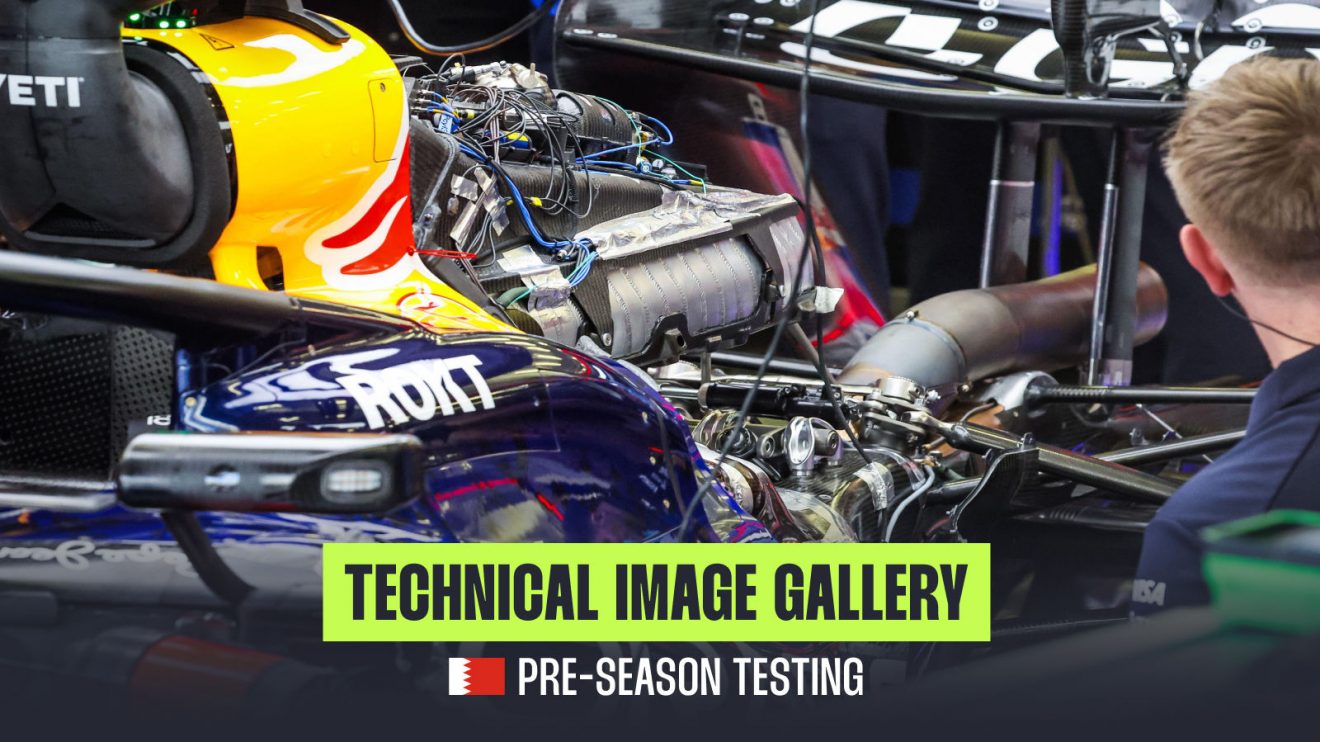
A peek under the covers of the Red Bull RB22 reveals they’re using an air-to-air cooler arrangement on their power unit, which is mounted in the saddle position above the power unit.

A peek at the McLaren MCL40’s rear wing endplate reveals they’ve retained a similar upwashing swage line solution that the cars predecessor had.

The Mercedes W17 on the stands in the garage being prepared for action. Note the low tech string solution on the cars bib, which the team will have monitored via a high-speed camera.

A low-down shot of the Racing Bulls VCARB03 presents us with a view of the floor’s leading edge and the strakes mounted upon it.

Williams have two small winglets on either side of the FW48’s airbox to help tidy up some of the flow in that region, whilst there’s another winglet mounted beside the trail arm of the halo too.

A great shot of the nose and front wing reveals the centreline pod that houses the actuator for the active aero. The centre section of the upper flap that it’s mounted on doesn’t move when Mercedes deploys active aero either, only the outer sections of the flap are in motion.

A close up of the nose and front wing on the Aston Martin, with the active aero actuated by the metal rods that can be seen attached to the centre of the upper flap.