
Opinion: Formula 1 is undermining innovation with 2026 engine politics


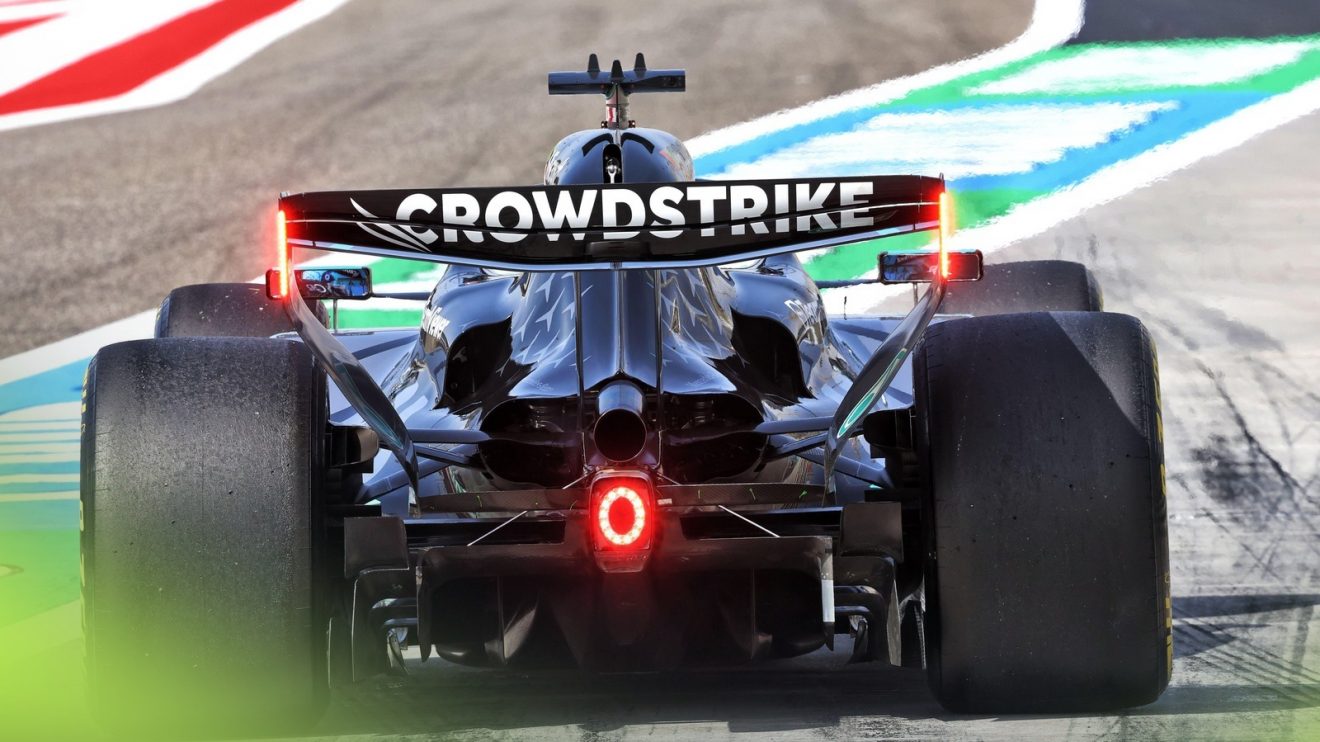
A rear shot as Mercedes driver George Russell leaves the pit lane during pre-season testing in Bahrain.
As cars filed out of the Bahrain pit lane to start the opening day of F1 2026 pre-season testing, behind the garages the battle lines were being drawn.
What should be a glorious, crowning moment of the sport with dramatic new regulations and cutting-edge engine design risks being overshadowed in a messy political showdown.
Engine rule saga threatens to undermine the fabric of F1
Want more PlanetF1.com coverage? Add us as a preferred source on Google for news you can trust.
Concern centres on whether Mercedes’ interpretation of the compression ratio regulations is correct or not. Under the all-new F1 2026 regulations, the power unit’s compression ratio must be 16:1 when measured at ambient temperatures. What happens outside of that is, in essence, inconsequential as far as the regulations are concerned.
That’s certainly the stance Mercedes has adopted; it has met the regulations as they are written. Nothing more, nothing less.
The rules were the same for everyone, and it found an opportunity – to brand it a loophole implies wrongdoing or subterfuge. Of the five power unit manufacturers (PUMs) in F1 in 2026, only Mercedes has been able to exploit it. Red Bull Powertrains initially went down that route, but has now sided with the other manufacturers in uniting against Mercedes. We can only presume that change in position is because RBPT failed to make its version work, while the other PUMs missed it entirely, and it’s now too late to do anything about it.
That is the crux of the issue: Mercedes found a potential advantage that its rivals can’t replicate. And so, instead, they’re looking at other avenues to counter that potential deficit. As the old saying goes; if you haven’t got it, get it banned. That could, at least hypothetically, lead to a situation where the eight Mercedes-powered cars are protested, and an Australian Grand Prix result left hanging in limbo, a season opener decided in meeting rooms and not on the race track.
Should the sport continue down the current path, the only certainty out of this is that Formula 1 as a whole will lose.
Mercedes has, by all accounts that currently matter, developed a power unit that is in-keeping with the FIA’s own interpretation. It has met the accepted definition of F1, to deliver engineering excellence, and found something its rivals haven’t.
And what is the risk? Mercedes-powered teams arrive in Melbourne with a performance advantage over their rivals? An unknown advantage that has no clear consensus as to exactly how big or small it might be. Some say the equivalent of three horsepower, others say several tenths of a lap. In truth, it doesn’t matter, it’s the principle and the precedent.
The governance of Formula 1 is fairly complex but is ultimately designed such that rash changes can’t be made in an attempt to maintain a level playing field. Facilities do exist to push changes through, but these are rare because forming a consensus in F1 is difficult. As a result, only the most egregious issues get a hurried fix. Typically, that’s through the F1 Commission, where all teams have a vote, as does the FIA and Formula One Management.
More on the Mercedes power unit saga
FIA targets pre-Australian GP solution to Mercedes engine saga
Cadillac F1: Rivals united against Mercedes on engine saga
A team having interpreted the rules best, arriving with a pace advantage, is the very ethos of what Formula 1 is about. It won Brawn a world championship, and dropped jaws at the 1978 Swedish Grand Prix. Lotus did as much with the Cosworth DFV. Innovation and interpretation is what Formula 1 has been about since it was conceived in the late 1940s.
For that, Mercedes can feel aggrieved. It has worked with the FIA to develop a power unit within the regulations, only for its rivals to form a united front in an attempt to head off its (unproven) advantage. And we must remember, this is only a potential advantage; until wheels are turned in anger, we have no hard and fast way of knowing that what Mercedes has done is an advantage.
Instead of rising to the engineering challenge, those who are disadvantaged, even if it’s only perceived, will look for any avenue available to them. In this instance, it’s changing the interpretation such that whatever Mercedes is doing gets banned. That in itself isn’t such an issue – again it’s been common practice in F1 – it’s how it’s being approached and what the fallout might be.
As it stands, it’s plausible that eight cars are protested following the Australian Grand Prix. That could mean the result is up in the air as it goes through all manner of protests after the fact. At the moment when F1 should be putting its best foot forward, it is instead taking solid aim at its left foot and threatening to pull the trigger.
If Mercedes is compliant — and there is no indication it is not — then the uncomfortable implication is that others have been out-developed. They’ve been caught short and are looking to mitigate that loss and save face. Imagine being at one of those major brands, who’ve invested huge resources into the project, only to have missed a trick.
This is not a debate about whether Mercedes is right or wrong, it’s face-saving and reputational self-preservation. Instead of having the sport celebrated for the engineering brilliance on display, there are those seeking to punish those who’ve risen to the challenge rather than taking a damn good look in the mirror and acknowledging their own shortcomings. If innovation is discouraged, F1 2026 becomes little more than a spec-formula.
Mercedes read the rules, consulted with the regulator, and developed a power unit that complies with all current interpretations. Whether it has an advantage or not is beside the point, it has done something novel that others haven’t – or couldn’t. Does that really deserve to be punished?
If Formula 1 cannot tolerate a manufacturer interpreting the rules better than its rivals, then it is no longer rewarding excellence — it is managing equilibrium. Innovation has always defined Formula 1. The question now is whether the sport still has the nerve to live with it.
Want to be the first to know exclusive information from the F1 paddock? Join our broadcast channel on WhatsApp to get the scoop on the latest developments from our team of accredited journalists.
You can also subscribe to the PlanetF1 YouTube channel for exclusive features, hear from our paddock journalists with stories from the heart of Formula 1 and much more!
Read Next: Mercedes F1 2026 compression ratio debate nears boiling point ahead of homologation