
F1 uncovered: Exposing the hidden details of the Red Bull RB21


The RB21 was another car that proved to be tricky to get the best from in the early part of the season but, as Red Bull ramped up development, the car became more usable, especially in the hands of Max Verstappen.
Out of reach in terms of the constructors’ championship, a late development splurge would still be enough to put the Dutchman in the frame for the drivers’ championship, as it coincided with McLaren’s updates drying up too.
Too little, too late..?

An interesting shot of the RB21’s rear end without the sidepod and engine cover bodywork in place, whilst the upper half of the rear wing is yet to be installed either. Note the internal drum assembly on the rear brake duct assembly, which not only has a different coating to alter how the temperature transfers between each section, it also has a number of vanes to control how the air moves between this drum and the outer one

An overview of the RB21 as it’s prepared for action, showing the internal ducting and fairings used on the front and rear brake duct assembly, whilst also presenting some of the detail of the inboard suspension elements.

A close up of one of the more expansive cooling louvre panel options on the RB21’s engine cover.

A close up of the chassis vanity panel with the two additional driver cooling snorkel inlets in place.

Another look at the more expansive cooling louvre arrangement from the RB21’s engine cover, this time from Mexico with some of the louvre panels removed to aid in extracting the heat.

Red Bull continued to chase performance from the RB21 throughout the course of the season, with numerous updates made to improve its output. On this occasion there were changes to both the sidepod and floor edge. The alterations, made at the Mexican Grand Prix, included a revised G-Line shape for the sidepod (green dotted line), whilst the forward upswept section of the edge wing was also altered and furnished with two vanes, rather than one.

Earlier in the season, at Monza, Red Bull had made changes to the layout of the rear portion of the edge wing and how it connects to the floor, with the innermost support bracket moved to the underside of the assembly (old configuration inset).

An overview of the older floor configuration, used prior to Mexico, shows how the edge wing sits atop the floor cutout at the front to create a stacked vane layout.

Another angle of the floor, this time showing the forward portion, with the various geometries on the top of the downslope that lead back from the leading edge also giving an idea of how that might look from the underside. Notably one of the inboard floor fences also sits above the floor’s tideline.

The updates for the RB21 kept coming late into the season, with another tweak made to the outer floor fence at the Brazilian Grand Prix, as an additional stepped profile was added into the downsloping transition.

A close look at the floor fence arrangement on the RB21, with the inner of the two middle fences sat above the leading edge of the floor. Also note the wing-shaped fairing at the chassis end of the rear leg of the lower wishbone.

The floor fences and leading edge of the floor from the front reveals numerous details, including how each of them is designed independently in terms of their shape and how they interact with the leading edge. Note the cutout in the lower front corner of the innermost fence too and how the lower section has a different thickness from top to bottom.

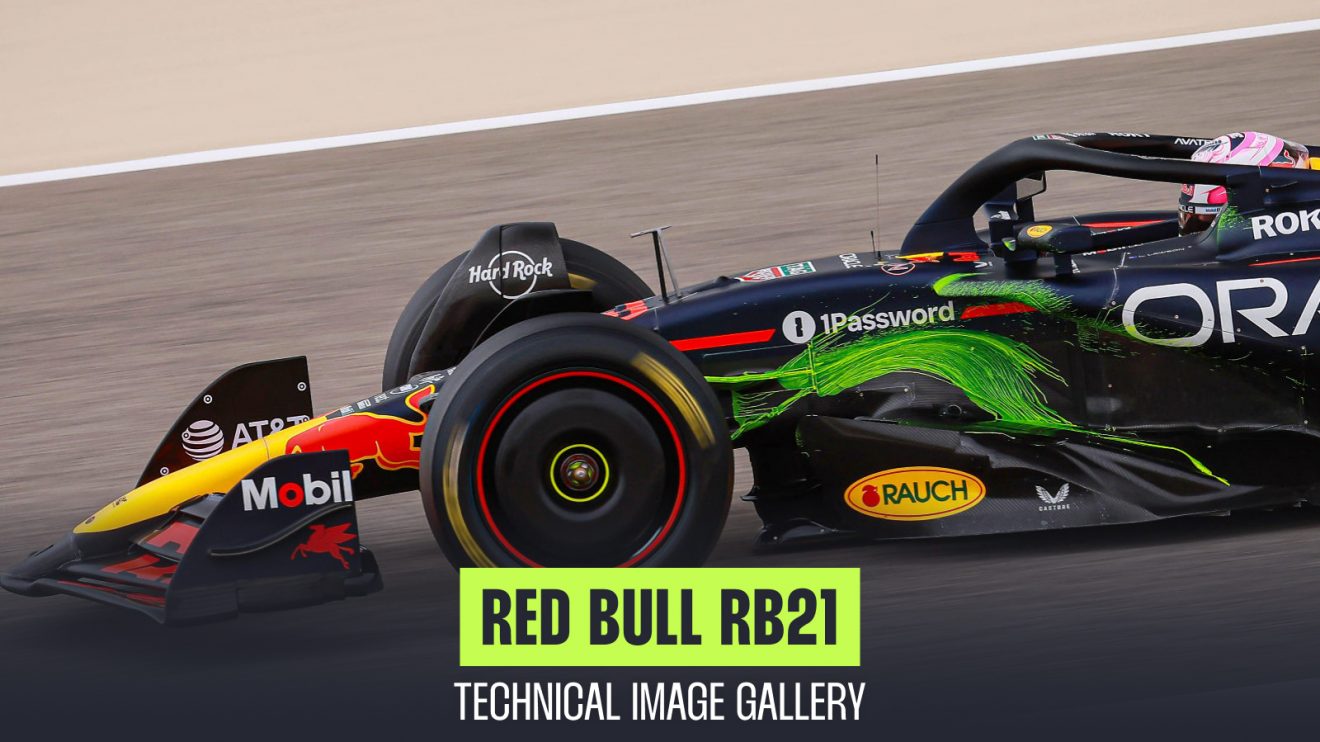
The RB21 with green flo-viz paint on the sidepod’s undercut and under the G-Line, as the team evaluate whether they’re getting the performance in the real world that was anticipated in their simulations.

A close up of the front brake duct assembly on the RB21, with the caliper fairing detached we’re able to see the pin-like fins used to help keep it cool (think of it like the hairs on your arms standing up). Also note the surface of the disc fairing has been coated to alter how heat is transferred within the brake drum once the outer drum is in place.

Another shot of the front brake assembly, this time with the caliper fairing in place for comparison.

A close up of the RB21’s front suspension fairings, with special attention to be given to the wing-shaped sections near the chassis used to alter the losses usually associated with this region.

A top-down overview of the RB21’s nose and front wing arrangement.

Comparing the two front wing specifications that Red Bull used in Azerbaijan, with Verstappen opting for the novel L-shaped flapped section beside the nose, as first seen in Zandvoort.

Verstappen and Tsunoda had different front wing configurations in Singapore, with the Japanese driver utilising the older specification, devoid of the L-shaped mini-flap (small arrow) and the more gentle top flap curvature (dotted white line) and elongated Gurney on the trailing edge (large arrow).

A look at the differences in front wing design between the Belgian and Dutch Grand Prix.

The L-shaped mini flap was added to the RB21’s front wing as part of the update package introduced at the Dutch Grand Prix.

A close up of the front section of the plank and its skids on the RB21.

A close up of the internal ductwork and fairings on the rear brake duct of the RB21, with the winglet arrangement on the inner fence also visible.

The winglet arrangement noted in the image above is more visible in this side-on shot but also shows how the upper tract is formed from it too.

A close up of the upper winglet array on the top of the RB21’s rear brake duct’s fence.

A low down shot of the RB21 reveals some of the details inside the diffuser section that might otherwise be missed, with the surface geometry of the central boat section of note.

A look under the RB21’s covers at the Honda powerunit installation and its ancillaries, with the inboard rear suspension components also on show.

A peek inside the rear cooling outlet on the RB21’s engine cover reveals further details regarding the rear suspension elements.

A look at the rear wing with the upper flap open as if DRS were employed shows the notch and recess arrangement between the flap and tip section to prevent the flap closing too far.

A close up of the exhaust outlet as it exits through the looped rear wing pillar having come up through the crash structure and under the rear suspension.

A close up of the front portion of the sidepod, including the inlet arrangement.
Read next: F1 uncovered: A final probe into the hidden details of the Ferrari SF-25