

US GP conclusions: Verstappen’s big chance, more Piastri evidence, Ferrari culture clash


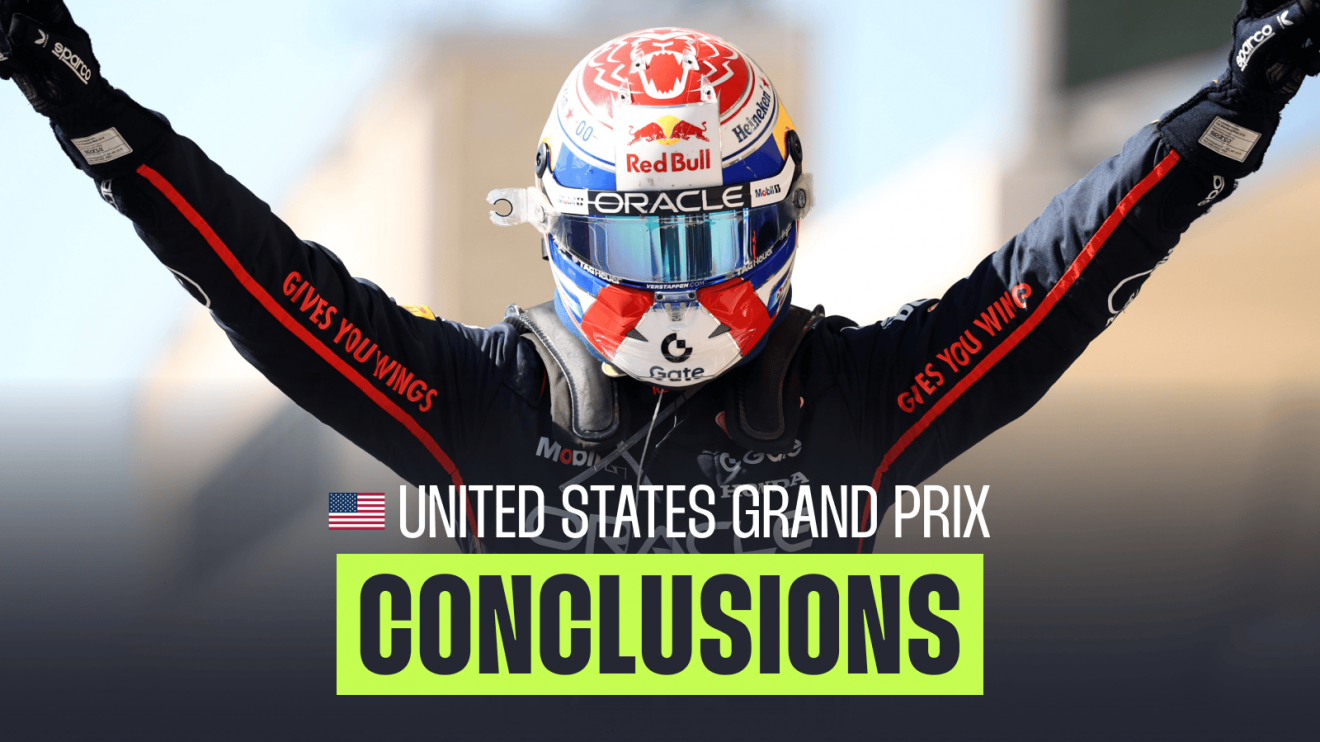
Max Verstappen sits just 40 points behind Oscar Piastri after winning in Austin
Red Bull driver Max Verstappen claimed his fifth victory of the F1 2025 season in the United States Grand Prix at the Circuit of the Americas in Austin, Texas.
Verstappen dominated from pole position to collect a third win in four races and reduce his deficit to championship leader Oscar Piastri to 40 points with five rounds remaining. With Lando Norris second for McLaren and Charles Leclerc third for Ferrari, here are our conclusions from Austin…
Max Verstappen looks re-energised in the F1 2025 title race
The lowest point of Max Verstappen’s season?
Undoubtedly it came with his spin just before the safety car restart at Silverstone.
So lost were Max and Red Bull that weekend that they ended up taking a gamble on the setup, turning to the sort of low-downforce rear wing you might typically see at Monza.
It was a desperate move – a last resort – yet in Verstappen’s brilliant hands it was enough to deliver pole, Max relying on all his skill and judgement to hang on for dear life through the fast corners in qualifying.
But in the rain of race day? Even he was rendered defenceless in the conditions in which he invariably excels.
And his spin on acceleration out of Stowe, while somehow running as high as second place, had the air of a cry for help.
What’s the point, you could almost hear him mutter as he rejoined somewhere between the Williamses on the fringes of the top 10. It’s all over.
Max Verstappen vs Yuki Tsunoda: Red Bull head-to-head scores for F1 2025
? F1 2025: Head-to-head qualifying statistics between team-mates
? F1 2025: Head-to-head race statistics between team-mates
And it did look all over at that stage, coming seven days after his retirement on the first lap in Austria, that itself coming a few weeks after his late-race meltdown in Barcelona.
How decisive, you wonder, might the points lost in those three races prove in Abu Dhabi seven weeks from now?
For make no mistake: Verstappen, almost out of nowhere, is now a serious contender in this title race.
Securing a fifth consecutive championship at the end of a season dominated by McLaren would seal Max’s place in the eyes of many as the greatest driver in history.
If his victories at Monza and Baku had the feel of a corner turned by the team, such dominance at a more conventional circuit in Austin has confirmed that Red Bull and Verstappen have regained their status as the most potent combination in the pit lane.


The change in Verstappen compared to days like Silverstone – the energy, the body language, the way he talks about the car and its behaviour on track – could not be more stark.
It is as though a switch has been flicked over recent races and Max has been transported back to his dominant days of 2023.
Having relied on Verstappen for much too long since the start of the team’s mid-2024 slump, driver and team are now back on the same wavelength, a process no doubt assisted by the fresh engineering focus brought by Laurent Mekies.


Mekies made an interesting comment after the last race in Singapore, admitting that Red Bull is effectively compromising the development of its 2026 car to keep upgrading the RB21 late into this season.
Doesn’t say a whole lot about Red Bull’s hopes under the new regulations, you might say.
But it reveals everything about the scale of the opportunity opening up before Verstappen against an increasingly nervy McLaren in the closing weeks of 2025.
Max Verstappen back in the mix? How the F1 2025 title race has developed
? Azerbaijan GP conclusions: Piastri SOS, Lando’s big problem, Max’s post-Horner wavelength
? Singapore GP conclusions: Norris corners Piastri, Russell’s big chance, double Red Bull exit?
In the early months of this season, as the team pointedly refused to impose team orders on Oscar Piastri and Lando Norris to prevent Verstappen from winning at Suzuka and Imola, it seemed that McLaren was taking a calculated risk.
It was willing to lose the occasional race to Verstappen, it appeared, on the assumption that its own dominance – combined with Red Bull’s ongoing struggles – would take McLaren’s bogeyman out of title contention sooner than later.
Even then it seemed quite bold to dismiss Verstappen as a serious threat and bank on him, the most fierce competitor of all, effectively giving up.
There were times, particularly in the first half of 2025, when he came close.
But now? Now, with Max smelling blood, it smacks of tempting fate.
Be afraid, McLaren. Be very afraid.
Oscar Piastri is still not over his post-Monza wobble
It is never a wise move to try a switchback at the first corner on the opening lap at the Circuit of the Americas.
How do we know this? Rewind to Austin 2022.
Carlos Sainz was in the process of trying exactly that against Max Verstappen that day. Yet just as he was starting to think about getting a run on the Red Bull on the downhill approach to the esses, he was spun around and into retirement by George Russell.
George, of course, took the penalty that afternoon and deservedly so.
Yet by trying a move so risky at that stage of the race, Carlos had put himself in a position of maximum vulnerability.
It was naive of him, especially on such a wide circuit, to assume that a driver behind would not fill such an inviting gap on the inside.
It was one thing for Sainz, a driver prone to those sort of misjudgements and free to take risks without the pressures of a title fight hanging over him, to make such a move.
Quite another for Oscar Piastri, after the bruising experience of recent races and with a lead of 22 points to protect entering this weekend, to leave himself so exposed to misfortune.
Study the replays of the start of Saturday’s sprint and there is a moment, as Lando Norris claims the inside of the corner, for Piastri to commit to the outside line, knowing the run-off area would be there if he needed it.
That would have been the safety-first move.
That his survival instinct did not kick in, that he instead chose the high-risk option with so many cars around, was yet more evidence that Oscar is still not thinking clearly this side of Monza.
As noted in PlanetF1.com’s conclusions from the Singapore Grand Prix, it is no coincidence that Piastri has not been quite the same since Norris’s retirement at Zandvoort.
That was the moment the dynamic between the McLaren drivers changed: Norris suddenly with nothing to lose and Piastri suddenly having everything to lose.
Without Zandvoort, McLaren would not have been emboldened to ask Oscar to swap positions with Lando at Monza; Piastri probably would not have panicked in Baku; he may not have whined so much over team radio about a pretty innocuous move by his teammate in Singapore either.
And who knows? Without the bitter taste of Singapore, he might not have been quite so determined to get one over Norris at the start of the Austin sprint.
Of greater concern to Piastri, perhaps, is the pace deficit between himself and Norris here, consistently hovering at around 0.3s – sometimes smaller, sometimes larger – across both qualifying sessions on Friday and Saturday.


Maybe this was just one of those weekends Norris is capable of from time to time, blowing his teammate away at a circuit where he has performed well (and Piastri has struggled) in the past and revelling in the extra feel offered by the upgraded front suspension he first ran in Canada.
And it did not help Piastri – so adept at applying the lessons from the data across the three practice sessions on a standard race weekend – that this happened to be a sprint event, denying him the opportunity to gradually chip away at the gap on Friday and Saturday.
Yet Norris’s comfortable advantage over him this weekend will only add to the doubts threatening to derail Piastri’s season.
The only silver lining?
If Verstappen keeps this up, soon enough McLaren will be forced to abandon its policy of total fairness and throw its full support behind one driver.
If (when?) that time comes, Piastri must make sure the high ground still belongs to him.
Expect Mark Webber to be pushing for that decision to be made before it’s too late.
Charles Leclerc deserves the car to match his Verstappen-level talent
If Lewis Hamilton was disappointed to be denied a Ferrari with which to compete for the title in 2025, just imagine how Charles Leclerc felt.
The momentum had been building up nicely across last season, his three wins in Monaco, Monza and Austin marked by the confidence with which he seized those occasional opportunities.
With Ferrari falling just 14 points short of McLaren in the 2024 constructors’ championship, the pain of Carlos Sainz’s impending exit was intensified by his suspicion that the team was finally on the verge of mounting a sustained title challenge at last.
Then came February. Then came the decision to change the car’s concept for the final year of the current rules. Then came the ride-height issue that shipwrecked Ferrari’s season.
Ah. So that’s how it’s going to be, then, is it? Another wasted year.
More than once this season Leclerc has spoken of the emotional challenges of the start of 2025 as the reality dawned that his title ambitions would have to be shelved for another 12 months at least.
All his career, stretching back to that first victory lost at Bahrain 2019, Leclerc has been told that his time will come at some point.
Yet here was an acknowledgement that, no, he doesn’t have all the time in the world to realise his potential.
That, you suspect, is why the rumours linking him with a future away from Ferrari have been more persistent in 2025 than ever before.
Unlike in previous years, however, Leclerc has rarely allowed the frustration of Ferrari’s shortcomings to seep into his driving, instead using it to drive him to ever-more complete performances.
Six podiums (and a pole in Hungary) this season is probably six more than the badly born, fundamentally flawed SF-25 really merits.
Regular readers will know that this column has often sought to make parallels between Leclerc and Max Verstappen over the years, such are the similarities between them in terms of both talent and technique.
It has always felt strangely significant, for instance, that Leclerc’s infamous accident at Monaco’s Swimming Pool in 2021 came at exactly the same stage of his career (three-and-a-bit seasons in) Max hit his lowest point at that precise spot in 2018.
At this stage – eight years in – Verstappen was marching his way to a second successive title in 2022 while Leclerc, who turned 28 last Thursday, remains limited to infrequent podiums and even rarer wins.
That’s the difference that having the right car – and, yes, the right team – can make: one driver’s destiny, another’s unfulfilled promise.
Charles’ growth has been stunted to a large extent by the environment to which he has been exposed at Ferrari, far more pressurised and chaotic than the settled, razor-sharp, well-drilled team Max found at Red Bull.
Yet Leclerc in 2025 has regularly cut through the noise to produce the kind of performances Verstappen would supply on a near-weekly basis in 2020 as he began the ascent from ground zero to his first title.
All Charles is really lacking now is the car to match his talent.
When he finally gets it, wind him up and watch him go.
The culture clash threatening to undermine and unseat Fred Vasseur at Ferrari
When the initial round of rumours surrounding Fred Vasseur’s future as Ferrari team principal surfaced ahead of the Canadian Grand Prix in June, a seasoned Italian reporter appeared on a prominent F1 podcast.
His main complaint?
Not that Ferrari found itself trailing McLaren by so far in the standings already in 2025, having pushed the constructors’ champions all the way just six months earlier.
Not the team’s inexplicable decision to overhaul its car concept for the final year of these highly volatile regulations, an era in which the smallest changes to the car can bring severe unintended consequences.
Not the move to sign Lewis Hamilton. Or to replace Carlos Sainz.
And not even the failure to beat Aston Martin to Adrian Newey.
No, il giornalista’s biggest – and strangely personal – gripe was instead Fred’s reaction to Ferrari’s problems.
Vasseur, it was claimed, was way too calm and relaxed about everything. Infuriatingly so.
Unable, or simply unwilling, to grasp the reality of Ferrari’s disastrous start to the season.
Effectively gaslighting the media – and by extension the tifosi – by constantly downplaying the significance of the team’s issues.
Our Italian friend’s whole argument seemed to be built on the premise: why is this oaf not losing his mind like the rest of us?
People outside Ferrari land talk often, to the point of cliché, of the cultural challenges and impossible pressures exerted on the team by a demanding Italian media.
Yet here was eye-opening proof of what you are really up against when you take on the role of Ferrari team principal.
The only conclusion from this character assassination of Vasseur was that people like this are precisely the reason why Ferrari has gone almost two decades without a title.
Everything Fred has sought to achieve at Ferrari since his appointment in 2022, after all, has been about bringing a bit of sanity and perspective to the place.
Blocking out the noise. No longer panicking or overreacting when things go wrong. Keeping the focus on the long-term vision rather than constantly ripping the whole thing up and starting again.
Isn’t all this exactly what Ferrari needs? The results under Vasseur up until this year were inarguable.
Yet now that inner peace has been punctured – now the whole of Italy, it seems, is turning against him – there is no easy way of patching it back up again.
Hence why John Elkann, the Ferrari chairman, felt the need over the United States Grand Prix weekend to issue the dreaded vote of confidence in Vasseur, not even three months after rewarding him with a new multi-year contract.
Maybe not right now, then. Maybe he’s safe for the foreseeable future.
But the tide has turned, irreversibly so, and the people out to get Fred will have his head sooner rather than later, if not at the end of this season then with a slow start to 2026.
What a pity that would be.
The sprint format must matter more if it is to become the norm
It is well established in the world of behavioural science that people become more receptive to an initially unpopular idea if they are gradually exposed to it.
First you start off small in small doses – let’s say three sprint races per season – just to warm the public to the idea.
Then you increase it slowly (doubling the number to six) as it becomes more tolerated.
And then, before you know it, what began with fierce resistance ends up becoming the accepted norm.
If that, as many believe, is Formula 1’s plan with the sprint format, it is taking its time about it.
The 2026 season will mark the fourth year in succession that the number of sprint events will remain at six, yet few doubt that the alternative format will eventually become a fixture of every single race weekend.
Almost certainly it is a matter of when, not if, the sport’s decision makers commit to making that leap.
Yet the sprint occupies a very odd place on a grand prix weekend these days, existing entirely in its own bubble and running parallel to the main action.
It is more an irrelevance than an augmentation of a race weekend, not helped by the fact that the rewards (just eight points for the winner) are so scarce.
More enjoyable than a practice session, the television pundits like to remind us, but that’s pretty much all it is good for.
The golden age of the sprint format, if such a thing ever existed, was in the first two years when the result of the sprint set the grid for Sunday’s race.
There was a sense of jeopardy – an additional little hurdle to overcome between qualifying and the grand prix – in those days that the sprint sorely lacks now. And it worked.
Daniel Ricciardo’s victory at Monza 2021, for instance, owed everything to the sprint format and the opportunity presented by an extra standing start, allowing him to creep forward from fifth on the original sprint grid to the lead out of Turn 1 on Sunday.
So too did the accident between Max Verstappen and Lewis Hamilton at Silverstone that season.
Recall how Lewis noticed on the opening lap of the sprint that Max’s Red Bull was de-rating out of Woodcote, convincing him that Copse was the place to attack 24 hours later.
Imagine how different the complexion of the United States Grand Prix would have looked had this weekend’s sprint been held under the 2021/22 format.
The collision between Oscar Piastri and Lando Norris would have left both McLarens at the back of the grid on Sunday and handed Max Verstappen the chance to make the title fight even more interesting.
As it was, however, McLaren was able to move on quickly from a second collision between its drivers in as many rounds and Norris was free to take up his place on the front row as if his clash with Piastri a few hours earlier had never even happened.
The reason the current semi-detached sprint format is in place is because Formula 1 shied away from the debate about the 2021/22 format skewing pole position statistics.
It was a missed opportunity to remind people that both things can true – that one driver can set pole position (and in the process be counted as the official polesitter) by setting the fastest lap in qualifying, and that a different driver can start from pole position.
That would also have put an end to the unfortunate trend of counting drivers who inherit first place as the result of a grid penalty – see Charles Leclerc’s ‘poles’ at Spa in 2023/24 despite lapping (in one case significantly) slower than Verstappen in qualifying – as the official polesitter.
If there is to be long-term value in the sprint format, it simply has to matter more.
Reverting to the original format, and ensuring the consequences of the sprint carry into race day, would be a good place to start.
Read next: McLaren’s conundrum: Will Max Verstappen capitalise on wilting Oscar Piastri?


