

Mercedes’ major F1 2025 milestone revealed as final one percent remains tantalisingly out of reach


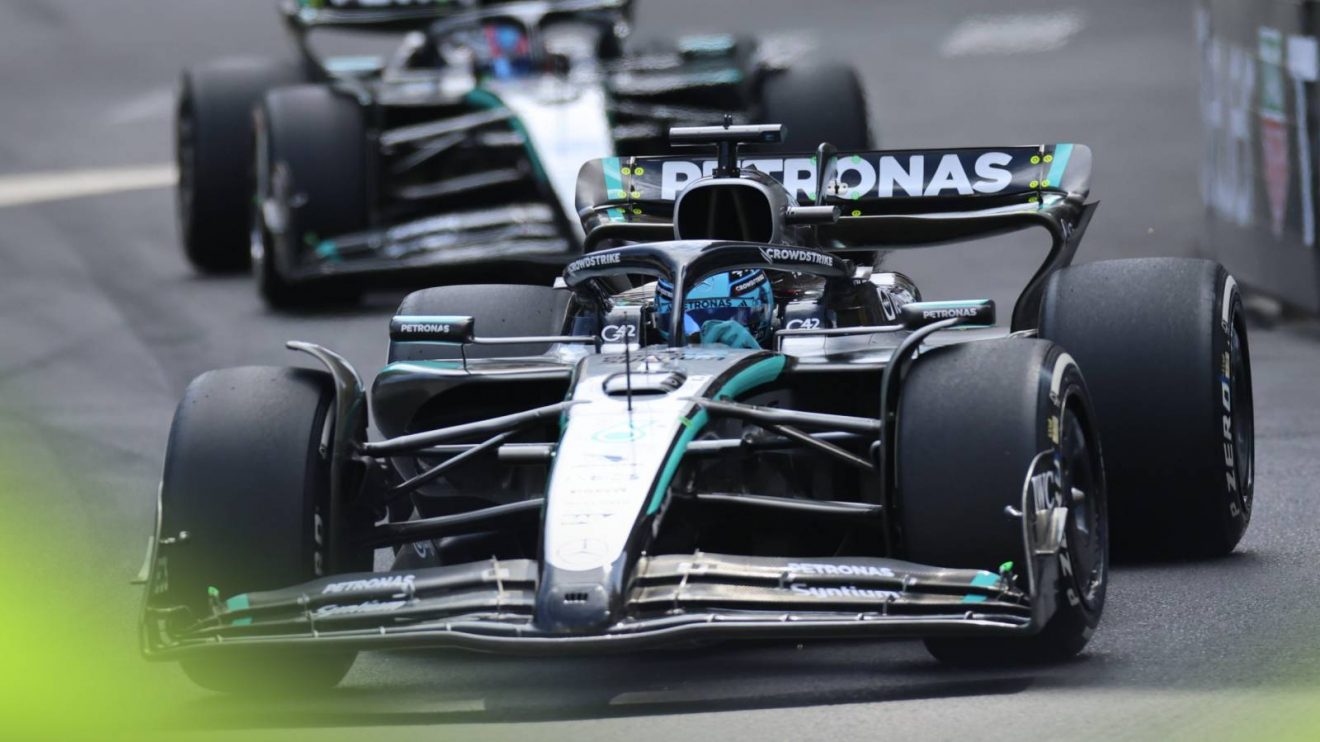
Mercedes has revealed it completed the European leg of the F1 2025, powered almost entirely by biofuel.
Mercedes has confirmed it hit a major milestone in F1 2025, while on the road around the European rounds between Imola and Monza.
Mercedes, together with title sponsor and technical partner Petronas, has increased its use of biofuels for the European season this year, with 99 percent of its fuel requirements for its race and marketing truck logistics filled by using HVO100 biofuel.
Mercedes marks new achievement with 99 percent biofuel coverage
Having achieved 98 percent biofuel use during the European leg of the F1 2024 season, Mercedes has eked a little closer to total coverage this year as the Brackley-based squad has managed to hit 99 percent coverage across the continent-spanning races making up the European portion of the calendar.
Starting off with a trip across to Imola in May, F1 spent the summer in Europe with the team’s respective fleets of trucks driving between races until the final round in Europe, the Italian Grand Prix at Monza.
In Mercedes’ fleet of race and marketing trucks, moving the race team and the hospitality unit around, the team was using sustainable HVO100 biofuel, a second-generation hydrotreated vegetable oil.
The team kicked off its use of this fuel during the European season in 2022, initially just for trials, but embarked on attempting to do the whole European leg on biofuel in 2023. Achieving a 67 percent reduction in emissions, this exceeded the team’s goal of 60 percent for its maiden attempt.
The team improved this figure to 98 percent in 2024, and has further refined this to 99 percent HVO100 coverage in 2025.
But why not 100 percent?
Attempting to build on this initiative across Europe, with supply levels of HVO100 differing depending on where on the continent the team is travelling, has added to the complexity of achieving 100 percent coverage.
When this happens, Mercedes does have to turn to utilising a ‘splash and dash’ strategy of using normal diesel, as might happen on a route with unexpectedly high fuel consumption or a road diversion, explaining why 100 percent coverage has remained tantalisingly out of reach. No engine modifications have been needed to use HVO100, which is a “drop-in” solution for fuel.
The push is part of Mercedes’ ongoing target to achieve carbon net zero across its entire operations by 2040, with a target of 2030 for the race team emissions by 2030.
“Our sustainability strategy is built on innovation on and off the track, and the expansion of HVO100 across 99 percent of our European season’s race and marketing truck logistics is testament to this,” said Mercedes’ head of sustainability, Alice Ashpitel.
“Every kilometre travelled using biofuel moves us closer to Net Zero by 2040, demonstrating our commitment to sustainable high performance.
“We are proud to be driving change, not just on track, but across every part of our operations. In line with our ambition to become one of the most sustainable global professional sports teams, we are committed to achieving Net Zero for total Race Team Control emissions by 2030 and full Net Zero across all scopes by 2040.”
What effect do these initiatives have on emissions?
Across the four years of using HVO100 in Europe, Mercedes has avoided circa 1190 tonnes of CO2 equivalent emissions, with an 81 percent reduction in lifecycle emissions compared to standard diesel use.
Separately, Mercedes also completed its first fully electric long-distance transport run, using a eActros 600 to haul the W16s from Brackley to Zandvoort for the Dutch Grand Prix – a round-trip of 673 kilometres using electric power, in a further step towards reducing emissions.
The team plans to further expand HVO100 use beyond Europe and increase its fleet of electric trucks in future seasons, and has also invested in Sustainable Aviation Fuel as it remains on track to quadruple its aviation emissions reduction.
Since ’22, Mercedes has invested heavily in the use of such fuels for its business travel, with an expectation of a reduction of 10,500 tonnes of CO2 in 2025, up from 8,000 tonnes in 2024.
“A net reduction in our emissions sits at the heart of our operations and the ambitious sustainability targets we have set ourselves,” said team boss and CEO Toto Wolff.
“We continue to invest in innovative solutions and technology that will enhance our performance, helping us go further faster.”
“From 2022 to 2025, we are targeting emissions reductions of over 27,500 tonnes of carbon through our investment in SAFc, quadrupling our annual aviation emissions reduction since our original SAF investment.
“This reflects our commitment to understanding and addressing our environmental impact, while also supporting the growth and credibility of the SAF certificate market. We aim to showcase the potential and impact of SAF, encouraging others to adopt SAFc and drive further investment in this growing market.”
Read Next: How Mercedes made up lost ground to win in Singapore