
McLaren’s papaya rules fall flat in the face of the Singapore Grand Prix


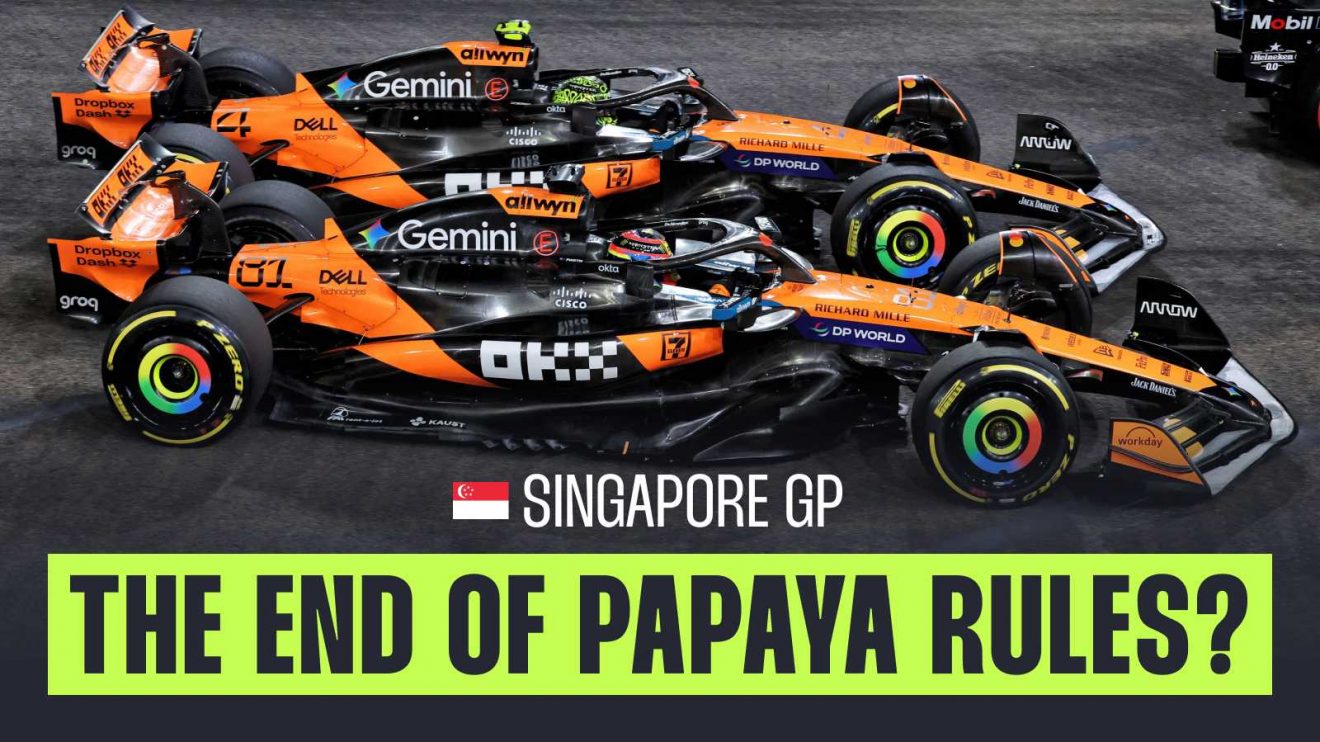
Have we witnessed the end of McLaren's papaya rules at the Singapore Grand Prix?
McLaren Racing has emphasised its commitment to fairness, equality, and rule-directed conduct en route to what it hopes will be a Championship double at the conclusion of the F1 2025 season. There’s just one problem: motorsport isn’t fair.
And the Singapore Grand Prix highlighted exactly where the team’s “papaya rules” mandate falls short. There is no way to guarantee fairness in a sport where only one man can win.
Singapore Grand Prix: McLaren’s papaya rules put to the test (again)
Papaya rules. As McLaren emerged as a potential title contender early on in the 2024 Formula 1 season, the team was quick to instruct its two victory-hungry drivers in a particular code of ethics: The team has no favorites; all we ask is that our drivers race one another cleanly and with respect.
On its face, it’s a great ethos — one that sees the Woking-based team looking for a title sweep. Yet as we reach the critical moments of the drivers’ title battle, it’s clear exactly where those papaya rules fall short. In Formula 1, there can be no fairness.
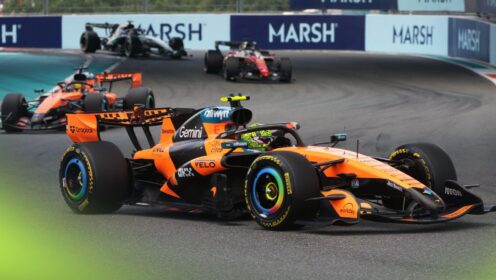
We’ve seen another example of that breakdown in ethos at the Singapore Grand Prix, where Lando Norris launched from fifth on the grid to third on the track, bouncing between the Red Bull of Max Verstappen and the MCL39 of teammate Oscar Piastri en route to a podium position.
More Singapore Grand Prix analysis:
? Has Mercedes’ new front wing cured the W16’s tyre issues?
? Red Bull ramps up McLaren pressure with fresh Singapore updates
Piastri was on the radio in an instant, critiquing Norris’ move as “not very team-like” and asking the team if they’re “cool with Lando barging me out of the way?” The measured response from the pit wall saw the Australian call the move “not fair, not fair.”
The situation looked particularly damning from Piastri’s onboard. Take a peek at Norris’, and it’s possible that there’s room to argue it was simply a bold move from the Briton, who was bounced into his teammate after a brush with Red Bull’s Max Verstappen.
It could have merely been a racing incident. But papaya politicking has instead transformed even the most minor moment into another stone to add to the scales of justice — scales that the team has seemed desperate to balance.
That balance is impossible in a sport like Formula 1. Any effort to even the scales only threatens to destabilise them completely at a later point in time.
Take, for example, the Italian Grand Prix. While Lando Norris had track position over teammate Piastri, the British driver was able to direct the McLaren team to pit his teammate first in an effort to cover off the competition. Piastri’s stop was normal. Norris’, however, was long as a result of a wheel gun issue.
In that moment, McLaren could have made several different choices. It could have apologised to Norris and allowed the race to play out. It could have allowed its drivers to race (cleanly, and with respect) for the position.
Instead, it asked Piastri to cede that position to his teammate. And Piastri did, even though he pointed out that he thought a slow pit stop was simply a “part of racing” and not an issue the team needed to intervene in.
Looking back on Piastri’s quotes about team conduct and papaya rules after that race are illustrative of the problem with McLaren’s fairness mandate: You cannot plan for everything.
“We’ve had a lot of discussions, clarified a lot of things, and we know how we’re going to go racing going forward, which is the most important thing,” Piastri explained in the FIA’s pre-Azerbaijan Grand Prix press conference.
But when he was quizzed on how the team would have acted in various other situations, Piastri didn’t have an answer.
“You can’t plan for every single scenario that’s going to happen,” he admitted.
“I think we’re realigned, and ultimately I respect the team’s decisions and trust that they’ll certainly do their best to make the right ones.”
But Piastri’s frustration in Singapore seems to imply that that first-corner incident was not the way he expected the team to handle that situation.
Regardless of Norris’ intentions at the start, the Briton violated the primary element of McLaren’s papaya rules: Race your teammate cleanly.
One could argue that Norris only collided with Piastri because he’d already made contact with Verstappen. But does that excuse the contact with Piastri? Should Norris have been conscious of how a move on Verstappen could have pushed him into his teammate? Does that teammate-on-teammate contact justify an order to swap positions? And whatever the answer to any of those questions above: Why? Why is that the particular response to any one of these scenarios, and how does that response fit into the team’s scope of its papaya rules?
But even more critically: How does the team justify any decision it makes as being in the name of equality? How can it claim that both drivers are equal when it is impossible for both drivers to share a finishing position? How can the team balance the scales if, at the end of the season, only one of its drivers can be crowned champion?
McLaren is unique in its cultivation of fairness over all else, and in many ways, it has created a culture that allowed the team to enter the championship conversation so decisively. Teamwork is critical to lifting the entire operation to new heights, to prevent unnecessary intra-team spats that could put the whole operation at risk.
But Formula 1 is not merely a sport of teams. It is also a sport of drivers, and one of the tasks of an effective team is to understand when to play the team game and when to let its drivers take matters into their own hands — when to ask drivers to compromise and when to shrug their shoulders in the face of a driver request.
McLaren has found itself in an awkward position now that the 2025 championship battle is reaching its sharpest end. Despite its good intentions, it has nevertheless meddled with the running order regularly enough that both drivers not only expect further meddling but also feel aggrieved when that meddling doesn’t favour them.
The result? McLaren has backed itself into a corner where it can no longer claim that it’s allowing its drivers to organically fight for every position, but where it also isn’t publicly backing any one particular driver. It set a precedent that’s almost impossible to uphold. And in return, it could very well be eroding the trust that its drivers have in the team culture.
That erosion could very well be the end of papaya rules as we know it.
Read next: Piastri fumes at Norris’ ‘pretty **** job’ but Brundle defends actions