

Has Mercedes’ new front wing cured the W16’s tyre issues?


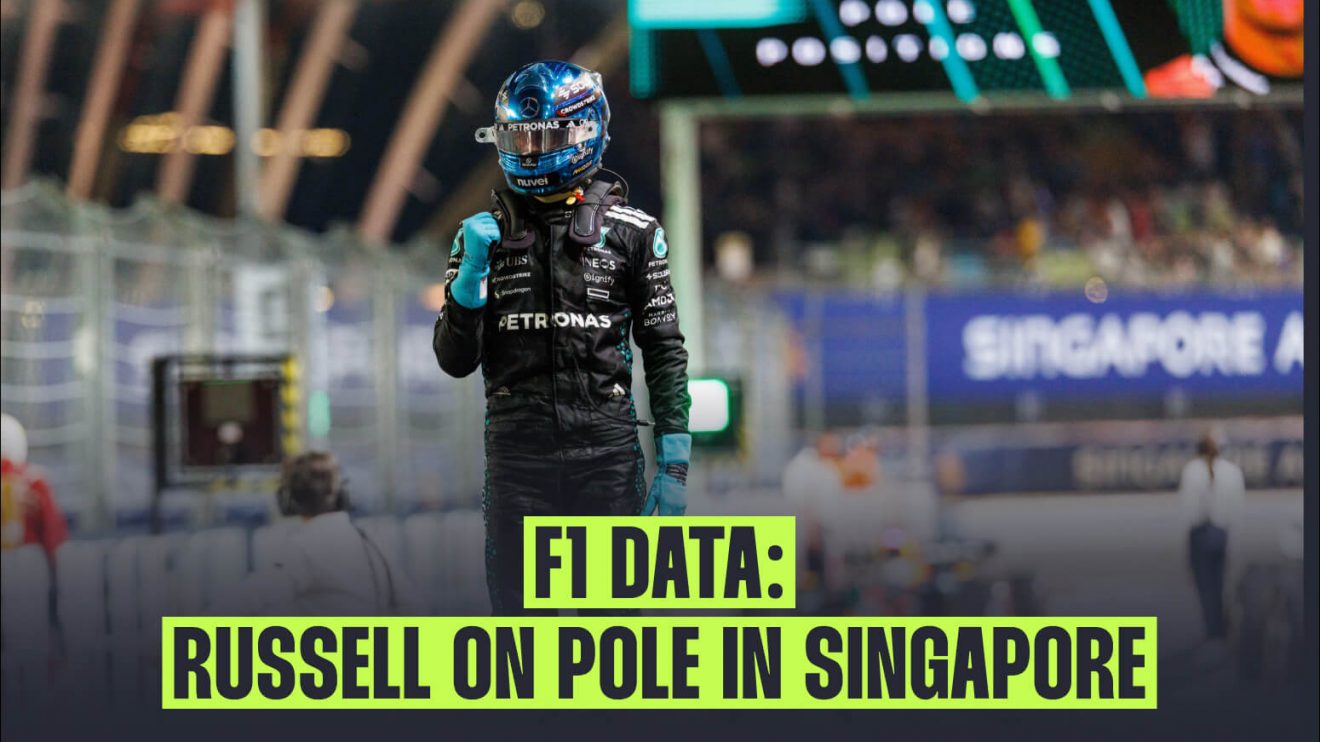
George Russell will start the Singapore GP from pole
In a qualifying session where all eyes were on the McLaren drivers and Max Verstappen as part of the ongoing title battle, George Russell unexpectedly claimed pole position – his second of the season.
Let’s take a look at the data behind the Briton’s brilliant session, and how Mercedes, with its latest upgrades, managed to find fresh performance in Singapore.
A Mercedes comeback?
After Canada, which was their best race of the season, Mercedes entered a run of poor results, and it seemed that the handling of the W16 had become increasingly difficult. The driver who felt this most was Kimi Antonelli, whose series of disappointing finishes sparked discussions about his future within the team.
The main issue for the German outfit has been its suspension system, which has struggled to transfer downforce effectively to the wheels. The result has been excessive tyre overheating, directly affecting race pace. This is also why Mercedes has typically performed better on cooler tracks, where temperature issues are naturally reduced.
However, with the introduction of a new front wing designed to improve overall balance, Mercedes seems to have found the right setup to give its drivers more confidence in the car’s limits.
And the results followed immediately: George Russell took his second pole position of the season, 0.182 seconds ahead of second-placed Verstappen, with Antonelli finishing fourth.
The renewed confidence of both Mercedes drivers in the W16 was evident from the very start of qualifying, and the opening phase of Q3 confirmed that they would indeed be contenders for pole.
Russell went to the top of the timesheets after the first runs in Q3 with a phenomenal lap. Comparing this lap to Verstappen’s reveals where the key differences lay.


Already in the opening corners, George managed to create a notable advantage — his run through the first three corners was excellent, gaining around 0.25 seconds in that part of the track alone.
He carried this momentum through Turn 5, which allowed him to stretch the gap to nearly three-tenths by the DRS zone heading into Turn 7.
Even this first sector alone clearly shows Mercedes’ progress. The new front wing gave the W16 greater stability in the slow corners, eliminating the understeer that typically appears in such sections.
It seems the W16 in Singapore had just the right amount of understeer — small enough to let the driver attack the corner with confidence, yet present enough to provide stability on throttle exit.
By the end of the lap, the difference to Max hadn’t changed much. Entering the middle sector, the Dutchman was faster through Turns 7, 8, and 9 — the kind of corners typical for a street circuit.
At Turn 10, we can notice something rather unusual: Verstappen lifted off the throttle much earlier than Russell. The effect on his speed through the corner can be clearly seen in the image below.

It seems Max chose a slightly different “tactic” through this part of the lap, allowing him to get back on the power earlier than George. While he did lose some time here, it wasn’t enough to significantly affect the lap overall.
The Red Bull driver gained some of that time back with a stronger run through the final corner, leaving the ultimate gap at 0.175 seconds in Russell’s favour.

Already after the first flying laps, it was clear that these two would be the main contenders for pole, as the McLaren drivers simply didn’t show their usual pace.
That turned out to be true — the “incident” between Verstappen and Norris led to Max aborting his final lap, leaving George Russell on pole after improving his initial time by a mere 0.007 seconds.
Although slower in the first sector, Russell improved through Turns 7, 8, and 9 — the same corners where Max had been quicker on his first run. That was enough for him to extract every last thousandth from the Mercedes in those final moments.
The question now is whether Russell can also go on to win in Singapore.
Singapore, alongside Monaco, is one of the toughest circuits on which to overtake. Despite its four DRS zones, the narrow track, proximity of the walls, and slow corners make it nearly impossible for drivers to use the advantage of straight-line speed.
That’s why the start will be absolutely crucial. The driver who leads after the first lap will have the best chance — and a nearly clear road to victory.
From a strategic point of view, this circuit isn’t the most interesting one either. We’ll most likely see one-stop strategies using medium and hard compounds — unless a Safety Car changes the situation.
The biggest overtaking opportunity here will come through the undercut, since with fresh tyres a driver can easily be up to a full second faster than the rival ahead — and that can make all the difference on a track where track position is everything.
Read next: Winners and losers from the 2025 Singapore Grand Prix qualifying


