
Singapore GP conclusions: Norris corners Piastri, Russell’s big chance, double Red Bull exit?


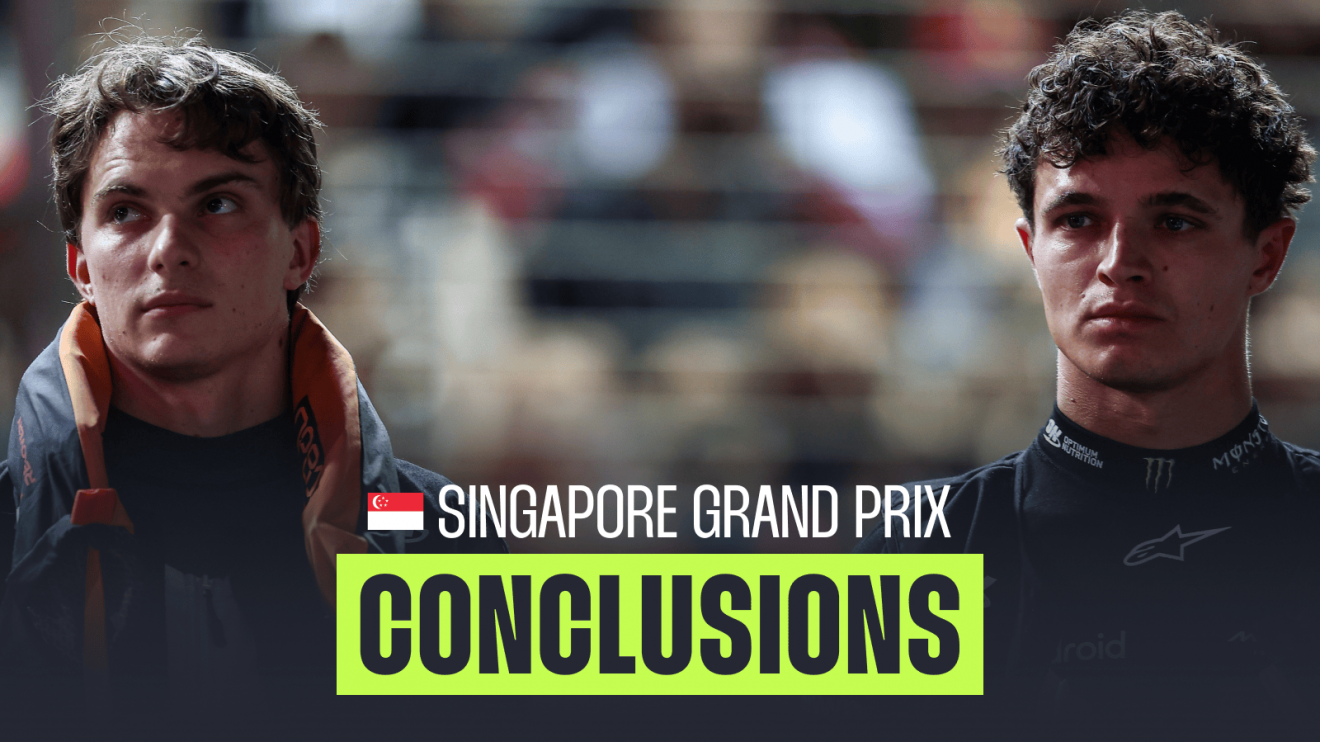
A clash between Oscar Piastri and Lando Norris overshadowed McLaren's title celebrations in Singapore
Mercedes driver George Russell claimed his second victory of the F1 2025 season in the Singapore Grand Prix at Marina Bay.
Russell dominated from pole position to secure his first win since Canada with Red Bull’s Max Verstappen second and Lando Norris third for McLaren, which claimed a second consecutive Constructors’ title. Here are our conclusions from Singapore…
Oscar Piastri suddenly looks like the vulnerable one at McLaren
The great unanswered question of Oscar Piastri’s disastrous Azerbaijan Grand Prix last time out?
Was it just a coincidence that a performance so error-prone – so utterly unlike him – occurred at the race immediately after the events of Monza?
Piastri’s cluster of errors in Baku were not normal mistakes, but the sign of a driver shaken completely out of his previously impenetrable bubble.
This, to be clear, is not about what was or was not said behind closed doors at McLaren in the aftermath of the Italian Grand Prix, but what Piastri’s decision to obey the team’s request to swap positions with Lando Norris ultimately conveyed.
Oscar, after all, was meant to be the tough one. The ruthless one.
The one prepared to upset people from time to time – recall how he had no issue walking away from Alpine to take up a McLaren seat at the end of 2022 – to get what he wants.
Oscar Piastri vs Lando Norris: McLaren head-to-head scores for F1 2025
? F1 2025: Head-to-head qualifying statistics between team-mates
? F1 2025: Head-to-head race statistics between team-mates
Yet by following McLaren’s request at Monza almost without resistance, Piastri revealed himself to be really no stronger than Norris back on that awkward afternoon in Hungary last year.
For perhaps the first time since he arrived in F1 almost three years ago looking for all the world a clone of Max Verstappen, Piastri displayed weakness.
And as his teammate knows so well, once that veneer is shattered – once people, not least your fellow competitors, come to realise that you might have a bit of a soft centre – there is no patching it back up again.
So it would be hypocritical in the extreme to criticise Norris for finally seizing the day and demonstrating the aggression and assertiveness he has routinely been accused of lacking over the years.
His opportunistic, forceful move on Piastri at the first corner in Singapore – a racing incident to all intents and purposes – brought confirmation that the tables have turned within McLaren at this delicate stage of the 2025 title battle.
Suddenly, having had Lando exactly where he wants him all season, Piastri now looks like the vulnerable one.


It was alarming how quickly Piastri, unusually emotional over team radio, became disillusioned and sank without trace after the collision at Turn 3 in Singapore in the way Norris often has at the first sign of adversity.
What we are witnessing here is the difference between a driver now with something to lose and another with everything to gain, free to take calculated risks like banging wheels with his teammate at the start of the Singapore Grand Prix.
All of this, of course, can be traced back even further than Monza and to the moment Norris pulled to the side of the track to retire at Zandvoort.
That, the moment Piastri became the clear favourite for the title and could afford to play the percentages a little more, was the moment he stopped thinking with the clarity that helped put him in that position in the first place.
Without a substantial points difference between its drivers after Zandvoort, McLaren simply would not have been emboldened to ask Piastri to fix the team’s own mistake at Monza.
And Piastri would surely not have so willingly given away points to his main competitor without a bigger margin to play with.
It probably seemed a relatively small price to pay inside the helmet at the time – a couple of points out of a chunky lead for the sake of maintaining team harmony. No shortage of kudos, perhaps a little payback down the line, for playing the team game too.
Not so much now Lando has taken a further nine points (it could so easily have been more) out of Oscar’s advantage over the last two rounds.
Recap: How the Oscar Piastri vs Lando Norris battle has ebbed and flowed
? Azerbaijan GP conclusions: Piastri SOS, Lando’s big problem, Max’s post-Horner wavelength
At the start of this season it seemed obvious that Piastri’s best hope of winning the title would be preying on Norris’s self-doubt, making him uncomfortable and pushing and prodding Lando into crisis corner as often as possible.
And up until recently he has done precisely that, keeping consistent, taking every opportunity presented to him and standing back as Norris self-destructs.
But now?
Now Piastri is finding out that nothing – not even having someone who’s been there and done it in your corner – can prepare the human mind for the doubt and uncertainty that suddenly hits when the realisation of a lifelong dream is so close yet still so far away.
Oscar, it turns out, is not so bulletproof after all. Nobody is.
And so Norris now has the chance across the final six races to do to Piastri what Piastri has been doing to him.
Champions again: McLaren has put its rivals to shame in F1 2025
It was around this time last year, as McLaren nudged into the lead of the Constructors’ championship for the first time in more than a decade, that the promise and potential of the 2025 season began to dawn on people.
This year, it was said, had all the ingredients to be the season of all seasons, easily the most thrilling and competitive this side of 2021.
The narrative was set and it was dripping in gold: Max Verstappen fighting with all his might in a wounded, weakening Red Bull to contain an ever-maturing McLaren, with Mercedes and Ferrari somewhere in the mix too.
Irresistible, eh?
It has not turned out that way, however, to the extent that McLaren has secured a second successive title in joint-record time.
Far from the battle royale promised on paper, the best has only become better in 2025.
Or have the others just got worse? A bit of both actually.
Following the team’s trend since mid-2023, every improvement made to the MCL39 – best described as an aggressive evolution of its predecessor – has been delivered with purpose, crucially allowing McLaren to constantly keep a lid on the more undesirable consequences of car development in the ground-effect era.
Initially annoyed by the suggestions of other teams that the car was a product of some sort of technical trickery, McLaren soon began to welcome them, taking it as a sign that the focus of its rivals had drifted from their own underperforming machinery.
McLaren’s handling of the battle between Oscar Piastri and Lando Norris – trusting the drivers to play nicely, striving to maintain total fairness (sometimes to the team’s own detriment) and confident of dealing swiftly and effectively with the uncomfortable moments inevitable in an inter-team title battle – has been equally unorthodox, yet no less refreshing, too.
Dreading the day Oscar and Lando came together? No.
More than once Zak Brown and Andrea Stella – the kind of two-headed management team that probably shouldn’t work but really, really does – spoke of embracing it, looking forward to when it finally happened so it would finally be all over and done with.
Such a relaxed outlook – seeing this sort of thing as a challenge rather than a burden – is highly unusual among senior figures in elite sport operating under all the pressures, both internally and externally, it brings.
But it belied a confidence within the team that 2025 would still end happily for McLaren even with a drama or two between Norris and Piastri priced in.
A confidence only possible, perhaps, with the comfort provided by such a clear car advantage.
And for all McLaren’s excellence this season, the ease with which the team has defended its title has only exposed the various shortcomings of its closest competitors.
Take Red Bull, whose failure to get back on track after losing its way so spectacularly with development last year has rendered Verstappen, still the most gifted one out there, largely defenceless in the drivers’ championship.
Take Ferrari, whose inexplicable decision to overhaul its design concept for the final year of the current regulations – an era, remember, in which even the tiniest changes to the car can bring severe unintended consequences – remains as puzzling as it did the day the covers first came off the SF-25 in February.
And what of Mercedes, once again blown away by its own customers and whose complete inability to get to grips with ground effect is to last the entire four-year rules cycle? ‘Humiliating’ does not cover it.
All of these teams have had their moments during this maddening, unpredictable, volatile game of ground effect, yet they have been put to shame in 2025.
With the music stopping, only McLaren – nowhere to be seen at the start of this era – has been left with its faculties and a clear sense of direction.
The rest, to a greater or lesser degree, are all lost.
George Russell should start the F1 2026 season as title favourite
There has been a small yet significant change in George Russell this season.
In many ways he remains the same George Russell he always was – hugely self-confident, relentlessly aggressive, always with two feet and 10 toes on the absolute limit – but now he operates with an extra layer of maturity.
Where once he would force it, overreach and grasp frantically at the rare opportunities that came along for Mercedes, these days he lets everything come to him instead.
If there was a race that Russell was ever going to fall back into his old habits, it was probably Singapore.
More than once this weekend he pointed out how this circuit has bitten him in the past – most memorably when his risk/reward dial blew itself up late in the race in 2023, George pacing his final stint so badly in pursuit of victory that he ran out of rubber long before his undignified exit on the final lap.
He was struggling in the early phase of this weekend too, crashing out of FP2 on Friday and, by his own admission, was still lacking rhythm even as qualifying began.
Yet it was alright on the night. Always is with Russell in 2025.
He can be relied upon and trusted now – the natural result of stepping fully out of the shadow of Lewis Hamilton this season – in a way that wasn’t always the case in previous years when it seemed he was constantly striving to prove himself.
That’s the difference. The complete elimination of doubt, some might call it.
Once again, he refused to be lured into the trap of making mistakes in the search for performance and his lap for pole position – almost but not quite out of nowhere – was among the most impressive of the entire season.
That, right there, was the moment this race was won, helped by Red Bull and Max Verstappen’s inexplicable choice of the soft tyre for the race start.


Russell has blossomed – and continues to blossom, for the process is not yet complete – beautifully into one of the most consistent and versatile drivers on the current grid.
Just in time for a title tilt in 2026, maybe? The stars are aligning.
If it is true, as many believe, that Mercedes’ preparations for the new rules are more advanced than most, opportunity knocks for Russell next season.
As commonplace with major engine regulation changes, the Mercedes factory team should have an inherent advantage over its customers – notably McLaren – when it comes to the integration and packaging of the new power unit.
And unlike McLaren, which must serve (and be seen to serve) Oscar Piastri and Lando Norris equally at all times, Mercedes has a clear team leader in Russell.
Toto Wolff may not have had a wingman role in mind when he signed Andrea Kimi Antonelli as Hamilton’s successor a year ago yet Russell’s teammate, for all his current difficulties, will have an important part to play next season.
By being Andrea Kimi Antonelli – raw, inexperienced, inconsistent – he will afford George Russell the necessary breathing space to keep being George Russell.
Just as Sergio Perez allowed Max Verstappen to be Max Verstappen, for instance. Or how Valtteri Bottas allowed Lewis Hamilton to be Lewis Hamilton for all those years.
Every time he has been presented with a race-winning car on merit during his Mercedes career, stretching all the way back to that first taster at Sakhir in 2020, Russell has delivered.
And when – not if – he is finally rewarded with a new contract in the coming weeks, he will be instantly installed as title favourite f0r 2026.
That new deal, you suspect, will be worth the wait.
Williams won’t be taken seriously until it does the basics right
“What we now need to do is understand how we could have been wrong in our own measurements and what we need to change in terms of process with immediate effect.
“There’s only one area of the car that we were not compliant with and it’s an easy fix. But, irrespective, the rule is the rule and it’s black and white in that regard.”
These were the words of James Vowles, the Williams team principal, late on Saturday night after both cars were disqualified from qualifying in Singapore.
Oops. Hang on a second. No, they weren’t.
Sorry, forgive us: those quotes were actually Vowles’ reaction the last time a Williams was thrown out of qualifying little more than a year ago at Zandvoort.
Our mistake. Easy to get mixed up, you see, when the content of both statements was identical: hugely disappointing; the car passing the team’s own checks but the FIA’s measurement being the only one that matters; a car still quick enough to recover those lost positions in the race.
Oh, and vowing – on both occasions – to ensure that something like this “doesn’t happen again.”
How’s that working out then, Reverend Vowles?
How much have Williams’ “processes” – another term to crop up in each statement – really improved over the last 12 months?
It has become a pattern of the Vowles era that moments of light at Williams are followed swiftly by the dark.
Recall, for instance, how the promise – and much of the goodwill – built up during his first season in charge in 2023 was instantly lost with the spare chassis drama of last year’s Australian Grand Prix.
Only two weeks ago, meanwhile, Carlos Sainz’s podium in Baku brought breathless talk of ‘validation’ for The Vowles Project.
And maybe it was.
Or maybe it was merely a case of a driver with exceptional car control mastering the tricky conditions of qualifying, then using all of his experience – and a car suited to the layout of the circuit – to convert his high starting position into a result on a weekend many of the traditional frontrunners underachieved.
Sometimes it really is that simple.
Vowles has spoken for some time about the opportunity beckoning for Williams under the new regulations next season.
Yet even with the team throwing everything at 2026 from an early stage of this year, what reason is there to expect Williams to be ahead of its fellow Mercedes-powered teams at the start of F1’s new era?
Faster than Mercedes? McLaren? Yeah, right.
Faster even than Alpine, which in Sainz’s own words would have challenged for pole position in Bahrain this year without its current engine shortfall?
Even if 2026 brings the great leap forward Vowles hopes, Williams will not be taken seriously until it does the basics right.
Arvid Lindblad and Alex Dunne at Racing Bulls? It’s what the old Red Bull would do
The moral of the story of Carlos Sainz’s Baku podium being regarded as validation for the Vowles era?
Few sports overstate the significance of a single good result quite like those in Formula 1.
Exhibit A: Daniel Ricciardo, Monza 2021.
Hailed at the time as Ricciardo’s resurrection after a season of struggle with McLaren, in reality his victory that day owed everything to the newly introduced sprint format.
The randomising effect of two standing starts at Monza allowed Daniel to gradually creep forward from fifth on the original sprint grid to the lead at the start of the main race 24 hours later.
And once he made it to the front – with a Mercedes-powered McLaren, lacking the overall downforce of other cars, bulleting down the straights – there was no catching him.
Don’t let the facts get in the way of a good redemption story, though.
There was a similar reaction to Yuki Tsunoda’s sixth place in Baku, his best result since his promotion to Red Bull greeted as some sort of breakthrough.
And it was – if you choose to look at it that way. But it wasn’t. Not really.
Few seemed to notice that Yuki failed to make an impression on Liam Lawson’s Racing Bull despite the advantage of DRS and medium tyres 18 laps fresher than Lawson’s hards.
For all the criticism Lando Norris received for his passive performance on a day the opportunity was wasted to take a chunk out of Oscar Piastri’s points lead, Tsunoda somehow escaped scrutiny for the same offence.
It’s all about perspective, you see.
As noted in PlanetF1.com’s conclusions from the Azerbaijan Grand Prix, the day Tsunoda claimed his best result for Red Bull should also be remembered as the day his hopes of being retained for 2026 were dealt a decisive blow.
Yet nor should Lawson’s own career-best result in Baku sway Red Bull’s decision on his future either.
If Baku was Lawson at his best – his car control, as with Sainz, coming to the fore in those cold, slippery conditions of qualifying – Singapore demonstrated why Red Bull was hesitant to promote him to a full-time F1 seat in the first place.
His accidents in FP2 and FP3 were classic Liam Lawson mistakes – typical of the ‘reactive’ drivers who literally react to whatever the car is doing at any given moment and live entirely on their reflexes and car control – that underlined his lingering limitations.
The reactive drivers, long-term readers of this column will be aware, can be just as fast (if not slightly faster) than their more manipulative rivals on a good day.
Yet they also have considerably less margin for error and tend to make more mistakes, both the tiny corrections that add up over the course of a lap and the more serious, car-damaging offs.
Hence why it is usually the Liam Lawsons of this world who tend to find the barriers at circuits like Singapore, and look quite untidy on track generally, and not the Max Verstappens who appear to be on rails by comparison.
Initially thought to be a direct contest between Lawson and Tsunoda, the battle for the final Racing Bulls seat for 2026 – assuming Isack Hadjar becomes Verstappen’s new teammate and Arvid Lindblad takes his place – took a twist in Singapore when McLaren announced that Alex Dunne has cut ties with the team ahead of an expected deal with Red Bull.
Could it be that Tsunoda and Lawson are both dropped for 2026 with Lindblad and Dunne forming an all-new Racing Bulls lineup?
Perhaps a clue to Red Bull’s thinking came in the summer of 2024.
It was at last year’s Singapore Grand Prix that Ricciardo’s F1 career met a grizzly end, left to dangle uncomfortably for the duration of his final race weekend before the announcement arrived that he would be replaced by Lawson for the rest of the season.
In truth, though, the swap was telegraphed a few months earlier when Helmut Marko revealed that Red Bull’s shareholders had dictated that Racing Bulls must return to its Toro Rosso roots as a team to train young drivers.
The message from the top was clear: no more ghosts of Red Bull Racing, no more rehabilitation projects, no more failures – only youth, promise and potential.
If Red Bull remains truly committed to that vision, there is no place here for Lawson or Tsunoda in 2026.
Dunne and Lindblad? It’s what the old Red Bull would do.
Want to be the first to know exclusive information from the F1 paddock? Join our broadcast channel on WhatsApp to get the scoop on the latest developments from our team of accredited journalists.
Read next: McLaren’s papaya rules fall flat in the face of the Singapore Grand Prix