

Why officials were right to make Max Verstappen sweat for Nurburgring licence


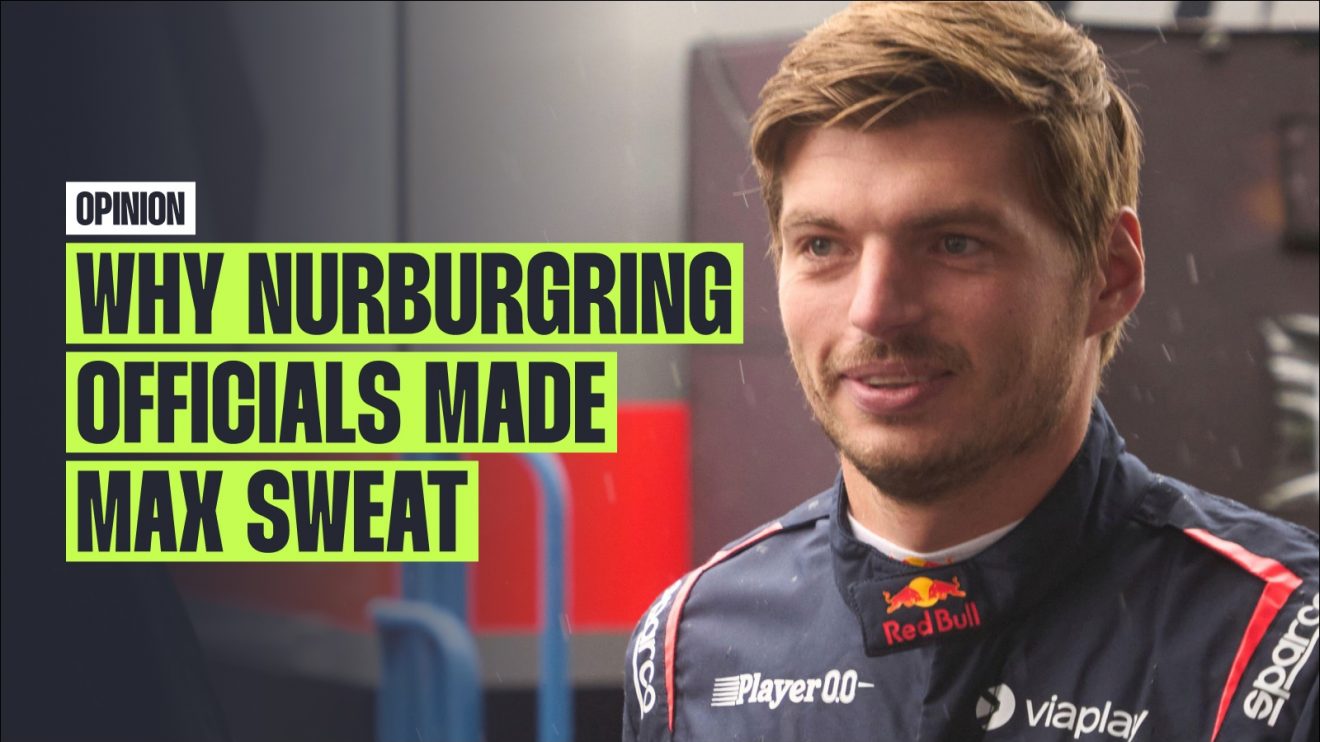
Max Verstappen has obtained his Ring License allowing him to race GT3 cars in the Nurburgring 24.
Officials at the Nürburgring were right to make Max Verstappen jump through a few hoops to gain his Ring Licence.
The four-time world champion, a driver many believe to be the best in the world, shone on his racing debut at the fearsome German circuit as he was forced to prove himself, just like a rank amateur, for the right to compete in the Nürburgring 24 Hours next year.
Max Verstappen had to prove himself worthy of a Ring Licence
Max Verstappen will be recalled among the very best drivers to have ever competed in Formula 1, though his precise position on that leaderboard will be the subject of much ale-infused debate.
F1 is widely regarded as the highest form of motor racing, and in a simplistic sense, it is. The cars are the most developed and analysed with cutting-edge technology. In the sport as it is today, all of the drivers are immensely talented – there is no need for pay drivers as there once was. As such, the quality today is higher than it’s ever been. For Verstappen to stand out from the crowd highlights his exceptional talents.
Of course, there are bumps along the way that mean more talented drivers may never reach the pinnacle – money chief among them, with politics a close second – but if we accept that talent shines through, F1 is the best of the best.
Verstappen has risen to the top of that heap. Racing since he was a mere teenager against the greatest drivers on the planet in four-wheeled rocket ships, it’s a challenge unlike any other.
And it’s exactly that point officials at the Nurburgring will have noted. In Formula 1, Verstappen has raced against elite drivers in the best machinery known to man. In GT racing, the clientele is rather different.
GT racing is, in many regards, a pure form of racing, true to the sport’s heritage. It’s propped up by wealthy enthusiasts who are keen to go racing, and choose to do so at the wheel of something exotic. There are plenty of other classes out there, TCR, TA2, and so on, but they don’t boast machinery from Ferrari, Lamborghini, Porsche, et al.
The current vogue for GT racing is GT3 and GT4 competition. Run by a Frenchman named Stephane Ratel (a former business partner of one B.C. Ecclestone), it’s gained popularity over the past decade because of the way it commoditises the sport. It’s a customer racing competition, meaning should you or I wish to go racing, the cars are available for purchase.
In theory, there is no difference from car to car. All the brands are put through a Balance of Performance process to level the playing field such that, over a race stint, a Mercedes should complete the race in the same time as an Aston Martin, BMW, or Audi. Each car has its own strengths and weaknesses, its own identity and character, but all are capable of racing on the same track at the same time. By anyone.
There was a period around the turn of the decade when there were concerns surrounding the direction of GT3 racing, as amateurs struggled with that generation car. They had more downforce than previously, and while the pro drivers could wrangle them, the amateurs were invariably slower. There’s also the small matter of the cost, with cars these days up around the $1 million marker.
One step down, GT4 has grown in popularity. It is less expensive, less reliant on aerodynamics, but also less performant. The category has seen strong international growth such that where once it formed a class within broader national-level GT competitions, there are now standalone races for GT4 machinery. Like GT3 cars, these are off the rack style purchases, balanced against one another to create a fair platform for all, regardless of which brand you might choose.
Hence, when Verstappen wheeled his Cayman GT4 around the Green Hell 25 seconds faster than his closest direct competitor, the world took notice. It was a mightily impressive feat that has next to nothing to do with set-up or power or tyres; it’s the result of a driver wringing the neck of a car with supreme skill.
And still, even with that in mind, officials at the Nürburgring were right not to simply rubber-stamp the Dutchman’s efforts to race in the 24 Hours event in GT3 machinery.
More on Max Verstappen at the Nurburgring
? Max Verstappen’s first words after Nordschleife permit ruling
? Max Verstappen secures impressive finish away from F1 at the Nurburgring
The DMSB Permit, colloquially known as a Ring Licence, is an endorsement that a driver is across all aspects of racing at the intimidating former home of the German Grand Prix. At over 25 kilometres, it is not a standard circuit in the modern sense. Nor is the Nürburgring 24 Hour a standard race as most would understand it.
Perhaps the best analogy is the 24 Hours of Le Mans, though even that isn’t really accurate. While both are multi-class races with unique regulations (Le Mans uses three Safety Car positions around the La Sarthe circuit to manage traffic), there is less variation between the cars.
At the 24 Hours of Le Mans, GT3 machinery forms the bottom rung of the ladder, which works its way up to the Hypercar class. It’s a significant performance gap, but by and large, the drivers involved are experienced and understand how to go class racing – it’s part of the World Endurance Championship, after all.
Fundamentally, the same is true of the Nürburgring 24, though the difference in performance is arguably more significant.
While there are no Hypercars, and GT3 machinery is instead the top class, the bottom run of the ladder is much lower; think 2006 BMW E325s (the E90, to be specific).
In this year’s event, pole was 8:10.580s in an Audi R8 LMS GT3 evo II, set by Christopher Haase – a factory Audi driver whom I can personally vouch for as very, very rapid. His best lap was 2:50.888s quicker than the slowest qualifier – a difference of more than 25 per cent, front to back of the grid. And before you ask, that was not an excessively slow qualifying time, there were two other cars within four seconds (one of which was a Dacia Logan).
It is that variation that the Ring Licence is designed for. It is not to gate-keep against the likes of Verstappen, who is clearly more than capable behind the wheel of a racing car, but to afford them the experience of racing against cars across a broad spectrum of performance, driver by driver with an even broader spectrum of abilities.
Hence, off the back of passing the theory test, it was right that Verstappen was not automatically awarded a Grade A permit – which meant he’d have been eligible for GT3 machinery. Having him compete in the slower, GT4 machinery, he gained the experience of lapping slower machinery, of the nuances of racing on the Nordschleife, and of dealing with faster cars. His performance there entitled him to a Grade B permit, enough to race in the Nurburgring 24 Hours but not in a GT3 car.
A committee subsequently met and deemed Verstappen a suitable candidate for a little leniency, and fair enough. He’d gained the experience necessary as he is a proven elite-level driver.
However, that he was made to wait on that decision is no bad thing and has been misconstrued in some corners. It was never a move about prohibiting him from racing, but making an informed and reasoned decision as to whether, in his handful of racing laps in GT4 machinery, he’d gained the necessary experience to do it next time at the circuit’s biggest race, in its top class of cars.
It was not about whether Verstappen was good enough, it was ensuring he has all the tools and experience he needs to keep himself safe from the unpredictable amateur competition he’ll be lapping at breakneck speeds.
And when might that be? Well, next year’s Nürburgring 24 is scheduled for May 14-17 – a weekend that falls nicely between the Miami and Canadian Grands Prix.
Read next: Why Toto Wolff’s 400km/h theory for F1 2026 won’t happen


