
Why Toto Wolff’s 400km/h theory for F1 2026 won’t happen


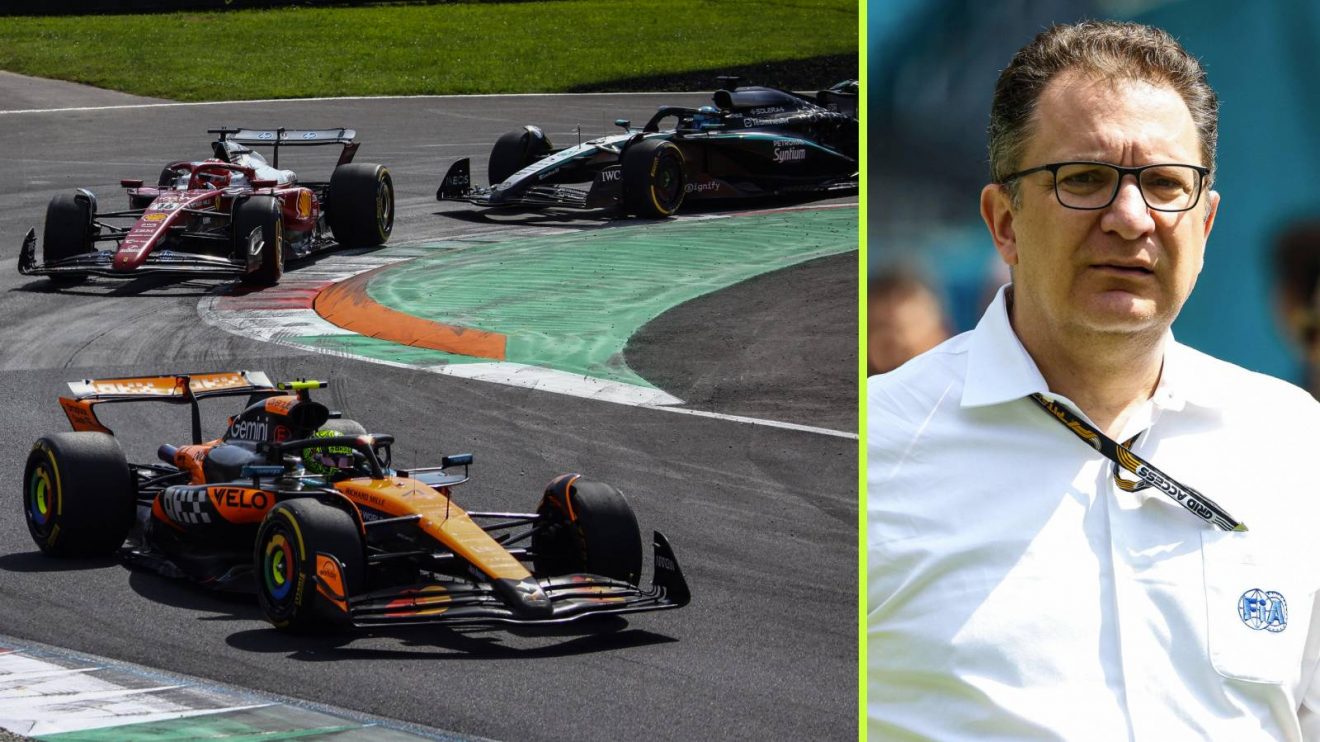
Nikolas Tombazis has poured cold water on any chance of 400km/h speeds under the F1 2026 regulations.
Top speeds of 400km/h won’t happen in F1 2026, Nikolas Tombazis has declared, as he revealed the main objectives sought with the new regulations.
Formula 1 moves to a revolutionary new regulation ruleset next season, with a new 1.6-litre V6 power unit in the back of cars that will utilise active aerodynamics for the first time in over 30 years.
Nikolas Tombazis: FIA confident 400km/h speeds won’t happen
Just a few short months away from the new cars hitting the track for the first time, uncertainty abounds about how the new regulations will shake out, both in terms of the competitive pecking order and how the cars will handle and drive.
Certainly, many of the drivers have expressed some misgivings about the way the cars handle in the simulators, although it’s worth remembering that the simulation models in use are still in a period of intensive refinement as more and more data becomes available.
There’s also the uncertainty over the new power units, with the engine formula refreshed for the first time since 2014. While the 1.6-litre V6 architecture is retained for the new regulation cycle, the engines move to sustainable fuels and introduce an increased electrical output to a ratio closer to 50/50 between the hybrid ancillaries and the internal combustion engine.
Recently, Mercedes boss Toto Wolff commented to Germany’s Auto Motor und Sport that next year’s car could “scratch the 400km/h limit” when the full potential of the power units is unleashed, with this claim causing something of a stir in the F1 paddock.
“Maybe Toto’s engine will reach that,” Max Verstappen joked.
“I don’t know. I think the FIA has already explained quite clearly that they won’t allow it.”
Carlos Sainz, who has driven the Williams, which is a customer of Mercedes’ High-Performance Powertrains (HPP), in the simulator, poured cold water on the suggestion: “I wish that’s the case. HPP must be doing a good job, but I didn’t hit [400km/h].”
Asked about the claim during the FIA Press Conference at Zandvoort, Wolff smiled, “Sounds good, no? Everybody’s talking those engines down, so I had to figure out – is there anything positive?
“And that is, if you were to deploy – obviously it sounds sarcastic – but if you were to deploy all the energy on a single straight, you could make those cars go 400 kilometres an hour. I don’t know if somebody got afraid by it, but you could. But there wouldn’t be much electric energy left for the few other corners on a circuit.”
The FIA’s single-seater technical director Nikolas Tombazis shared his thoughts on the 400km/h theory.
“I can assure you there won’t be speeds of 400km/h,” he exclusively told PlanetF1.com.
“I think it was more of a light-hearted comment, which, from what I heard, he meant to say that, with the power the cars have and with the low resistance the cars have, you could conceivably – if you combine everything together – have cars going over that speed.
“Now, the way all the energy management regulations work, that is not possible, physically or engineering-wise. We have quite a lot of control, as FIA, on those regulations, and on top of that, we have a strong card to play if necessary, and that is for safety reasons.
“We could intervene if there was anything, but we are quite confident and quite sure that the regulations don’t permit those sorts of speeds.
“It is the performance envelope of the car; if there were no regulations on any management, that would allow such speeds.”
More on the F1 2026 regulations
? Explained: The 2026 engine regulations set to seriously shake up Formula 1
? F1 2026: Confirmed teams and power unit suppliers for F1’s huge regulation changes
How will the impact of the new F1 2026 regulations be felt initially?
With such complicated regulations on the way, the FIA is in the process of refining the finer details as the first runs on track are a little over four months away.
With eight races left under the current regulations, the plan is for the first run with the new cars and power units to take place behind closed doors, away from the public and the media, at the Circuit de Barcelona-Catalunya in January.
Between now and then, the FIA is taking on board all of the feedback from the teams, but given that the governing body doesn’t have special access to data directly from the teams, it is reliant on teams being as transparent as they can be.
“Invariably, a new regulation will have a wider spread initially. That is part of the game,” Tombazis said.
“It will also have more variable performance initially, meaning there will be some ups and downs as people learn the new regulations.
“The FIA doesn’t have access to the people’s horsepower or downforce in the wind tunnel or the exact performance they’re going for. We don’t know that.
“It’s not part of the regulation that we can have access to this data, for obvious reasons. Therefore, exactly who’s doing well and who’s doing badly, I think, is somewhat still very much speculated.
“So all of these speculations that somebody will do particularly well or particularly badly, I think it’s all just that speculation.
“Clearly, there are some newcomers. They have a very uphill road to follow and, logically, they will have a steep learning curve. It will be a steep learning curve for everybody, of course, because of the new regulations but, for them, it will be doubly so.”
But, while there may not yet be a clear picture of what to expect from F1 2026, Tombazis said a key priority is in ensuring the new cars drive naturally and without unnecessary complications for the drivers.
“What we are discussing, and where we are focusing our attention, particularly, is the exact characteristics of the cars and how they behave,” he said.
“The obvious priority is that cars have a natural feel to them, and that we overcome any challenges in terms of energy management, how the electrical and combustion energies are balanced.
“So, in that respect, the teams, as the season is approaching, they’re doing more and more simulations, and more and more runs on their simulators, and some of these teams are giving us a reasonable amount of feedback on that, saying, ‘OK, in a particular circuit, we get this phenomenon or that phenomenon’.
“That feedback is getting more and more mature as time approaches, and we still have a process ongoing with the teams to dissolve some of these snags in the regulations and the energy management side, in order to make sure that the cars will behave normally.”
The ‘two core objectives’ with the new F1 2026 regulations
With some of the feedback from the drivers expressing some misgivings about how the cars handle in the simulator, Tombazis believes such complaints are to be expected from demanding drivers at this early stage in development.
“Clearly, if you have more electrical and less combustion power, you are adding a level of complication in the management,” he said.
“The exercise now is to make sure that we don’t overburden the drivers with that, that the key driving skills have to remain the differentiating factors.
“Secondly, with the feedback of the teams from the simulators, that we eliminate any unnatural characteristics that make it look strange. These are the two core objectives.
“Any new regulation does need to have a bit less performance than the previous one. The cars naturally go faster year by year and, if the new regulations also made the cars go even faster, you can imagine where Formula 1 would be now.
“So it is natural that, if a driver gets out of one car and goes into a slightly slower car, he’s not going to say, ‘Wow, I’m really happy here’, in terms of comparison.
“While we’re getting closer to the season, running on the simulator with the cars close to the performance that they could have is quite recent. This process of refining the regulations is something that is still ongoing.
“So, the drivers sometimes have driven a particular condition, identified an issue in a particular way, which has now been resolved. So I think, on that basis, their comments are right in terms of factually right, but probably a bit premature, because you don’t take into consideration the final product.”
Read Next: Why F1’s future power unit regulations are already being discussed before 2026