
FIA verdict announced in Carlos Sainz Dutch GP penalty removal review


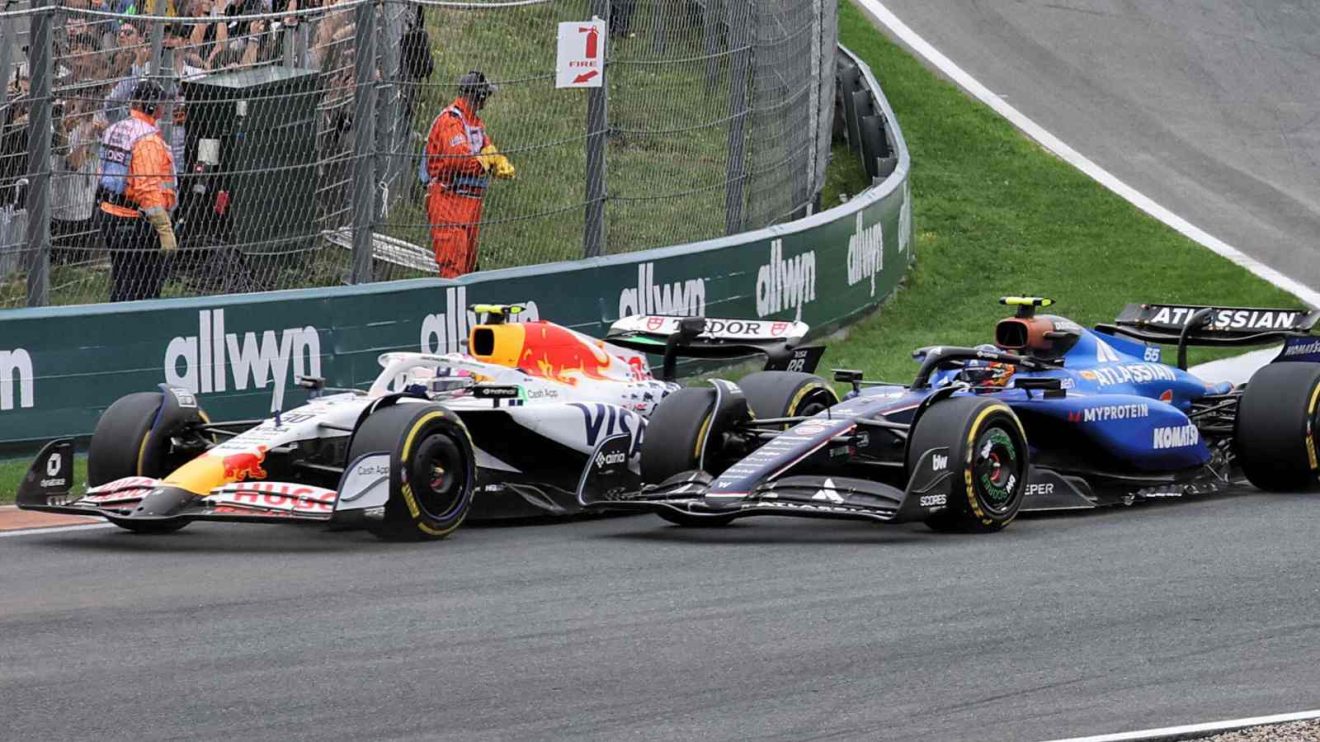
Carlos Sainz was penalised after contact with Liam Lawson at Zandvoort.
Williams has succeeded in having Carlos Sainz’s penalty points removed for the collision between the Williams driver and Liam Lawson at Zandvoort.
Sainz was given a time penalty and penalty points on his FIA Super Licence after being found at fault for a collision between himself and Racing Bulls’ Liam Lawson in the Dutch Grand Prix.
Williams’ petition for right of review succeeds
Before the Italian Grand Prix, Williams confirmed its intent to lodge a petition for a right of review into the race-destroying incident, which had left Sainz incredulous as to why he had been found at fault.
Following a hearing between Williams, Racing Bulls, and the FIA stewards from Zandvoort, the stewards have agreed to rescind the two penalty points awarded to Sainz, agreeing with the team’s assertion that it was a racing incident.
The 10-second time penalty imposed upon Sainz has not been removed, with the stewards saying they have “no power to remedy that served time penalty by amending the classification”.
The gap to the car ahead on track was 17 seconds, meaning the time penalty doesn’t have any impact on Sainz’s result, regardless.
“We are grateful to the stewards for reviewing Carlos’ Zandvoort penalty and are pleased they have now decided he was not at fault and that this was a racing incident,” the team said in a statement.
“While it is frustrating that our race was compromised by the original decision, mistakes are part of motor racing, and we will continue to work constructively with the FIA to improve stewarding processes and review the racing rules for the future.”
How did Williams successfully argue its case?
The initial hearing was held on Friday, bringing together representatives from Williams, Racing Bulls, and the FIA stewards from the Dutch Grand Prix.
Williams was represented by sporting director Sven Smeets and team manager Dave Redding, along with Sainz himself.
Racing Bulls requested permission to attend the opening arguments, despite not being summonsed to do so, which was granted. Lawson was joined by team manager Marco Perrone, while the FIA’s F1 sporting director Tim Malyon was on hand to observe the debate between the parties with the Dutch GP stewards.
This hearing was to determine whether or not there were any new, significant, relevant, and unavailable elements to consider in order to proceed with a right of review.
Williams lodged camera footage from the 360-degree camera on Sainz’s car, as well as the rear-facing camera from Lawson’s car, while Sainz’s testimony was also added – all presented as the allegedly ‘new’ elements.
The camera footage were not live transmissions, meaning these videos could only be reviewed post-race, as confirmed by Malyon and acknowledged by Racing Bulls.
Sainz’s own testimony was also not available to the stewards at the time of their decision, while Williams argued that all the data, telemetry, radio and video available to the stewards did not include any of the aforementioned.
The stewards acknowledged these elements were not available to Williams at the time of the decision, agreeing that they are ‘new’. They are also ‘relevant’, due to the video footage and Sainz’s account being pertinent to the incident.
Williams submitted these elements were significant, due to them being evidence of the positions and proximities of the cars throughout the contentious incident, while Lawson’s rear-camera footage shows his rear wheels moving towards Sainz after the apex of Turn 1. This shows, according to Williams, that Lawson had a momentary loss of control requiring corrective steering input, “resulting in Lawson colliding with Sainz, not the other way around”.
With Sainz offering his testimony to back up this footage, Racing Bulls’ team manager reverted to the Driving Standards Guidelines but “acknowledged that the submissions he wished to make in that regard would only be relevant if the Stewards were satisfied that the Review Criteria are met.
With the stewards agreeing that the newly available video footage presented was a significant element, a threshold for a right of review was met as the evidence was new, relevant, and unavailable to Williams at the time of the initial decision, although expressed reservations about the inclusion of the testimony of Sainz due to such testimonies never being available in the moment.
“The Stewards have the power and authority to issue a decision in session without hearing from a driver,” the stewards said.
Nevertheless, the petition was upheld, with matters progressing to a second hearing.
Williams submitted that while Sainz’s axle was not ahead of Lawson’s front at the apex, Sainz was entitled to attempt to race alongside Lawson through Turn 1.
Arguing that Sainz had left space for Lawson on the inside but the collision occurred due to Lawson’s momentary loss of control, Williams described it as a racing incident, and did not call for a penalty for Lawson.
Sainz said that he hadn’t been ready for Lawson having a moment mid-corner and colliding with his car.
In response, Racing Bulls submitted that the collision only occurred because Sainz chose to drive too close to Lawson.
“Lawson denied that he was not in control of his car and said that a slight snap of the type which occurred is not unusual when cars are racing closely side by side, in this case both on fresh tyres after a safety car restart,” the document read.
In reaching their verdict, the stewards said that, “Having considered the matter extensively and having reviewed the new video evidence and heard from the drivers of both cars and their team representatives, the Stewards determine to rescind the Decision.
“The Stewards agree with Williams’ characterisation of the collision as a racing incident.
“The Stewards are satisfied that the collision was caused by a momentary loss of control by Lawson.
“However, in the Stewards’ assessment, no driver was wholly or predominantly to blame for that collision. Sainz contributed to the incident by taking the risk to drive close to, and on the outside of, Lawson when Sainz had no right to room there and there was a real possibility that, if the collision had not occurred where it did, Sainz would run out of track at the exit and/or a collision would have occurred at the exit for which Sainz would likely be predominantly if not wholly to blame.”
Read Next: Cadillac ‘won’t be last’ verdict offered in F1 arrival impact declaration