
V8 vs V10 vs V12: Why the romance of F1’s engine freedom is officially dead


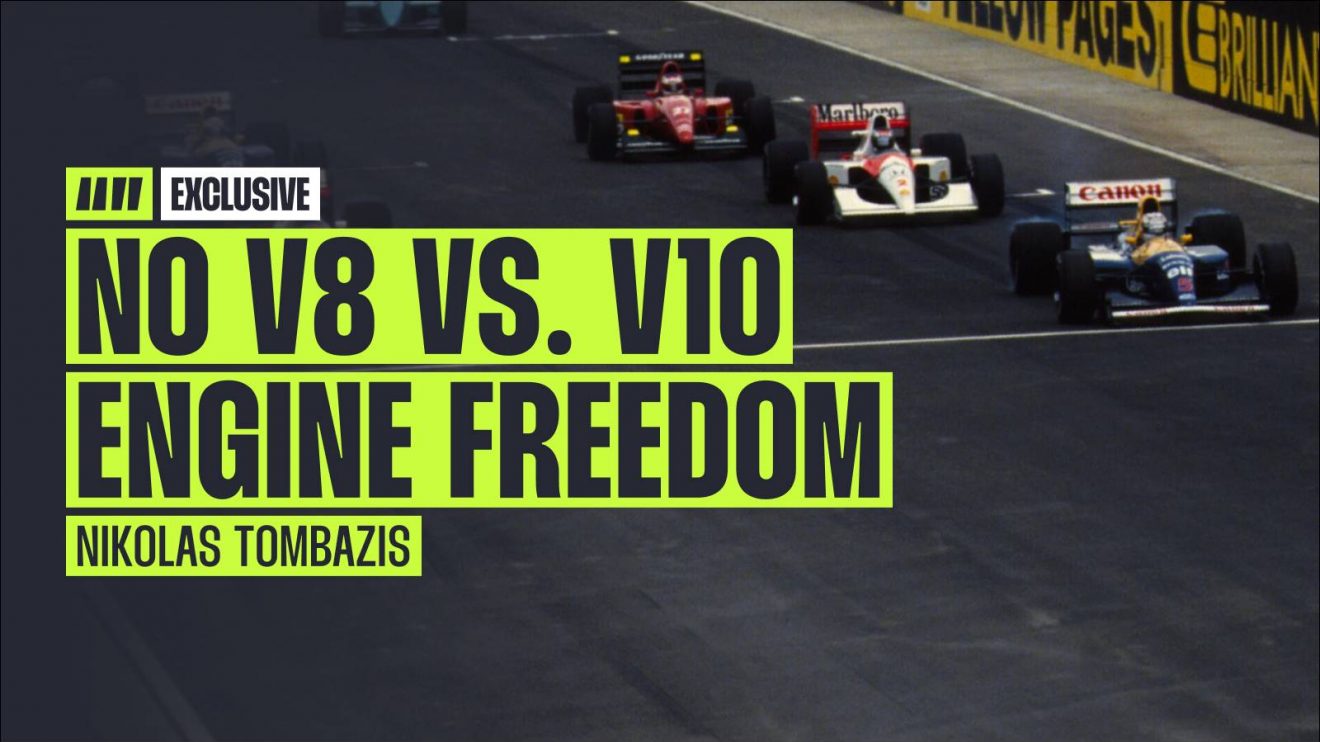
A V8 vs. V10 vs. V12 Formula 1 won't be returning in the near future, as Nikolas Tombazis has explained.
Allowing engine manufacturers greater freedoms to manufacture V6s, V8s, V10s, or even V12s, under the F1 cost cap, begs the question, ‘Why not?’, but the romance of the idea has been shot down by the FIA’s Nikolas Tombazis.
F1 will use a hybrid V6 power unit in 2026, utilising a revised architecture from the frozen designs used between 2022 and ’25, as the sport swaps to sustainable fuels and increased electrification.
V6, V8, V10, V12… Why F1 won’t allow more engine types
The introduction of the new V6 hybrids takes place against the backdrop of ongoing discussions about the direction F1 should take for its next engine rules, given the compromises that have had to be made on the chassis front to work with the new engines.
In order to maintain lap times comparable to today, the FIA is introducing active aerodynamics for the first time in over 30 years, with the cars utilising ‘X-Mode’ and ‘Z-Mode’ to actively switch between low-drag and high-downforce, depending on where a driver is on track.
Added to that is an electrical systems ‘override’ boost, which will essentially work as a ‘push-to-pass’ system by utilising the full potential of the electrical energy stored in the battery, as the cars have an energy ramp-down rate when driving along straights – this is to ensure there are no unnatural actions required of the drivers, such as mid-straight braking, in order to regenerate electrical energy.
If it sounds complicated, it’s because it is, sparking the discussions this year about what to do with the next engine formula. Serious discussions were held about whether or not to shorten the next engine rules cycle in order to move to a more simplistic naturally aspirated or turbocharged V8 in 2029 or ’30.
A meeting between the FIA and the power unit manufacturers was intended to be held in London in the week after Monza, but with the governing body becoming aware that it would not have the support of a supermajority of the manufacturers, it postponed the meeting; F1 will thus race with the upcoming engines until at least the end of 2030, as originally planned.
The introduction of sustainable fuels does raise an interesting idea, though. If F1 is to move back away from electrification for the next engine rules, why not allow greater technical freedom, given the existence of a cost cap that restricts the manufacturers from overspending in the pursuit of performance in the same way the teams are restricted?
In 2026, new power unit manufacturers are only permitted to spend $190 million, while incumbent manufacturers are capped at $148.5 million. All will then be restricted to $148.5 million in 2027.
But, if all the manufacturers can only spend a certain amount anyway, why not loosen the regulations and allow them to build according to the architecture each desires? This would potentially allow for a wide-ranging array of ideas, such as what was last seen in F1 in the early 1990s, where V8s lined up against V10s and V12s.
An example of what could be possible was demonstrated by Sebastian Vettel at Imola last year, when he drove Ayrton Senna’s 1993 MP4/8, complete with its Ford V8, using sustainable fuel, and also partnered with P1 fuels to drive Nigel Mansell’s V10-powered Williams-Renault at Goodwood during the summer of 2024.
But the answer to the question of ‘Why not?’, according to the FIA’s single-seater director Nikolas Tombazis, is not that simple.
“We believe that the cost cap, in itself, cannot be the only mechanism to control costs,” he told PlanetF1.com in an exclusive interview.
“Why? Because the PU manufacturers, for example, or the teams, all operate in slightly different conditions.
“Some are independent PU manufacturers, like Red Bull [Powertrains], for example, are becoming. Some have a strong OEM presence.
“Some are developed within a factory, where there’s much more happening. Some have separate units. Some are in Italy, Germany, the UK, Japan, or America.
“So there’s a huge variety of conditions. The cost cap is trying, of course, to cut across the border, to be as equitable, let’s say, amongst those conditions.
“But the truth is that, if you try to equate all of that, you will never have exactly the same effect of the cost cap in different jurisdictions, different countries, different business models.
“The same applies to the teams, as well as to the PU manufacturers. That means that if all we said is ‘You’ve got X amount of money and do what you want otherwise’.
“I’m exaggerating, but you know what I mean. These differences in situations that exist in different countries will be amplified and will have a huge effect on performance, and would render it impossible to develop a competitive power unit if you are, for example, in America or Japan, or if you’re part of an OEM or not.
“So it would mean that there would be a massive performance differential. So we’ve always felt, from day one of the cost cap, and I still believe it now, that the cost cap, whether it’s team or PU, cannot be the sole controller of costs.
“There’s also got to be some control of the technological side in order to keep the things realistic.
“If there were maximum freedom technologically and just a cost cap, it would also encourage teams and PU manufacturers to find the loopholes in order to gain an extra 5 million of budget somewhere; that would be an extra bit of horsepower, an extra bit of technology, and that would make it, I think, ultimately, a worse sport.”
More on F1’s engine rules
? F1’s true future? Give us a Ferrari V12 v a V8 Red Bull and hybrid Mercedes
? V8 F1 engines off the table as decisive call made ahead of power unit meeting
With all the current teams and manufacturers operating within a very tightly prescribed formula, it has led to huge levels of convergence where the entire field can often be lapping within a single second of each other; this is in stark contrast to situations in F1 up until the last 20 years or so, in which the time gaps between teams could be vast, to the point where perhaps only 2-3 cars would finish on the lead lap.
“Of course, it was very interesting,” Tombazis said of the engineering challenge that F1 represented when the rules were far less restrictive.
“But one should not forget that, in the 1960s or 1970s, there could be drivers who lapped second-place two or three times. The gaps we had back then were enormous.”
A key factor, Tombazis said, was also that computing and simulation power was practically non-existent, meaning that potential couldn’t always be fully extracted, or even understood; in today’s high-tech world, the limits of engineering will be found far more quickly.
“The reason racing was so exciting then was that teams were much less professional than they are now. They didn’t have simulation capabilities,” he said.
“Cars were not reliable. They would have mechanical problems. It would slow down, and then somebody would catch up.
“They would one day be dominating, and maybe not knowing exactly why they’re dominating, and then next race, they would be in a bad place.
“So you had this variability because of the lack of scientific tools.
“If you had the same level of freedom now that you had back then, plus the simulation capabilities, the 1000+ workforces and engineers and everything where teams are able to run in a metronomic capability, plus the freedom you had in the past, I think the sport would be extremely lacking in terms of entertainment value.
“It would have a lot of interest for engineers, for sure, but engineers are not the main clients of the sport. I’m an engineer as well, but engineers are not the main clients of the sport.”
Read Next: McLaren at centre of legal action against former driver as London court case begins