

The eye-opening data behind Max Verstappen’s dominant Italian GP win


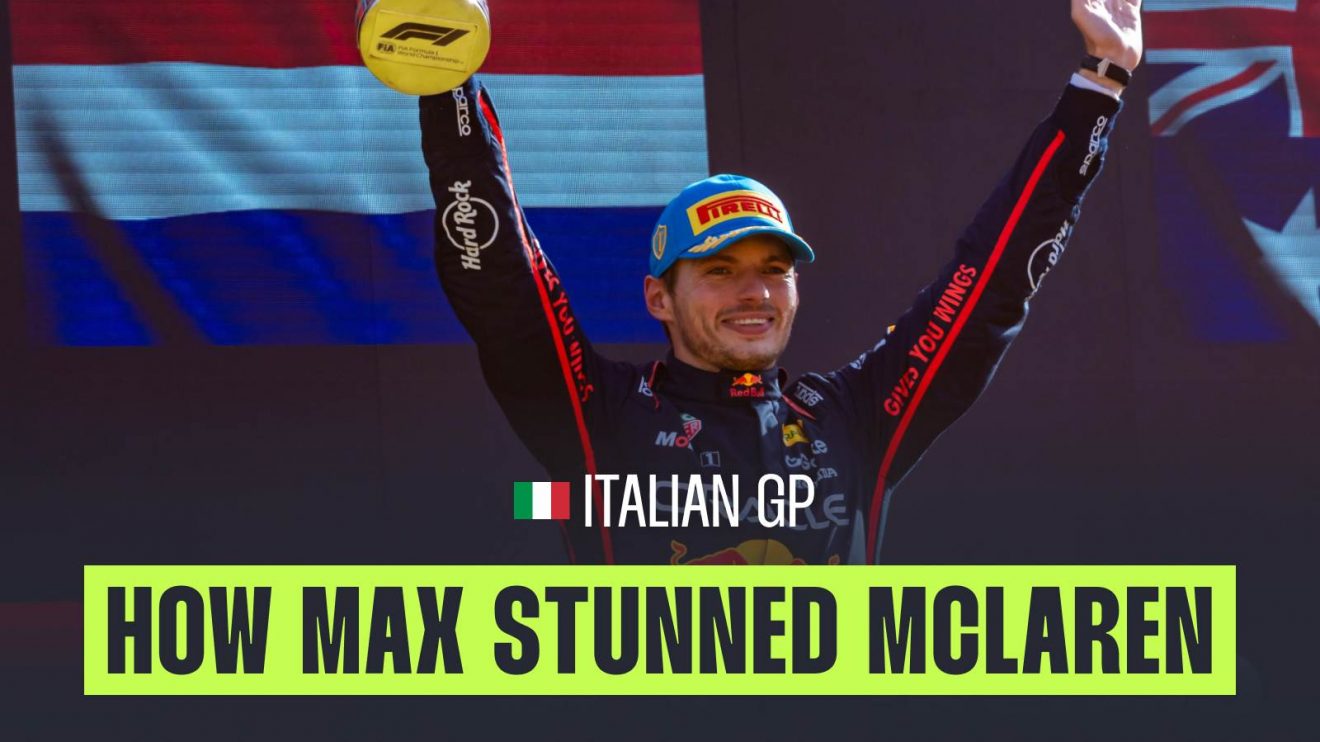
Max Verstappen took pole position and stormed to victory at Monza on Sunday.
Max Verstappen secured yet another victory at Monza – his third win in the last four races there – this time after a spectacular early battle with Lando Norris at the start of the Grand Prix.
Once he retook the lead from Norris after an early trip into the gravel, Verstappen was completely unchallenged for the remainder of the race, taking a confident win. But how exactly did he manage it? Telemetry data gives us the full picture.
McLaren was no match for Max Verstappen this time
We had already seen just how quick the Red Bull was around Monza on Saturday, when Max produced a phenomenal qualifying lap to beat both McLaren drivers and once again secure pole position for the main race.
The Dutchman managed this thanks to a clever trick Red Bull had up their sleeve – they modified the rear wing on his car to reduce drag, which is arguably the most important factor at Monza. The goal at this track is always to minimise drag in order to maximise top speed on the long straights that define this legendary circuit.
And, as we’ll later see in the telemetry data, this adjustment proved crucial in securing the win.
This isn’t the first time we’ve seen Red Bull play this card. Think back to Silverstone earlier this year, where Verstappen also clinched pole thanks to his advantage in straight-line speed. Unfortunately for him, the rain on race day turned Saturday’s strength into a biggest enemy on Sunday.
Starting from pole, expectations were high that Verstappen would keep his lead, making it hard for the McLarens to challenge him during the opening lap.
However, Lando got a better start, allowing him to pull alongside the reigning World Champion. The run down to Turn 1 at Monza is particularly long, which makes a good launch from the grid even more impactful.
More analysis from the Italian Grand Prix
? McLaren threw ‘papaya rules’ to the wind in Italian Grand Prix team orders call
? Winners and losers from the 2025 Italian Grand Prix
Shortly after, we saw another display of Verstappen’s racing ruthlessness. He left Norris no room on track, forcing the McLaren driver to put two wheels on the grass. According to the telemetry, this move reduced Lando’s speed significantly, though his biggest advantage at that point was having the inside line heading into Turn 1.
What we can also observe in the data is that, due to the slight loss of speed after going off-track, Norris was able to brake later than Max, which brought them back into a wheel-to-wheel battle at the apex of Turn 1.

On exit, Norris gave no space to his rival, which forced Max to cut the chicane and maintain the lead by leaving the track limits. As this clearly breached the rules, his team quickly instructed him to give the position back – which he did to avoid a penalty.
Even at that stage, it was already obvious that Verstappen had excellent pace. Just one lap after giving up the position, he was right back behind Norris, piling on the pressure.
It didn’t take long for Max to retake the lead – he pulled off the move in Lap 4 by overtaking Lando on the start-finish straight. With DRS activated, the RB21 was a missile, and the McLaren driver had no chance of defending his position.
In the image below, we can see just how much of a gap there was between the two cars as they approached Turn 1. What’s even more impressive is that Max managed to brake cleanly and get the car stopped despite having significantly higher speed, reduced downforce, and a full fuel load. Meanwhile, Lando made a small mistake and locked up the front-left tyre slightly.
From that moment onwards, Verstappen was unstoppable. The time gap between him and the driver behind kept growing steadily.

So how did he manage to outperform a McLaren car that has looked so dominant this season?
Once again, the answer lies in straight-line speed. A closer analysis of the lap data from the first half of the race reveals that the advantage Red Bull had on the straights played a big role in their lap times. Max was consistently quicker on the run before Ascari and again before Parabolica. On nearly every straight, the Dutchman was shaving off a few hundredths of a second compared to the McLarens, while crucially not losing time through the corners.

His ability to manage the car and look after the tyres just enough was key to securing the victory in Italy. The chart below shows both the lap times and how quickly his lead began to grow.


Up until around Lap 25, McLaren’s pace started to improve – something clearly visible in the data. However, despite being slightly slower, the gap never reduced enough to put Verstappen under any serious threat. On Lap 38, Max pitted and rejoined the track with a comfortable four-second lead over Hamilton. At that point, it was clear that unless something unexpected happened, this race was his.
McLaren tried to extend their first stint as much as they could, hoping for some strategic luck – but it didn’t come. In the end, it was another masterclass from Max Verstappen and yet another victory over the supposedly dominant McLarens.
Read next: Nico Rosberg predicts McLaren ‘talks’ after team orders take centre stage


