
Uncovered: How Isack Hadjar secured incredible Dutch GP podium


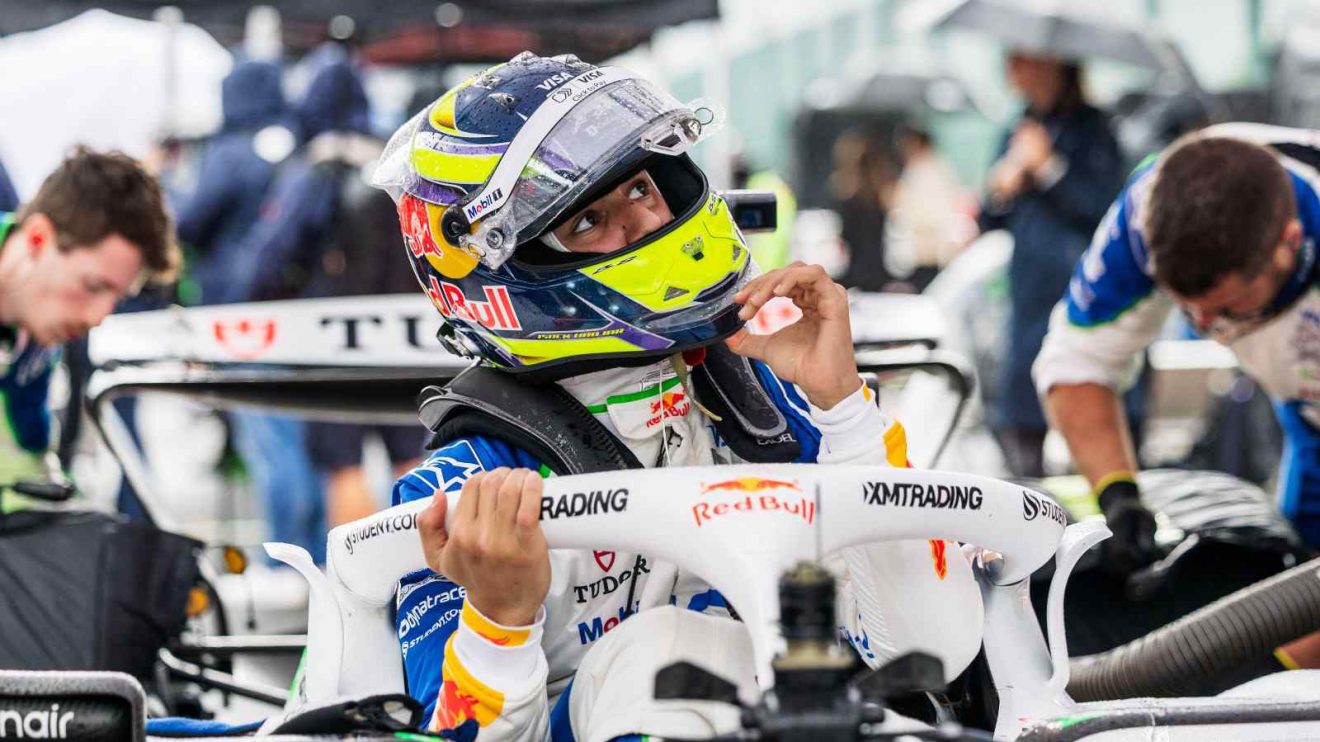
Isack Hadjar fell from the fourth row of the grid to last on the road on Sunday.
After a phenomenal qualifying session for the young Frenchman, the main question heading into the race was whether Hadjar stood any real chance of defending his position against the faster cars behind him — and it’s no exaggeration to say that he managed it brilliantly, ultimately finding himself, with a touch of luck, on the first podium of his career.
So how did Hadjar defend P4 from the Ferraris and Mercedes cars through two rounds of pit stops? We answer with the help of telemetry data.
A Sensational Drive for a Rookie’s First Podium
Hadjar knew that if he wanted a good result, he simply had to defend his position at the start of the race. The inside line at Zandvoort is far from ideal, but that didn’t stop the Racing Bulls driver from holding onto P4 through the opening laps. He was aided in this by Leclerc, who managed to pass Russell’s Mercedes on the opening lap and in doing so “shielded” Hadjar from early pressure.
That left Hadjar in the middle of two separate battles — the one up front between the two McLarens and Verstappen, and the one for fifth place between Russell and Leclerc. With no driver too close behind him, Hadjar found it much easier to extract maximum pace from his car.
And he did exactly that in superb fashion. As he said himself after the race, he didn’t expect to have such a strong race pace or to be able to keep up with cars that, on paper, should have been much faster. During the first stint, the Frenchman was on average a tenth of a second quicker per lap than Leclerc, and almost two tenths faster than Russell.
Around Lap 11, Leclerc closed to within 0.6 seconds of Hadjar, but there was no serious attack — likely because the Ferrari driver opted to preserve his tyres. By Lap 13, the gap between them had already extended to over two seconds.

Zandvoort is not a track where overtaking is easy. In order to pose a real threat to the driver ahead, he needs to be around 0.8 seconds per lap faster — which is a considerable difference in pace. Hadjar’s extremely precise driving never allowed the drivers behind to enter that window, making it easier than usual for him to hold onto his position.
However, if he wanted to stay in P4, Hadjar had to earn it on the track — and that included surviving several Safety Car restarts. The incidents involving Hamilton, and later Leclerc, made the race quite dull from a strategic perspective. All the frontrunners pitted under the Safety Cars, meaning there was little strategic excitement to speak of.
Hadjar’s first real challenge came on Lap 27, after the first Safety Car restart. This time, it was Russell directly behind him, and down the main straight he forced the Frenchman into a defensive line. However, that proved to be his only real opportunity. Isack Hadjar drove an outstanding remainder of the lap, and by the end of it had already opened a gap of more than three seconds.
The ongoing battle between Leclerc and Russell for P5 gave the young driver more space to race without pressure.
Then came another Safety Car — this time a Virtual, due to debris on the track. But now, Hadjar’s task has become significantly easier. In the incident involving Russell and Leclerc, the Mercedes driver picked up damage which visibly affected his pace later in the race.
This damage included scrapes to the sidepod as well as issues with the edges of the car’s floor — clearly visible during the live broadcast. Damage like this can significantly disrupt downforce and balance, leading to a drop in race pace.
If we examine the lap time chart below, we can see the difference between Hadjar’s lap times and those of his direct rivals — both after the second and the third Safety Car. The gap in pace was consistently around three to four tenths of a second per lap, and Hadjar needed very little time to build a safe margin over the cars behind.


By this point, he had already done everything within his power to hold onto P4 and deliver valuable points for his team. And with a stroke of luck — Lando Norris’s retirement due to a mechanical failure — the young Frenchman found himself on the podium, his first in Formula One, and all that just 15 races into his career. It’s quite a journey from his rookie mistake in Australia in the very first race of the season, to a podium in the Netherlands.
Although luck certainly played a role in the final result, it would have meant nothing had Hadjar not put himself in that position — thanks to his excellent driving. Holding off drivers like Leclerc and Russell in cars that are, by every metric, significantly faster is no easy feat. And Hadjar didn’t do it just once — he did it multiple times throughout the race.
As we said after his outstanding qualifying session, Hadjar is increasingly shining the spotlight on his performances — giving both his team and the Red Bull leadership every reason to seriously consider him for the second Red Bull seat alongside Max Verstappen.
Read next: What Lando Norris’ data reveals about his true Dutch GP performance