

Dutch GP pit lane change throws strategic curveball for teams


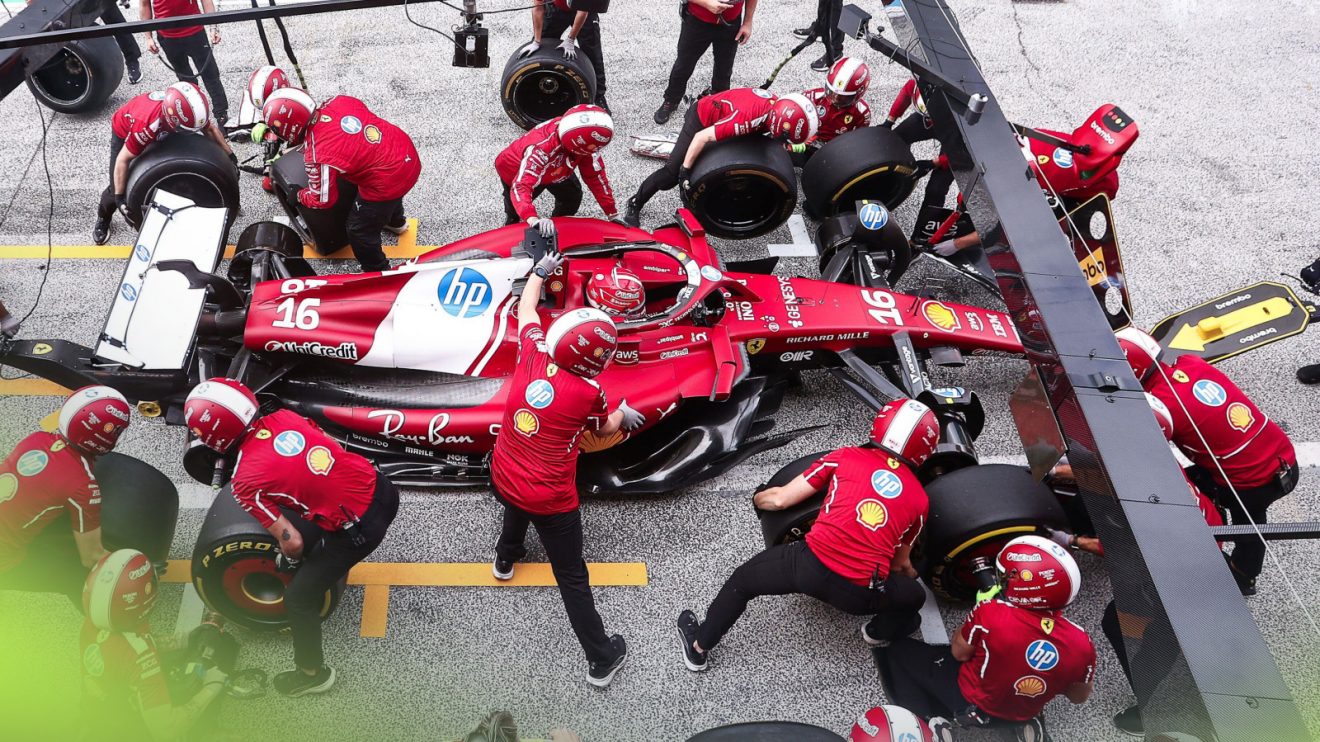
A change to the pit lane speed limit has created some strategic uncertainty for the Dutch GP.
Pirelli has suggested that the change in pit lane speed limit for this weekend’s Dutch GP has blurred the strategic line.
Once a clear one-stop race, Mario Isola suggests it is now not so clear cut, and teams could roll the dice on a two-stopper.
One-stop vs two-stop strategy ‘less predictable’
Additional reporting by Thomas Maher
Ahead of the weekend, the FIA increased the pit lane speed limit from 60km/h to 80km/h.
The Zandvoort pit lane is among the tightest on the calendar and the reduced speed was viewed as a safety precaution.
However, the call was made ahead of time to raise it to 80km/h, as is the speed limit at most other venues.
The net result is a transit time that is now three seconds faster than it was previously. Coupled with tyre degradation considerations, the ability (or otherwise) to overtake, and track position, and the subtle change could have significant ramifications..
“We consider the difference in the pitlane speed since the beginning,” Isola told the media, including PlanetF1.com.
“So it’s not a delta compared to our prediction when we came here.
“The reason why the advantage of a two-stop strategy compared to one stop is now less predictable is more for how manageable is the level of degradation.
“So clearly, moving from 22 seconds to 19 is helping to push teams to go to two-stop, but it’s still difficult to overtake.”
While the circuit configuration has been modified, the narrow, sinuous nature of the Zandvoort circuit has made it difficult to pass on.
Creating a tyre offset, therefore, could afford a driver the delta they need to attack, and pass, those ahead.
“In their simulation tool, they have also this coefficient that is giving you an idea the impact of overtaking,” Isola explained. “They consider that in their strategies, while we don’t consider this effect, because, for us, it’s an average.
“We try to give you an idea that is the average of all the teams.
“All the teams customise their strategy based on track position, grid position and other elements. We just try to give a flavour, an idea of what can be the most optimal strategy in the race.”
Adding to that is the choice of tyre compounds in use this weekend, with the C2 the hardest, the C3 the medium, and the C4 the soft.
“It was interesting to see that in FP3, they used quite a lot of tyres… more than usual,” Isola observed.
“I believe that one reason for this decision is that [on Friday], they realised that one stop is feasible.
“On paper, it’s not the quicker strategy.
“On paper, it is medium-hard-hard, that is the quickest strategy where you can also push more, but, considering how difficult it is to overtake here, a one-stop is a possibility.
“You protect your track position. You have flexibility, because the weather forecast is a chance of rain in the morning and also at the start of the race is still 40 per cent and maybe changing during the day… they need flexibility.”
More on the Dutch Grand Prix
? F1 starting grid: What is the grid order for the 2025 Dutch Grand Prix?
? Uncovered: McLaren deploy update tactic for Dutch GP performance gains
Tyre life is unlikely to be a concern, Isola added, suggesting that could prompt some onto the softest compound rubber.
“It’s interesting to observe that the soft compound is a compound that it could be used for a stint of the race,” he said.
“If you start planning a strategy, medium-hard, and then you realise that the stints are not long enough, or, for any reason, you need an extra stint, even if you have only one set of hards, one set of medium, then you can use a soft at the end.
“If you plan, from the beginning, a strategy of two-stop, then we believe that soft, hard medium is better, because you have the advantage of a soft that is giving you more grip at the start of the race, and then you develop the rest of the race with a hard and the medium.”
There is just one further complication for engineers.
An increased chance of rain for race day has brought with it cooler conditions, which will help teams manage rear tyre life.
“The cooler temperature, compared to last year, means that they can manage the rear degradation better,” Isola noted.
“Here, it’s all about managing the thermal degradation from the rear tyres, and, if you are able to manage it, you can extend the stint. And cooler temperatures are helping in this area.”
Read next: Lewis Hamilton reveals the ‘smart’ Ferrari strategy ploy versus McLaren