

Behind the scenes of the ‘storytellers’ bringing F1 to our TV screens


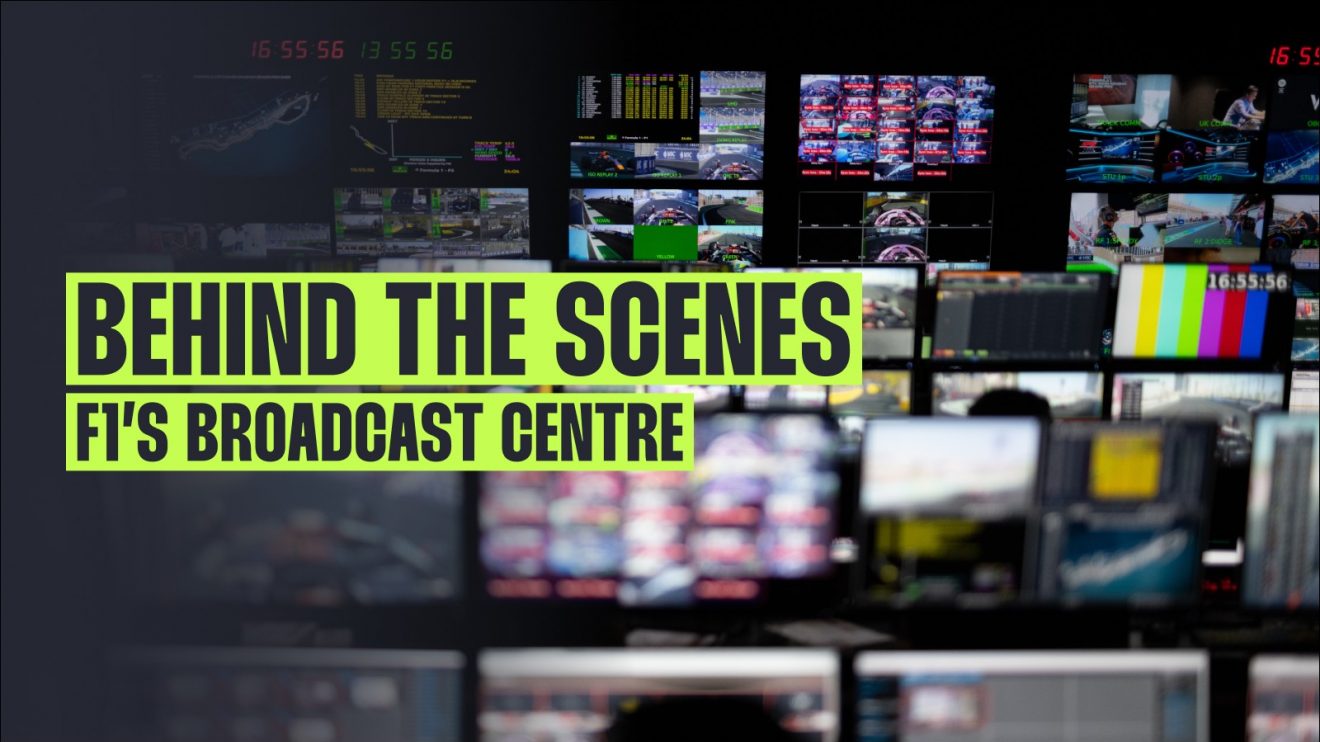
PlanetF1 was given a behind the scenes look at how the F1 broadcast is made.
PlanetF1.com was part of a select few to tour Formula 1’s Media & Technology Centre, the home of F1 broadcasts, during the Belgian Grand Prix weekend.
Golf courses can rival Formula 1 circuits in size and the speed of a tennis or cricket ball can exceed 100mph but it is when you combine all these aspects that the challenge begins to get harder and harder. 20 drivers, each going at 200mph over the course of tracks that can stretch up to 14km means it is not just a case of pointing a camera at the circuit and hoping for the best. The challenge is to be able to tell a story where the athletes are hidden behind helmet visors. Where new viewers can feel welcome and old ones do not feel patronised.
Is Formula 1 the hardest sport to broadcast?
That challenge is taken on at F1’s Media & Technology Centre in Biggin Hill, on the outskirts of south London. What started as a couple of old hangars at an airport has developed into a massive operation, receiving 500TB of data each race and somehow turning that into what is on our TV screens.
The heart of an operation is a dark room illuminated by the glow of hundreds of screens. Angles from across the circuit, the paddock and the cars are displayed with a mass array of buttons that are able to select which feed and when to show. Some of the room focuses on graphics, others are focused solely on data. One area works on digitally adding advertising boards meaning F1 can advertise more relevant products depending on the region. When a crane crashed into an overhead billboard in Austria, it was digitally re-added within 30 minutes.

There is a separate room dedicated entirely to driver radios where one person listens to all 20 drivers at the same time while another transcribes the words in a matter of seconds.
Across this vast campus, there is a TV recording studio, multiple commentary booths, endless offices and an area dedicated to designing the latest innovations – each coming with the task of being light enough not to annoy the teams.
Even in the two years since PF1 was last shown around the home of F1 broadcasts, the scale of the operation has grown massively. 140 employees call the MT&C home with 400 screens to look at. 60+ broadcasters take the feed from here, transmitting to 180+ territories across the world to an audience of 1.6 billion. 96 cameras are fixed to the cars and all that data is processed to enable the team to measure the cars within 1/1,000th of a second.
F1 2025: The season’s winners and losers
? The results of the F1 2025 championship
? The updated Drivers’ and Constructors’ Championship standings
In 2023, we described the environment as like being in NASA’s Mission Control and that feeling remains the same, even more so during a live session. PF1 was invited down during a race weekend, sitting in for the sprint qualifying session of the Belgian Grand Prix, a track that Dean believes is one of the hardest to cover.
Formula 1 is a sport that relies on its broadcast more than others. Besides from the score and how long the match has been going, there is not much more you need to be able to watch a game of football or tennis but seeing a car go around the track without any context makes it difficult to know if the driver is dead last or heading for victory.
The audience has also changed massively. 15 years ago, F1 was a sport for a niche audience and rarely captured the attention of casual viewers. These days, new viewers are tuning in almost every week to this highly technical sport.
“I think everything in our environment is quite difficult,” Dean Locke, Director of Broadcast and Media at F1, told PlanetF1.com. “A lot of sports have their various challenges – trying to tell a story and trying not to predict things too much as well. But our environment makes it incredibly challenging.”
The question Dean had just been asked was “Is Formula 1 the hardest sport to broadcast?” and it’s easy to see why the answer may well be yes.
“There’s the global nature of it,” Dean continued. “The way we broadcast to so many different countries and so many different and diverse fan bases.
“Making sure that a new fan doesn’t look at a graphic and go ‘I don’t know what that’s telling’ but then also not having a hardcore fan going ‘you’re patronising me’.”
Dean has been part of F1’s broadcast team for coming up to three decades and in that time, the scope of the project has changed almost beyond recognition.
“So I started quite a long time ago, at the end of ‘97 and Formula 1 or FOM, as it was then, was getting into covering sport, mainly around a sort of digital pay-per-view side of things, it was quite ahead of its time.
“They were desperately looking for people with Formula 1 knowledge and broadcast knowledge. I was at the BBC for drama at that point but I’d done quite a lot around Formula 1. I actually did my dissertation on Formula 1 at university.
“It was a very small team. We were based the other side of the airport. I came in as pretty much a researcher doing various things, but it was all hands-on back then.
“So you ended up doing some graphics, then you ended up doing some editing. Next thing you know, you’re looking after cameras. So I did that for a number of years, and started directing one of the track feeds, which I loved.

“It was at the same time that it was closed down. Bernie [Ecclestone] and everybody decided that didn’t work and closed that down. Then we started looking at our world feed coverage. That was done by the independent host so whether that was in Britain, it was ITV or BBC, Germany, it was RTL, and at the same time, there was a lot of development in sports coverage.
“So you had Sky starting to take over cricket and Australia were doing incredible things with cricket. The American sports networks were doing some great stuff for the NFL.
“There was a feeling that even though they were great F1 broadcasters, they were only doing one a year or maybe two at a push, and we felt that really hindered us from developing.
“We weren’t able to develop loads of new graphics, because we weren’t the key broadcaster. So there were some big conversations about ‘what about if we took the origin of the world feed over?’
“Bernie was really good. Trusted us, invested in us, and we built a system. In principle, it’s not that different to the way we do it now, it’s just the scale of it is dramatically bigger.
“And so I was the world feed director for quite a long time. And then when Liberty came in, they asked me to take a broader view and a broader sort of remit of content generally.”
In 2023, the transition was complete with Monaco the final venue to hand over the reins to F1 meaning that now, all 24 races, are controlled from the MTC in Biggin Hill and the Event Technology Centre, a 414m2 building next to the track.
That also makes Formula 1 somewhat of an oddity. If you watch a football game, chances are each country’s broadcaster has their own cameras, whereas in F1, the view you are seeing is the same across the world, giving FOM an enormous editorial control as well, an aspect that can be challenging when the race leader is 30 seconds ahead of everyone else.
“Firstly, we are neutral,” Dean said when asked how they decide what camera to show and when. “When there was a host country doing their broadcast, they weren’t always that neutral.
“So our editorial focus is on battling action, that’s what we want to see. We don’t want to see necessarily, single cars. So the higher up, the better but we’re going after action. We will quite often find ourselves in a battle for 10th.
“But that’s sort of my job a little bit, is to say ‘hey, we haven’t seen the leader for six laps. We probably should show a few bits of this’
“And then there’s some storytelling throughout, isn’t there? Whether that’s Colapinto just about to get his first points, but you can’t at the end of the race, go ‘we didn’t show him and then he got his first points.’
“So you have to kind of link all those stories together. So editorially, we’re looking out for battles, action, that’s why people tune into the sport, because of the drama. But then there are weaves of storytelling all the way through, and that’s what we fundamentally are: storytellers.”
It is also a sport that is continually evolving, one that is forever changing as technology changes and as Dean explains, it is often the sport that leads that advancement.
“I think sport broadcasting is on the forefront of technology and is groundbreaking. Normally, new initiatives come through sport.
“So you are looking at it and there are some amazing broadcast facilities around the world that are doing that. Sometimes, you can see something on a field sport and think ‘how am I going to do that in our environment? How am I going to do that at speed? How am I going to get that data on a car?’ and then there’s the AI stuff, you’re seeing a lot of that coming along.

“So we do look at sports, but you’re also looking across the board – film, gaming. You’re trying to take influence from everything.”
The F1 Movie highlighted what can be achieved by cameras, the difficulty is making them durable enough to last. Ayrton Senna’s famed Monaco laps were captured on a device that would be broken with the first 10% of a race. These days, cameras broadcast ultra HD all race long.
As to what comes next, Dean predicts more personalisation for the at-home viewer, one that makes a race unique to them.
“I find it really difficult to predict 10 years. I think three to five years is normally pretty good, and it’s good for us working out our strategy.
“We’ve got some incredible broadcast partners, so we have to work with them to say ‘what are you doing? What are you looking at? What excites you about the future?’
“It’s pointless designing or building something that then fans can’t access, their viewers can’t access. So it has to be in line with that.
“I think personalisation would be really key to how we engage around fans in broadcasting. So ‘do I want a different graphics package? Do I want a different audio package to what I’m currently getting? Do I want to track drivers all through the race that the world feed isn’t covering because they’re not storytelling, but actually, I still want to be notified if something’s going on.’
“So I do see a lot of inroads in some of the ways you see Formula 1 changing a little bit, and hopefully we can get more off the car, so we can get live 360s off the car, things like that. Certainly, in the next two to three years will be interesting. But I think that’s the surprising thing about live sport.
“15 years ago, people were saying ‘oh, people won’t watch live TV’ which an element is true because people are more series-based but for live sport, it’s still big, and people are still tuning in not to know the answer at the end.
“And we’re still seeing improvements in those numbers. So I think live sport still has a long way to go on how we do that.”