

Telemetry reveals where it all went wrong for Lewis Hamilton in Hungarian GP qualifying


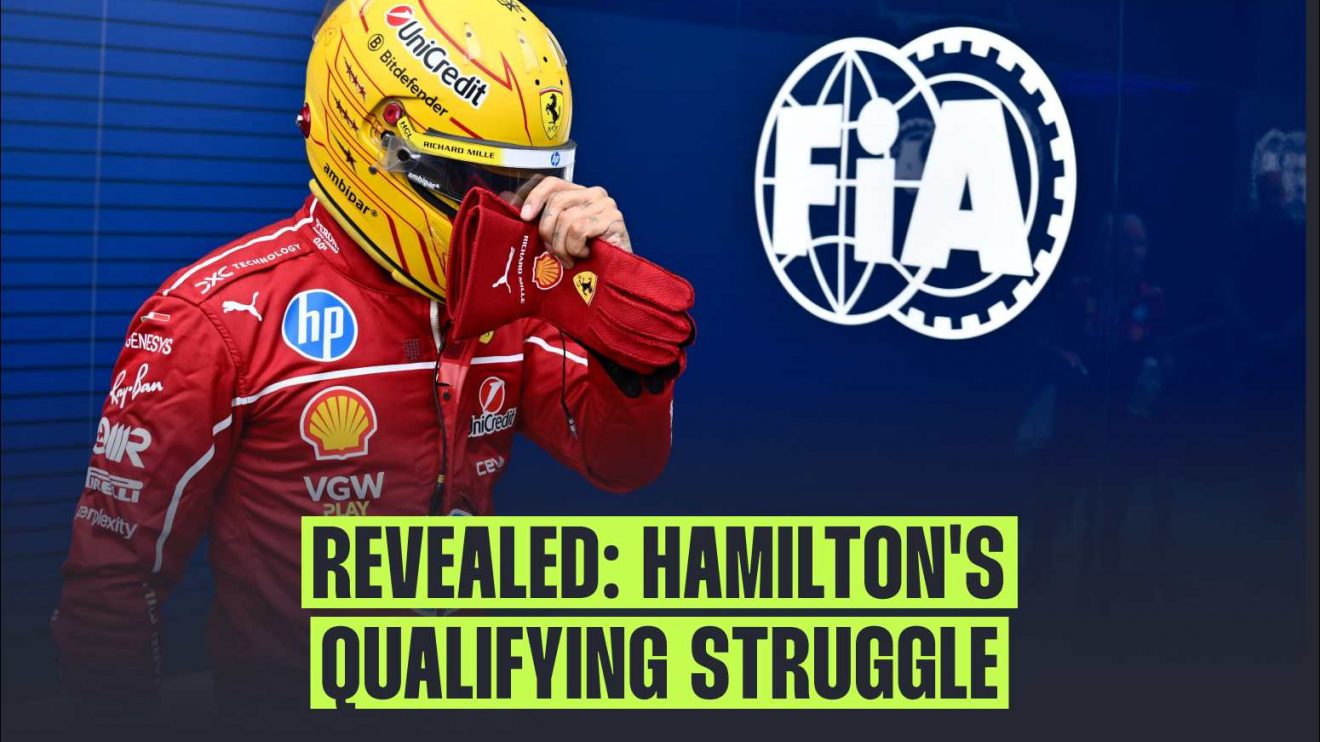
Telemetry reveals where Lewis Hamilton's Hungarian GP qualifying lap went wrong.
The qualifying struggles for Lewis Hamilton continue. After two Q1 eliminations in Belgium, the seven-time world champion ended his Hungarian Grand Prix qualifying session in P12 — far from where he wanted to be.
After the session, Hamilton admitted that the mistake was 100 per cent his fault, so let’s dive into the telemetry data to see exactly where things went wrong.
Lewis Hamilton struggles again in Hungarian GP qualifying
Charles Leclerc’s pole position is a strong indication that Ferrari’s development path is finally heading in the right direction. Earlier in the season, some of the blame for Lewis Hamilton’s poor performances was placed on the SF-25, which was certainly a tricky car to handle.
According to some sources, Ferrari faced a more serious issue with the rear suspension and the design of the gearbox casing. Fixing this kind of structural problem takes time, and only now can we say that things are beginning to move in the right direction. At least for Leclerc.
On the other hand, despite improved overall performance, Hamilton’s form remains inconsistent. One of his worst qualifying performances came just last weekend in Belgium, where the Ferrari driver failed to make it out of both SQ1 and Q1.
The issues carried over to the Hungaroring, a track where Hamilton has traditionally performed very well and enjoyed great success in past seasons.
During Friday and Saturday free practice, Leclerc was faster in all three session, with an advantage of around three to four tenths in their fastest laps. Unfortunately for Hamilton, that gap persisted into the first two qualifying segments.
In Q1, Leclerc was 0.151s faster, and in Q2 the gap grew to 0.247s.
As Hamilton himself admitted, the early exit was due to his own mistake — there was no unexpected external factor at play.
If we compare their Q2 laps side by side, we can pinpoint what exactly Hamilton was missing.


The first and third sectors were very evenly matched in terms of lap time. The key difference came in Sector 2.
Before Turn 1, Leclerc had better top speed, but Hamilton was more stable through the apex. The same was true in Turn 2, and their times were nearly identical heading toward Turn 4.
Interestingly, the start of Sector 2 was actually better for the Briton — he gained back a tenth through Turns 4 and 5. But very quickly, the advantage shifted once again to his teammate.
A slightly weaker exit through the chicane forced Hamilton to ride the curbs more aggressively on the exit of Turn 7, which cost him both time and acceleration going into the next section. From Turn 8 through Turn 10, the delta swung in Leclerc’s favor, but Turn 11 proved decisive — the Monegasque driver carried much more apex speed there.
As a result, Leclerc had a significantly higher speed heading into Turn 12, and by that point, the gap was already too large for Hamilton to overcome.
In the final two corners of the lap, Hamilton experienced more oversteer than Leclerc — likely due to worse tire degradation and less effective thermal management.
If we look at their Q1 laps, the situation was quite similar — if not identical. Hamilton had a notably stronger run through Turn 4, but again, a poor chicane and weaker Turn 11 compromised his lap relative to Leclerc.
The fact that Hamilton was strong in Turn 4, yet weak in Turn 11, only adds to the mystery. These corners are very similar in nature: both are fast with comparable apex speeds. The only major difference is that Turn 11 follows the connected sequence of Turns 8, 9, and 10 — a section where, for some reason, Hamilton struggled. He also struggled there during practice, as shown by the telemetry.
We can’t say for sure what made this particular part of the track so problematic for the seven-time World Champion, as there could be many contributing factors. But one thing is clear: the responsibility lies with him, especially now that we’ve seen just how far the SF-25 can go in the right hands.
A disappointing qualifying result will almost certainly require a creative race strategy. One possible scenario is that Hamilton starts the race on the hard compound tire and tries to extend his first stint as much as possible.
However, if rain does play a part in the race, Hamilton could make the most of his natural skill in finding his way into the points.
Read next: Charles Leclerc qualifying secret revealed after surprise Hungarian pole