
Hungarian GP conclusions: Hamilton shock factor, Verstappen investigation, Piastri raises Norris


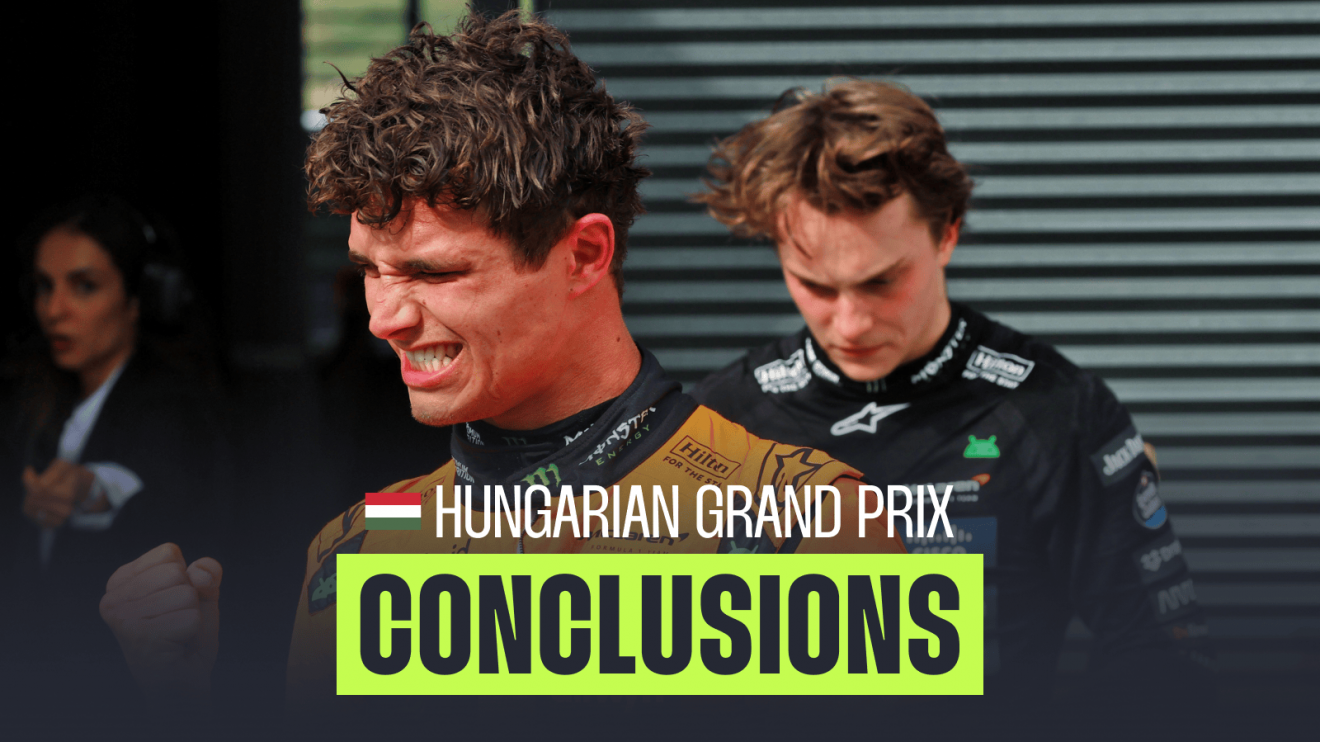
Lando Norris and Oscar Piastri are bringing the best out of themselves - and each other - in 2025
McLaren driver Lando Norris claimed his fifth victory of the F1 2025 season at the Hungarian Grand Prix in Budapest.
Norris utilised a one-stop strategy after a poor start to narrowly beat McLaren team-mate Oscar Piastri, with George Russell finishing third for Mercedes. Here are our conclusions from the Hungaroring…
Lando Norris and Oscar Piastri are driving each other to ever-greater heights
You raise your level and I’ll raise mine.
Even if that means you’ll raise yours even further still, I’ll raise mine again too.
The greatest and most gratifying rivalries in sport are built on that competitive dynamic, of two athletes not only pushing themselves to their own limits but also making each other better along the way.
Recall Ayrton Senna’s message over the radio to Alain Prost on the weekend of his death at Imola in 1994, telling him how much everyone in the paddock was missing him? It offered a snapshot of the sense of loss Senna himself felt with Prost’s retirement at the end of the previous season.
With Alain no longer around, Ayrton had lost the yardstick by which he had measured his own level for close to a decade.
For all the disagreements and tensions between them over the years, fundamentally Senna needed Prost just as Prost needed Senna.
One was diminished, his achievements deprived of meaning, without the other.
Styles make fights, they often say in boxing.
History tells us that the same is very much true, even with the obvious added technology factor, in F1.
Anyone who has studied the current McLaren drivers for any length of time should know the deal, and the differences in style, by now.
Oscar Piastri vs Lando Norris: McLaren head-to-head scores for F1 2025
? F1 2025: Head-to-head qualifying statistics between team-mates
? F1 2025: Head-to-head race statistics between team-mates
Lando Norris is almost certainly the faster one, the potential superstar and the one touched by magic, yet with gaping weaknesses when it comes to his temperament.
Oscar Piastri? Touched by a slightly different, more subtle sort of magic. Understated. Uncomplicated. Low key.
One of those racing drivers from the good ol’ days your parents would tell you about – think Jim Clark opting for the quiet life on the farm between races – brought back to life and thrust into the 21st Century.
Probably not quite as quick as Norris on balance, but not far away either. And, crucially, born with the psychological stillness his team-mate has sorely lacked to date.
They complement each other beautifully, strong in different areas but both a credit to the team they represent.
Such is the culture that McLaren has imposed – making it clear to the drivers that “bringing the house down” (Oscar’s words) would help nobody – Norris and Piastri have ended up becoming F1’s answer to Roger Federer and Rafael Nadal in 2025, never allowing the rising sense of competition to compromise the mutual respect between them.
It is why Piastri can climb from his cockpit at the end of 70 laps, look Norris in the eye, smile with sincerity and congratulate him on winning the Hungarian Grand Prix, having probably – and like many others – dismissed him as a contender for victory earlier in the race.
There was a time, and not too long ago, that Norris would meekly fade away for the rest of the afternoon after the sort of start he had on Sunday.
Yet his recovery – guiding a set of hard tyres through 39 laps, pushing where possible yet ensuring there was still enough life left in them to repel Piastri’s advances later on – was impressive in its inch-perfect execution.


Where did Lando’s resilience come from after that start? And barely a week after blowing the Belgian Grand Prix with a series of unforced errors?
Simple: the level Oscar is operating at is making Norris rise with it and become a stronger, more complete driver too.
And doubtless over the summer break Piastri will reflect on what he could have done differently here – stay calm and save the final attempt on Norris until the last lap, maybe? – to ensure that he comes back better than ever before at Zandvoort.
There has been some debate over recent weeks about this year’s title fight lacking an unidentifiable something – call it an edge – certainly compared to what came in 2021.
Is it the personalities at play? The team’s tentacles keeping control of the situation?
The fact that Norris and Piastri are still early in their careers, still incomplete in many ways and not the refined, established, uncompromising winners Hamilton and Verstappen were then?
A Max vs Lewis grudge match this may not be.
Some may not yet even consider it a rivalry in the traditional sense of the word.
Yet there is something uniquely alluring about this good-natured contest between two talented, humble, self-critical racing drivers propelling each other to new and ever-greater heights.
Shame, in some ways, that there has to be a winner and a loser at the end of it.
The big worry? Lewis Hamilton’s failures have lost the shock factor
Here’s a tip for the next time you visit a grand prix and find yourself sitting in the main grandstand: keep a close eye on the pit lane roughly halfway through qualifying.
Chances are you’ll see what was once considered the eighth wonder of the world, but has become an increasingly regular sight on Saturday afternoons.
You’ll know it when you see it.
Look out for a ghostly figure dressed in red. Yellow helmet. Walking – no, creeping – slowly. Head lowered.
Body language best described as a cross between downbeat and bewildered.
Usually spotted somewhere between the Ferrari garage and the FIA’s weighing area, having left its natural habitat at the end of last year.
There, more often than not these days, you will witness the Hamilton Shuffle in all its ingloriousness.
There was once a time when the failure of Lewis Hamilton to reach Q3 was regarded as the biggest surprise of a race weekend.
Now? Not so much.
As Lewis himself put it moments before springing the Hamilton Shuffle into action for a third successive qualifying session on Saturday: “Every time. Every time.”


If it wasn’t for his highly emotional reaction to his Q2 exit on Saturday – repeatedly referring to himself as “useless” and suggesting Ferrari should consider replacing him – 12th on the grid might have been greeted with a mere shrug of the shoulders, par for the course at this point.
Of all the knocks Hamilton has suffered over the course of this unedifying season – over the course of the last three-and-a-half unedifying years, in fact – Hungary qualifying was among those to cut the deepest.
It’s one thing to be cast away by a car’s limitations and underperform on the days when it is uncompliant.
But when that car is competitive enough – albeit largely thanks to the conditions – to set pole position in the hands of his team-mate? On a circuit where Lewis has excelled historically?
These are the moments that a driver has no choice but to accept that the problem isn’t with his tools, but with him.
These are the moments that begin to chip away at a legacy.
How many more punches is he prepared to take?
The Max Verstappen investigation: A function of F1’s overinflated racing rulebook
Haven’t you heard?
Lewis Hamilton did not appear in the post-race investigation hearing into the ‘incident’ with Max Verstappen at Turn 4 after waiving his right to attend.
The reason for Hamilton’s absence remains unclear at the time of writing, yet few would have blamed Verstappen if he had not bothered turning up either.
That such a non-event made it as far as the stewards’ room in the first place was an abomination and a function of F1’s overinflated rulebook.
As sports like football/soccer have turned to video technology over recent years, one of the more common complaints is that the authorities now look for more reasons to disallow goals than to let them stand.
F1 has risked going the same way ever since the infamous ‘Driving Standards Guidelines’ – put together by the FIA and the stewards with input from the drivers and only recently shared with the public – were updated late last season in response to the clashes between Verstappen and Lando Norris in Austin.
The first response now is not to stand in awe of a nicely executed overtake, but to thumb through those painfully restrictive rules in search of ways to A) chalk it off, and B) dish out a penalty.
As a general principle, it is never a good idea to impose too many rules on things that reward creativity, intuition and ingenuity.
It should not require a list of commandments engraved on slabs of stone to determine whether an overtake is illegal or not, but such qualities – increasingly absent among sporting bodies today – as common sense and astute judgement.
Most seasoned observers of motor racing, let alone former professional racing drivers present on the stewards’ panel, can tell within seconds whether a move crossed a line.
In the end, after hearing from Verstappen and the unnamed Ferrari team representative, who, according to the official verdict, seemed to indicate that Max was blameless, the stewards eventually came to a decision most watching from home had reached moments after the Red Bull emerged from Turn 4 ahead.
No contact and nothing to see here.
But everyone knew that already, didn’t they?
Apart, of course, from the stewards.
The skill is still there, but is Fernando Alonso’s body beginning to fail him?
It would complete the tragedy of Fernando Alonso’s last decade if his powers were to desert him just as he finally receives the car of his dreams.
Having spent so long refusing to stop chasing that setting sun in inferior cars, it would be nothing short of disastrous if he proved unable to exploit to its full potential whatever Adrian Newey provides him next year.
The shorter nose Aston Martin brought to Belgium last week appeared to be the first little sprinkling of Newey’s fairy dust, likely a direct product of all those “lunchtime conversations” in between his work on the 2026 car.
The impact of the upgrade was well hidden at Spa, a circuit fundamentally unsuited to a car so draggy over the last few years that it would not look out of place alongside RuPaul and the gang.
Different story in Hungary, where Alonso and Lance Stroll were both little more than a tenth away from pole position before sealing the team’s best result so far this season with fifth and seventh on merit.
The skill and the spirit, that Alonsonian knack of always seizing those days when opportunity knocks and a result is there to be had, are evidently still there.
But – whisper it – is Fernando’s body beginning to fail him?
Of greater concern in Budapest was the latest in a growing number of physical complaints over the last 12 months, on this occasion the management of a muscular injury in his back that persuaded him to sit out the first practice session.
You might recall that he was the walking wounded at the end of last year, old Fernando, struck down by various ailments across the final two triple-header bursts.
First there was the intestinal infection that forced his to miss two consecutive Thursdays in Mexico and Brazil; then came the sad sight of him hobbling around parc ferme at Interlagos after a particularly bumpy ride, then the reveal in Abu Dhabi that he’d hurt his shoulder in Brazil too.
It seems quite safe to conclude that the physical strains of this furious run of races to conclude the first half of 2025 have once again taken their toll on Fernando, who turned 44 last week.
As he discussed his shoulder injury at the end of last year, Alonso spoke of the need to be “more prepared physically” for the 2025 season.
Not because he was in any way unfit in 2024, per se, but because his advancing age dictates that he must push his body harder than ever just to keep up with competitors young enough to be his children.
The mind is as sharp as ever. The talent remains mostly undiminished. But is the body still willing?
Upon that question hinges Fernando’s hopes of a final flourish in 2026.
Even the great Fernando Alonso, try as he might, cannot outrun Father Time.
Gabriel Bortoleto is fast emerging as a future star
Not only does Fernando Alonso still have the talent, but he clearly has an eye for it too.
Nico Hulkenberg may have got the podium he waited all his life for at Silverstone, yet increasingly it seems that Gabriel Bortoleto is the coming man at Sauber/Audi.
Hungary marked Bortoleto’s fourth Q3 appearance in the five qualifying sessions (including Spa sprint qualifying) since Austria.
In the same period, Hulkenberg has progressed from Q1 just once (14th for the main race in Belgium).
Ignore Hulkenberg’s third place at Silverstone (if you dare) and Bortoleto has made him look distinctly second rate – Nico’s false start in Budapest was a poor mistake – over recent weeks.
It should perhaps be no great surprise that after racing at unfamiliar venues (China, Suzuka, Miami, Canada) at the start of 2025, Bortoleto has come to the fore at the heart of the European leg of the season.
Despite his enormous success in the junior categories, which included matching Oscar Piastri’s achievement of winning the F3 and F2 titles in consecutive years, Bortoleto was among the more unfancied debutants at the start of this season.
Partly due to the low expectations for Sauber in 2025, no doubt.
Partly also as a result of the immense focus on Andrea Kimi Antonelli and Oliver Bearman, the princes of Mercedes and Ferrari.
Yet also thanks to reservations over his own ultimate potential and Helmut Marko’s unflattering description of him as a B-class driver on the eve of the season opener in Australia, seemingly based on the efficient rather than commanding nature of his F3 and F2 title triumphs.
Like Marko’s own great revelation Isack Hadjar, second to Gabriel in F2 last year and another rookie to arrive in F1 with no great fanfare, Bortoleto is proving the doubters wrong too.
Read next: Winners and losers from the 2025 Hungarian Grand Prix