

The five most embarrassing disqualifications in F1 history


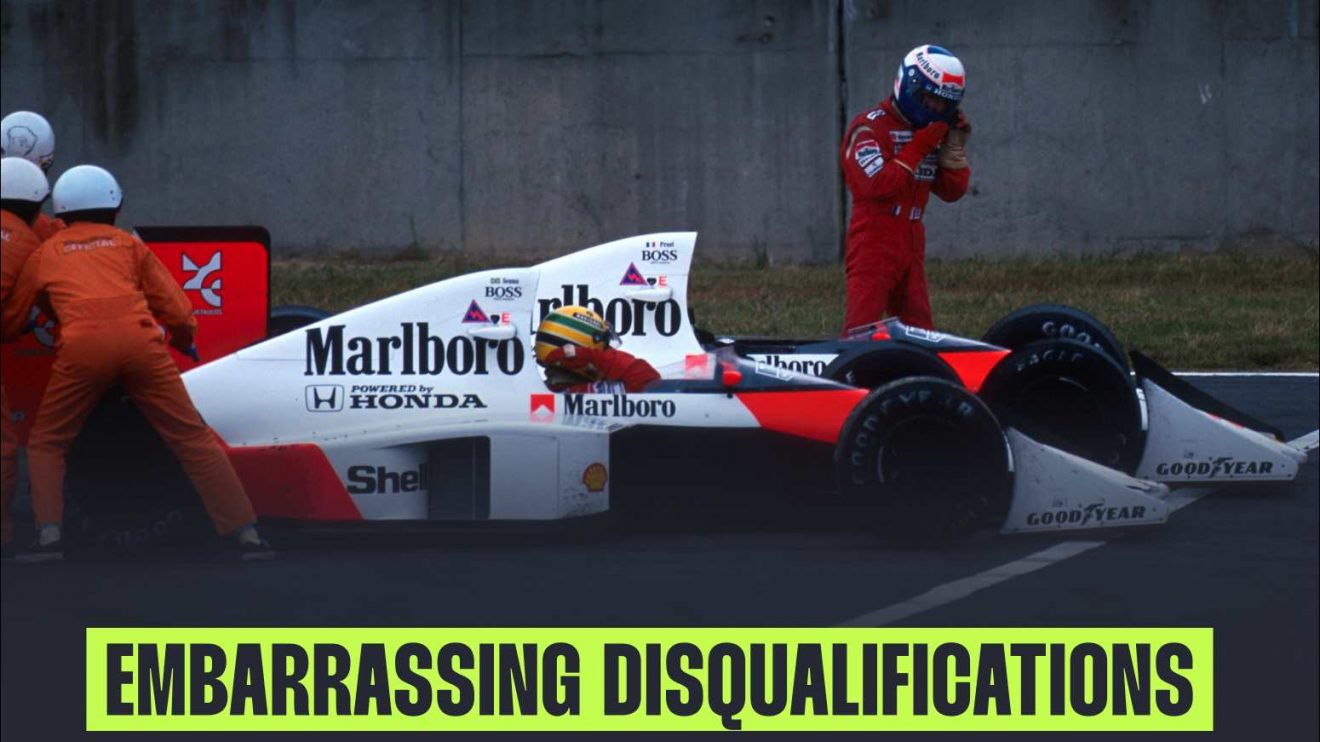
Ayrton Senna colliding with Alain Prost in the 1989 Japanese Grand Prix led to one of Formula 1's most embarrassing disqualifications.
A disqualification is never anything to be proud of in Formula 1 — but some are far more embarrassing than others!
Most disqualifications center on team-wide infractions: An excessively worn skid plank, an underweight car, an illegal change. But today, we’ve rounded up the five most embarrassing DSQs in Formula 1 history.
The five most embarrassing disqualifications in Formula 1 history
A helping hand
- The driver: Nico Hulkenberg
- The team: Haas
- The race: 2024 Sao Paulo Grand Prix
- The infraction: Receiving outside assistance
The 2024 Sao Paulo Grand Prix in Brazil was a chaotic one. Weather forced qualifying to be postponed to race day, and that session alone was plagued by five different red flags. By the time the race was started, it was clear things would be a bit crazy.
After an aborted start, a spin by Lance Stroll, additional formation laps, and a tenuous green flag under wet conditions, Nico Hulkenberg’s Haas spun on Lap 27 and ended up stuck.
Kind-hearted marshals flocked to the scene to give him a push despite Hulkenberg’s protestations, not realizing they were engaging in an act that would ultimately get Hulkenberg black-flagged.
As such, Hulkenberg was the first driver to be black-flagged during a race since the 2007 Canadian Grand Prix, when Felipe Massa and Giancarlo Fisichella were disqualified for exiting the pit lane while the red light was on.
A few untruths…
- The driver: Lewis Hamilton
- The team: McLaren
- The race: 2009 Australian Grand Prix
- The infraction: Lying to stewards
During the 2009 Australian Grand Prix, McLaren driver Lewis Hamilton was caught up in something of a lying scandal.
Reigning World Champion Hamilton passed driver Jarno Trulli under safety car conditions when Trulli’s Toyota skittered off the track. That alone was no major concern — but it would be what happened afterward that caused the disqualification.
McLaren informed Hamilton that he had passed Trulli under safety car conditions and should let the driver by — and Hamilton did so at the exit of Turn 4 while the race was still neutralized by the safety car. Technically, that meant Trulli had overtaken Hamilton illegally, and he was hit with a 25-second penalty that dropped him from his podium position.
The problem was that McLaren and Hamilton both told stewards that there had not been any radio communication involved. The stewards penalized Trulli under the belief that Trulli had passed Hamilton illegally; in reality, Hamilton had let Trulli by.
It wasn’t until the subsequent race in Malaysia that the lie was discovered. Hamilton was disqualified from Australia as a result, while longtime McLaren sporting director Dave Ryan was sacked. It was a DSQ that could have been entirely avoided had McLaren been honest with stewards from the start.
More records from Formula 1 history:
? The unfortunate holders of the most unwanted records in Formula 1
? Revealed: 10 crazy F1 records that will never be broken again
The controversial collision
- The driver: Ayrton Senna
- The team: McLaren
- The race: 1989 Japanese Grand Prix
- The infraction: Rejoining the track illegally (after hitting Alain Prost)
The penultimate round of the 1989 World Championship remains one of the most controversial in Formula 1 history. Heading into the race, title rivals Alain Prost and Ayrton Senna were separated in the championship by 16 points, both desperate to secure the honor. To do so, Senna needed to win in Japan.
While Senna had qualified on pole, it was Prost who pulled into the lead of the race in the first corner. The Frenchman pulled out a strong lead, only for the Brazilian to whittle that down to nothing on Lap 40. Senna fought hard, but Prost seemed unpassable.
Then, as Lap 46 came to a close, Senna lunged on the inside of Prost’s machine. Both drivers smacked together; Prost sustained suspension damage and abandoned his car. Senna, though, received a hand from marshals to restart his stalled Honda engine before cutting across the chicane, dipping into the pits, and dashing back onto the track to cross the finish line in first place.
The collision itself was shocking — but so was what happened in the aftermath of the race. Stewards, unimpressed, declared that Senna was to be disqualified from the race for cutting the chicane and slapped him with a $100,000 penalty.
That move handed the World Championship to Alain Prost with one race remaining in the season.
The bad driver
- The driver: Takuma Sato
- The team: BAR Honda
- The race: 2005 Japanese Grand Prix
- The infraction: Dangerous driving
Japanese racer Takuma Sato racked up three disqualifications during his tenure as a Formula 1 driver, but perhaps his most embarrassing came at his home race in 2005.
A dramatic start to the race saw Sato run wide into the gravel, then get side-swiped by Rubens Barrichello — an incident that Sato emerged from relatively unscathed. A safety car for Juan Pablo Montoya followed, but on Lap 10, Sato attempted an overtake on Jarno Trulli that… never could have paid off.
Trulli spun and was forced to retire; Sato finished the race, but he was slapped with a disqualification after the checkered flag.
“I think we have a dangerous person on the track and we have seen that for a few years,” Trulli told ITV at the time. “The [FIA] has to take action because his move was impossible.”
Another embarrassing DSQ came for Sato at the 2006 Chinese Grand Prix, when he was cut from the final results for ignoring the blue flags that told him a faster car was behind. Various other DSQ-free incidents involving Sato made him enemy No. 1 for many drivers.
An illegal start
- The driver: Hans Heyer
- The team: ATS Penske
- The race: 1977 German Grand Prix
- The infraction: Starting a race he did not qualify for
Modern Formula 1 fans are likely unfamiliar with driver Hans Heyer, but if they have heard of his name, it’s because of his disastrous 1977 German Grand Prix.
That event was Heyer’s first (and would ultimately be his only) attempt at Formula 1; he was something of a local hero in various regional touring car programs and had tried his hand at major events like the 24 Hours of Le Mans. German team ATS had acquired some old Penske Racing chassis, and it brought Heyer in for a shot.
Because more drivers had entered the race than could take the start, Heyer would need to qualify — and he failed to do so.
The start of the race was chaotic; the standard lighting system to denote the race start had been damaged, which resulted in the German flag being used to start the event, and it seemed that many drivers failed to get the memo.
Several drivers piled up… and Hans Heyer seemingly took advantage of the chaos to sneak his ATS Penske out onto the grid.
After nine laps, he retired with mechanical failure, at which point the stewards realized Heyer had been out on track illegally and promptly disqualified him.
To date, he remains the only driver in F1 history to DNQ, DNF, and DSQ in the same race!
Read next: 10 totally true F1 facts that sound completely fake