

Explained: Why Piastri was penalised for SC infringement but Russell was not


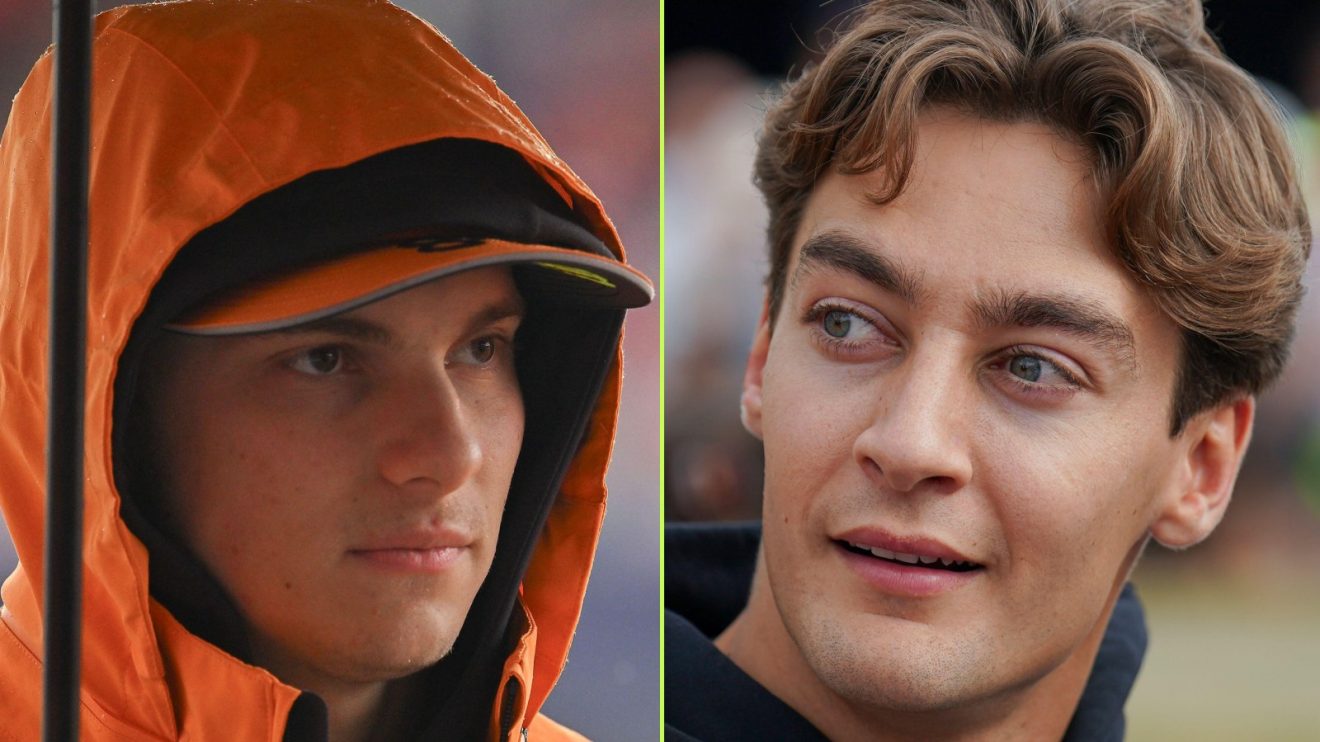
Oscar Piastri received a 10-second penalty for erratic braking which cost him British GP victory
Oscar Piastri missed out on British Grand Prix victory after the stewards issued a 10-second penalty for erratic braking.
Max Verstappen found Piastri’s punishment “strange” in comparison to what he experienced with George Russell in Canada – Verstappen the driver caught out both times – yet the stewards only deemed one instance to be a case of erratic braking, that being Piastri at Silverstone.
Oscar Piastri braked erratically, George Russell did not, say FIA
Additional reporting by Thomas Maher
Championship leader Piastri had been in control of a barmy and wet British Grand Prix, but just as the Safety Car – trigger by Isack Hadjar’s crash – confirmed it was on its final lap, Piastri’s victory chances took a critical blow.
When the Safety Car lights went out, Piastri hit the brakes, which caused Verstappen – running in P2 – to come sailing past, the stewards placing Piastri under investigation and soon issuing a 10-second penalty, which saw him finish runner-up to McLaren team-mate Lando Norris.
That was the second time in three races that Verstappen had been part of such an incident. At the Canadian Grand Prix, Russell – leading ahead of the Safety Car restart – had braked down the back straight, causing Verstappen to briefly overtake, though the stewards determined that Russell was not guilty of a Safety Car infringement.
Considering that Russell was not punished in that instance, Verstappen expressed surprise to see Piastri penalised at Silverstone.
Speaking to the media, including PlanetF1.com, Verstappen said: “The thing is that it happened to me now a few times, you know, this kind of scenario. I just find it strange. Then suddenly, now, Oscar is the first one to receive 10 seconds for it.”
Asked specially if the Piastri scenario was different to Russell’s, Verstappen responded: “Clearly to the stewards, yes.”
Indeed, the FIA stewards did look at the incidents very differently. In Canada, Russell’s braking was deemed to be standard procedure, but for Piastri, the British GP stewards panel thought he had braked in an ‘erratic’ manner.
Coupled with that, Piastri was found to have braked with more force than Russell, with a brake pressure of approximately 59psi used as Piastri reduced his speed from 218kph to 52kph in a short period, while Russell braked from 140kph to 85kph in Canada, meaning less of a sudden speed differential.
More key British GP talking points from PlanetF1.com
? Data suggests Oscar Piastri got unlucky with Safety Car penalty
? British GP Cooldown Lap: Hulkenberg shocks in Lando Norris win
It was only after a double Red Bull protest against Russell that his incident with Verstappen was addressed by the stewards, the document which they issued to dismiss the protest – regarding erratic braking and falling too far behind the Safety Car – explaining why Russell’s actions were deemed acceptable.
The FIA were represented by sporting director Tim Malyon and F1 race director Rui Marques for the protest hearing, the FIA document stating: ‘Mr Malyon explained that the incident had been observed by the race control team and assessed to not warrant being reported to the stewards.
‘He said that periodic braking under Safety Car is typical and to be expected. He said that for this reason, race control always allows a degree of tolerance with respect to the 10 car length rule recognising that there is a need for a reasonable degree of braking and acceleration.’
With the protest not upheld, the FIA declared: ‘Having regard to the evidence of Mr Malyon, we accept the driver of Car 63 [Russell’s] explanation of the incident and we are satisfied that the driver of Car 63 did not drive erratically by braking where he did or to the extent he did.’
Crucially, the British Grand Prix stewards were convinced that Piastri was guilty of erratic braking, which is why unlike Russell, he was not spared.
In addition to the 10-second penalty, the stewards also added two penalty points to Piastri’s Super Licence, taking him up to six for the 12-month period.
‘The stewards reviewed positioning/marshalling system data, video, telemetry, team radio and in-car video evidence,’ their Piastri verdict begins.
‘When the clerk of the course had declared that the Safety Car was coming in that lap and the lights were extinguished, Car 81 [Piastri] suddenly braked hard (59.2 psi of brake pressure) and reduced speed in the middle of the straight between T14 and T15, from 218 kph to 52 kph, resulting in Car 1 [Verstappen] having to take evasive action to avoid a collision.
‘This momentarily resulted in Car 1 unavoidably overtaking Car 81, a position which he gave back immediately.
‘Article 55.15 of the FIA Sporting Regulations required Car 81 to proceed at a pace which involved no erratic braking nor any other manoeuvre which is likely to endanger other drivers from the point at which the lights on the Safety Car are turned off.
‘What Car 81 did was clearly a breach of that article. In accordance with the penalty guidelines, we imposed a 10-second time penalty to Car 81.’
Piastri was perhaps a casualty of differing interpretations, as the stewards panel evolves from race to race.
In Canada, Gerd Ennser, Matthew Selley, Natalie Corsmit, Enrique Bernoldi and Marcel Demers served as the stewards for that Grand Prix.
Meanwhile, at Silverstone, the stewards panel was formed by Vitantonio Liuzzi, Nish Shetty, Mathieu Remmerie and Richard Norbury.
Ahead of the British Grand Prix, the FIA had moved to make its stewarding penalty guidelines available to the public, a document which showed that Piastri received the ‘baseline’ penalty for his breach.
Read next – FIA penalty guidelines: Which offences carry F1 penalty points and how many?


