

Data revealed: Key Hamilton mistake under scrutiny as massive opportunity missed


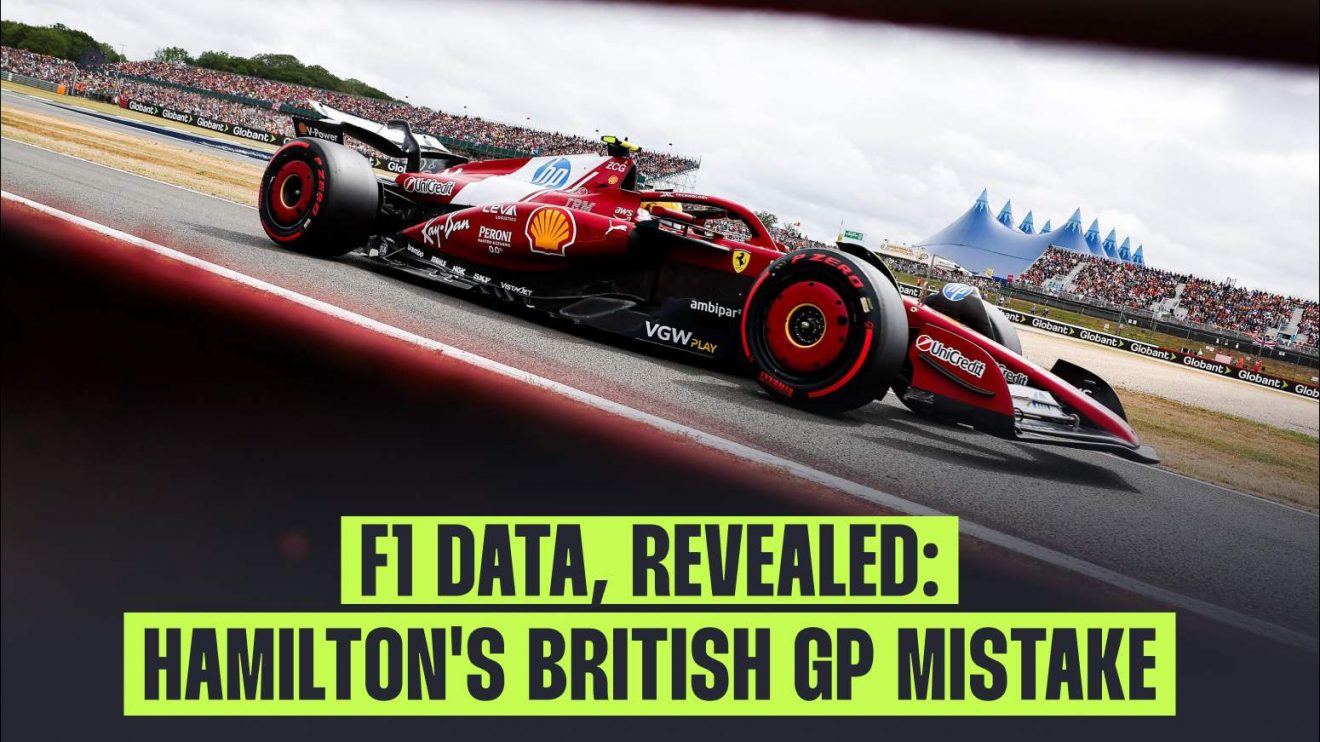
Data reveals one key mistake Lewis Hamilton made in qualifying for the British Grand Prix.
After Ferrari’s clear step forward with their recent upgrades — especially the changes to the car’s floor — it was no surprise to see them challenging for a spot on the front row in qualifying for the British Grand Prix, particularly given their strong pace in Q2 and the early stages of Q3.
But did Lewis Hamilton’s mistake in the final corner ultimately cost him a shot at pole position? The telemetry data gives us the clues we need to find out.
Did Lewis Hamilton and Charles Leclerc miss their best shot at pole?
After what has been a very slow start to the season for Ferrari, Silverstone looked like a prime opportunity for a strong result — arguably their best so far this year. If we set aside Charles Leclerc’s success in Monaco, the SF-25 hadn’t looked this competitive on track at any point in 2025.
Already after FP1 and FP2, it was clear Ferrari has found its way to the top, with their qualifying pace just one- or two-tenths off McLaren, and their race pace even stronger. At a circuit like Silverstone — where driver skill counts for more than at many other tracks — the fight was wide open.
Hamilton, of course, has a fantastic record here, with an incredible run of wins at his favourite circuit. Fans certainly felt something special might be on the cards.
That feeling only grew stronger during qualifying, especially after Hamilton topped the timing charts in Q2. His first Q3 attempt was solid, but there was still room for improvement. And indeed, in his second and final flying lap, the seven-time World Champion made gains in both the first and second sectors.
Unfortunately, an error in the final chicane saw him lose rear grip for a split second — and in qualifying, where margins are razor-thin, that was the difference between a potential front row and a P5 starting position.
Telemetry data allows us to calculate exactly where Hamilton might have ended up without that mistake. Let’s take a look.

By analysing the fastest laps of Verstappen and Hamilton, we can see exactly where the Red Bull driver built his advantage.
Verstappen was already gaining ground through the first two fast corners, opening up a gap of two tenths. Hamilton managed to claw that time back through Turns 6 and 7, leaving the two drivers practically level at that stage.
But then came the run towards Copse and the high-speed Maggots and Becketts section, where Verstappen carried significantly more speed and pulled out nearly four tenths of a second in his favour.
This, however, was mainly down to the different characteristics of their cars. Over the weekend, Red Bull opted to fit Verstappen’s car with a less-loaded rear wing, knowing it would give them a clear advantage in top speed.
That speed would come with a cost; the lower-downforce set-up would make the RB21 more difficult to handle in the high-speed corners, but it was a risk the team was willing to take.
In the end, it turned out to be the right call, as Verstappen’s brilliant driving allowed him to hold onto the advantage afforded by that higher top speed heading into Copse.
Hamilton did manage to reduce some of that gap through Stowe and again in the final corner, where, despite the mistake he made, he was still quicker than the reigning champion. The reason for that, once again, was the lower downforce setup on Verstappen’s car, which cost him valuable time in that part of the lap.
To understand just how much time Hamilton actually lost due to his mistake in the third sector, we can compare his final flying lap in Q3 with his first attempt.

By comparing Hamilton’s two Q3 laps — yellow line for the first attempt, red for the second — it’s immediately clear how much better his second effort was. He’d gained around two tenths by the final chicane, thanks in part to a superb exit from T4 where he managed to minimise the SF-25’s main weakness: rear-end instability on corner exit. His Copse speed was also significantly better the second time around.
But the white delta line shows where it all slipped away: Right at T16 and T17. Onboard footage reveals the Ferrari driver making several steering corrections just to keep the car on track. The telemetry data also clearly shows that Hamilton had to lift off the throttle more than he normally would through that final section.
From the data, we can see the error cost him about two tenths.
To be even more precise, we can calculate Hamilton’s ideal lap by combining his best first and second sectors from that final Q3 run with the third sector from his earlier attempt gives us a time of 1:24.899 — just 0.007s slower than Verstappen’s pole time.
So the conclusion is clear: without the mistake in the final corner, Hamilton would have secured P2, right on Verstappen’s heels. And had he matched the gains he made across the rest of the lap in that final section, he’d have been on pole.

The margins in qualifying this season are incredibly fine, and this is a perfect example of how the smallest error can see you slip down the grid. That said, seeing four different teams in the top five is brilliant for us as fans.
It’s also fair to say that Ferrari’s drivers probably missed their best shot yet to capitalise on their race pace and finally challenge for a win this season. Given the final outcome, doing so on Sunday will now be a much harder task.
Read next: British GP: Max Verstappen steals unlikely pole with Silverstone stunner