

Lewis Hamilton setback as telemetry data reveals British GP dark horse


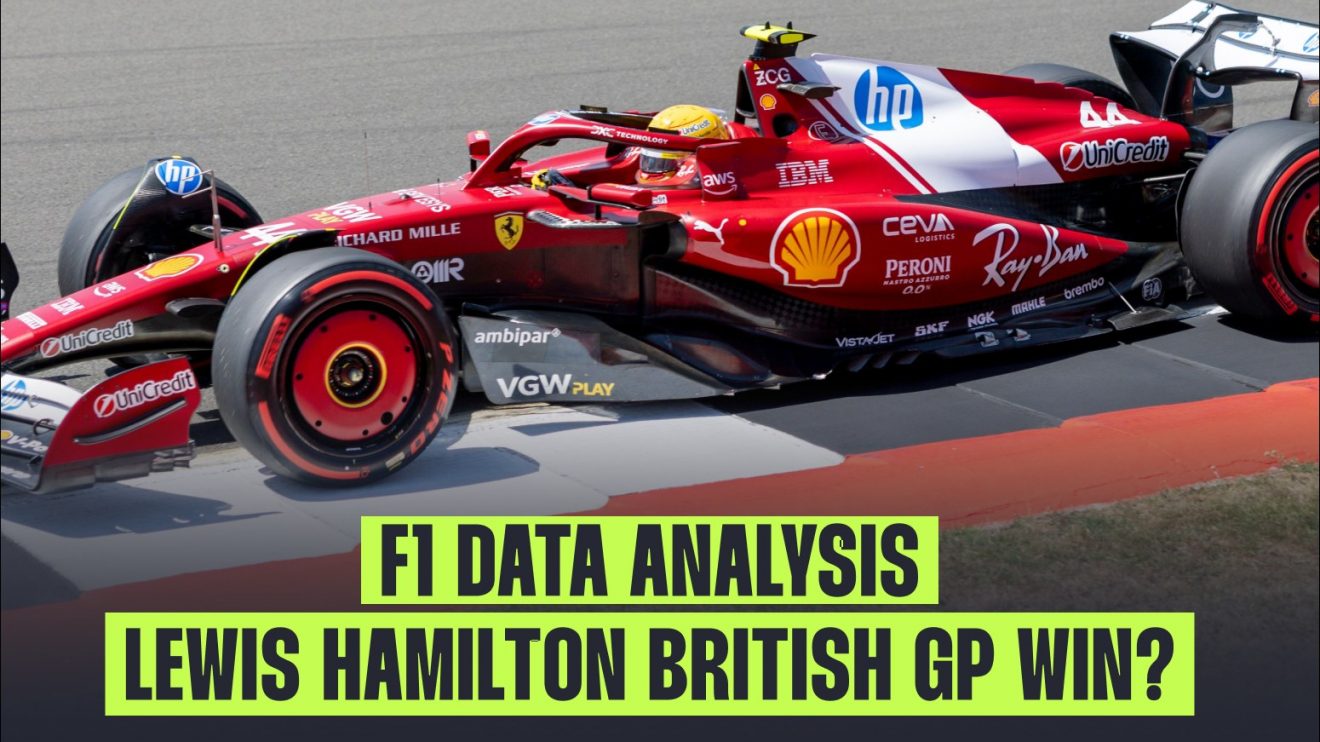
Can Lewis Hamilton win a 10th British Grand Prix?
After the first day of the British Grand Prix at the legendary Silverstone circuit, McLaren and Ferrari have emerged as the fastest teams on track so far — with Lewis Hamilton topping FP1 and Lando Norris setting the quickest time in the afternoon session.
This naturally raises the key question: can Ferrari pose a real threat to McLaren in the fight for victory? The telemetry data provides some answers.
Lewis Hamilton on top before Lando Norris strikes back
Although the first free practice session usually isn’t truly representative — with teams testing various setups and aerodynamic components — it was still notable to see Hamilton set the fastest lap after 60 minutes of running. His team-mate Charles Leclerc wasn’t far off either, finishing P4 and just two tenths behind.
Confirmation that Ferrari has indeed made progress, compared to what we’ve seen so far this season where they’ve rarely been the second-quickest team, came during FP2. In that session, Leclerc was second fastest, only 0.2 seconds behind Norris, with Hamilton in third, just three tenths adrift.
However, Silverstone is a very quick circuit that, on paper, should suit McLaren. The main reason for this is aerodynamic efficiency — it’s absolutely vital if you want to be fast here. Good downforce levels will give you better cornering speed through the quick bends, but the trade-off is increased drag, which reduces top speed on the straights. Go the other way and fit a lower downforce rear wing, and you’ll struggle through the corners.
That leaves engineers with a very tricky task to find the right balance — but if you’ve got the MCL39 at your disposal, the job is a lot easier thanks to the car’s superb aerodynamic efficiency, allowing you to be fast pretty much everywhere.
That’s why seeing any team so close to McLaren is a real sign they’re heading in the right direction. Ferrari has introduced major updates in recent races aimed at addressing the instability of the car’s rear end, and so far those upgrades seem to be paying off.
Since FP2 gave a more accurate picture of performance, we’ll focus on comparing telemetry data from that session.

F1 2025 head-to-head standings
? F1 2025: Head-to-head qualifying statistics between team-mates
? F1 2025: Head-to-head race statistics between team-mates
Comparing the fastest laps of Norris and Leclerc, we can see that Ferrari’s main deficit comes in the slower corners.
The biggest gap is through Turn 4, the slowest and probably most demanding on the circuit. Here, the difference in minimum speed at the apex is clear, with Norris gaining around three tenths just in this section. One factor behind Leclerc’s loss of time here was his team-mate, who arguably hindered him slightly at that point.
Leclerc also lost time in Turn 7, another slower corner. This time he was alone on track and his passage through the bend looked tidy enough — but the lack of downforce compared to the MCL39 told its story again.
On the positive side, the SF-25 showed great stability in Silverstone’s fast, front-limited corners — the kind that don’t overly punish rear-end instability, a key weakness for Ferrari all season. Through the high-speed complex of Turns 10 to 12, Leclerc clawed back small amounts of time, and he actually managed to cut his deficit by a hundredth of a second through Becketts.
In fact, if we look at the stretch from Turn 4 to the end of the lap, Leclerc was quicker overall — which suggests he might have topped the timesheets had he not been disrupted at T4.
The fact that Ferrari’s biggest losses came in the slow corners is underlined when comparing Hamilton and Norris as well. The delta graph showing their time gap follows a similar pattern, with the biggest drops appearing in Turns 4 and 7 — though Hamilton was even slower than Leclerc through Turn 7.

Hamilton also lost extra time through the final chicane (Turns 16 and 17), where a stable rear is crucial as you reapply the throttle — and that’s precisely what the SF-25 is still lacking.
What Can We Expect from Ferrari’s Race Pace?
Besides the headline lap times, FP2 gave teams — and us — valuable data on expected race performance.
One key difference from last year’s British Grand Prix is Pirelli’s softer tyre selection. This time, teams have C4 as the soft, C3 as the medium and C2 as the hard. In FP2, nearly everyone focused their long runs on the mediums, except Haas, who tested the hards.
The long-run data gave more cause for optimism, at least for Leclerc, as Hamilton seemed to struggle during this phase. Leclerc’s deficit to the front was minimal, even considering the mistake he made on his first lap of the stint where he pushed too hard and didn’t save his tyres as much as he should have for the rest of the run.
Even with that slip-up, and given the stint length, Ferrari looked as solid as ever in this category.

Hamilton, by contrast, complained of understeer throughout his (admittedly short) run, which led to significant graining. He also completed a short stint on softs, but it’s unlikely those tyres will be part of the race strategy. No other front-running drivers conducted long runs on softs, so those times don’t give much useful comparison.
From this data, we can see there’s no reason to count out Verstappen either — he looked quick despite his issues on single-lap pace. Mercedes seemed off the pace, but we should note their run was longer and we don’t know what fuel load they were carrying for their simulation.
As in the rest of the season so far, success will largely hinge on qualifying, and Ferrari do seem to have taken a step forward in that area. The gap to the McLaren drivers is still there, but with a bit of luck — and the Hamilton factor at Silverstone — anything could happen.
Read next: Christian Horner issues latest Verstappen update as Russell seat swap addressed


