

How McLaren sharpened the MCL39 into a versatile, all-circuit contender


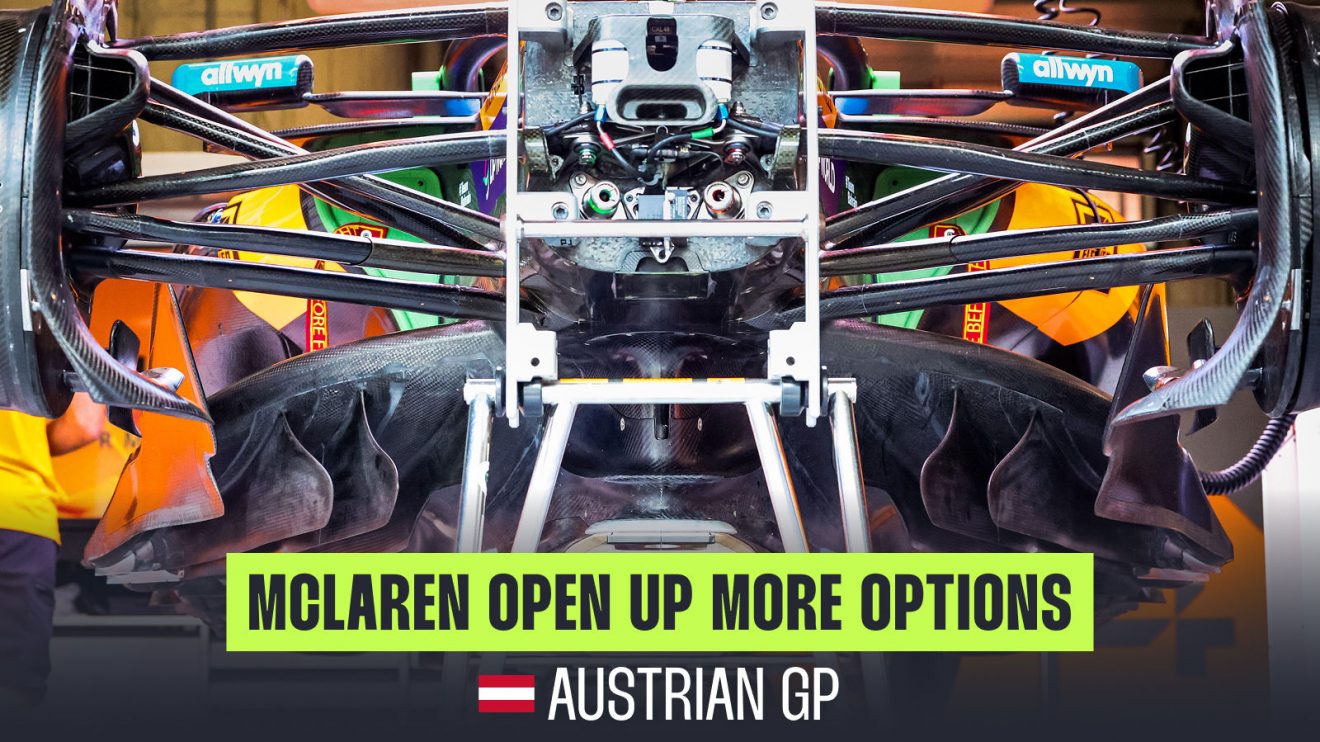
McLaren made a number of changes to the MCL39 ahead of the Austrian Grand Prix as the team looks to refine the car from both an aerodynamic and mechanical perspective.
The changes introduced at the Red Bull Ring centered on the suspension elements and their fairings, as the flow structures created by them have an impact on the bodywork up and downstream of them.
McLaren dial in the options at their disposal
The changes McLaren made at the front of the MCL39 were twofold, with the chassis and suspension fairing junctions amended in order to extract more aerodynamic performance.
It’s likely these changes are in response to the arrival of the new load and deflection tests, introduced in Spain, which results in the airflow cast from the front wing now following a slightly different trajectory.
Therefore, the designers want to correct the airflow’s passage along the car, with flow performance around and through the sidepods already exposed as a critical performance factor during this regulatory phase.

In this instance, the winglet-shaped fairings are now more loaded than before, resulting in them imparting more authority on the airflow. The shape of the lower rear leg also results in a small geometric change in the chassis too. The dotted lines on both the new arrangement in the main image and the old, inset, show how much curvature is present in the upgraded rearmost elements.
In response to the changes made to the front suspension’s layout in Canada, of which only Norris ran on that occasion, the team also made further changes to the front brake duct assembly, in order that they both work together more harmoniously from an aerodynamic perspective.
McLaren’s novel front suspension and steering arrangement has undoubtedly helped them in terms of extracting performance from their car this season.
However, there is a certain amount of compromise to be had. Improving their ride height control benefits this provides their floor and diffuser from an aerodynamic perspective, but it has resulted in a lack of feel for the drivers, especially when the car is on the limit.
This numbness, as the drivers have described it, is due to a lack of feedback coming from the car, with some of the motions usually associated with cueing the experience of braking and steering lost as a consequence.
More from the Austrian Grand Prix:
? Austrian GP conclusions: Verstappen’s Mercedes guarantee as Russell’s words come back to bite
? Austrian GP driver ratings: Norris’ perfect day and Tsunoda’s latest Red Bull nightmare
The updated components seek to return some of this feedback to the drivers without completely eroding the advantage their arrangement provides. Naturally, it was done with caution; McLaren’s technical director of engineering, Neil Houldey, explained that the team could have introduced this new configuration earlier in the season but wanted to be confident it had crafted an ideal solution.
“We’ve just made some small kinematic adjustments that we know will be better,” he explained. “They had some small negatives that we didn’t necessarily want to introduce at the start of the year.
“Running earlier on in the season gave us confidence that, actually, that wasn’t going to be a problem. So we were able to introduce this change without any real concern that it wouldn’t be any worse and should be better.
“With all of these things, we are trying to find the best of a number of different scenarios, and it was the same with the suspension. We were concerned in one area, we worked out that wasn’t a concern during the season, and you are just trading things to try and find the most optimum performance, which for Lando, we think we’ve now found.”
There were also changes at the rear of the car, as the team have identified areas where other teams have made gains and followed suit
“I’m not going to go into too much detail, but you’ll have seen up and down the grid that there have been a number of changes on the rear suspension of the car, so really suspension kinematics and this event we’ve just added something that we think will add a little bit more stability to the rear end, mainly on corner entry,” said Houldey.
Mermaid tails return

McLaren also reintroduced the front wing that they tested in Canada, which features what they have described as ‘mermaid tails’ in the outermost section of the wing (see above, left).
These mermaid tails work in conjunction with the flap tips, the geometry of which have also been altered as the designers look to influence the airflow and help generate outwash in a similar way to how the more curled variants on their old design, prior to the load and deflection tests.
After all, it’s obvious from the onboard footage that the upper flaps, which had moved around excessively on every team’s front wing, are now much less mobile as the load builds and decreases with speed, resulting in the outboard portion of the wing reacting differently too.
Not done with development, just yet…
As we draw ever closer to the halfway point in the season and with 2026 looming large on the horizon, it appears that McLaren have done a large proportion of the heavy lifting in terms of the larger development set pieces but that’s not to say they’re completely done with development on the MCL39.
As was the case with its predecessor, the team are now investing more of their development on finding performance on a race-by-race basis, with solutions being switched out accordingly, as explained by Houldey
“It’s not just aerodynamic options now,” he said.
“Actually, we are at the point where we are still putting base aerodynamic load on the car. You’ve seen some of these upgrades that have come, and you’ll see some in the future, but actually we are now at a point where more and more those options add performance at some events but actually would negative at others.
“I’d say throughout the front suspension, rear suspension, front wings, rear wings, there are many different things that we can now change event to event.”
Read next: McLaren’s Austria charge proves its racing spirit is the attitude F1 needs