

The Pikes Peak International Hill Climb is a reminder of where Formula 1 comes from


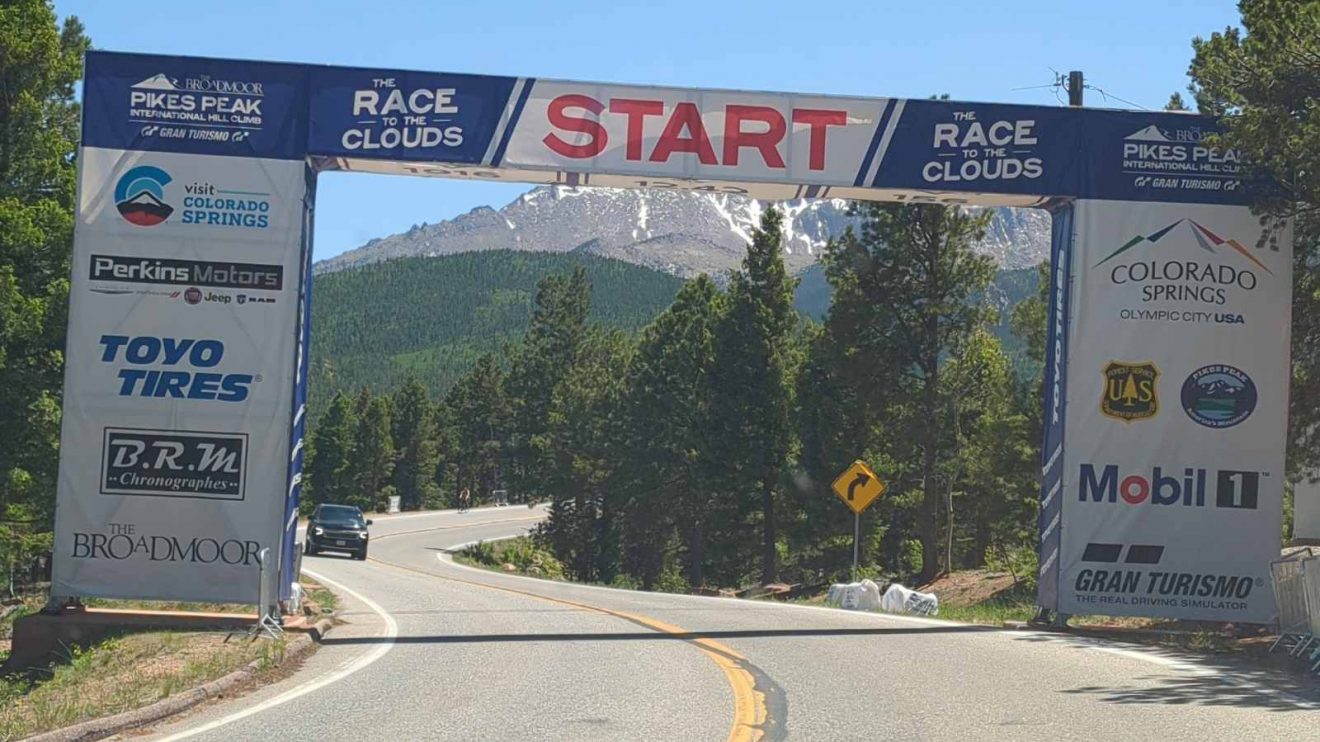
The start line for the Pikes Peak International Hill Climb.
Back in 1916, an audacious businessman named Spencer Penrose organized the first major racing event in his home state of Colorado: The Pikes Peak International Hillclimb. The event just completed its 103rd running, and we were lucky enough to be in attendance.
While the PPIHC may seem worlds away from modern Formula 1, the art of hill climbing used to play a major role in the development of many F1 drivers’ skills. Out in Colorado, we were able to experience the pinnacle of this form of motorsport and attempt to situate it within the greater racing landscape.
When hill climbing was a path to Formula 1
Modern motorsport grows increasingly specialized with each passing year; drivers are getting younger, starting out at ever earlier ages, and honing their talents toward one specific goal well before they even hold a road license. For aspiring Formula 1 drivers, that means getting behind the wheel of a kart as a child and battling fiercely through a complex tier of junior open-wheel categories in hopes of making it to the big leagues.
But that wasn’t always the case for F1. Back in its earliest, formative years, the sport was composed of drivers who got their start behind the wheel of their family’s tractors, on the back of a friend’s motor scooter, or in a road car. And for many drivers with humbler roots, hill climbing was often their first taste of competition.
A hill climb is concept simple in design but challenging in execution. Drivers are tasked with driving as quickly up the side of a steep hill or mountain as quickly as possible — one that often features tight turns and switchbacks. Whoever climbs to the top the quickest is declared the winner. It sounds easy, but anyone who has tried to navigate a mountain pass at any speed will know how challenging it can become.
It was on those mountain sides — often behind the wheel of lightly converted road cars — that some of F1’s icons cut their teeth.
Giuseppe “Nino” Farina, Formula 1’s first-ever World Champion, learned how to drive when he was just nine years old but didn’t begin racing until he purchased a used Alfa Romeo to enter in the 1925 Aosta-Gran San Bernardo Hillclimb — which he entered in hopes of beating his own father!
Juan Manuel Fangio, one of F1’s most iconic figures, grew up in Argentina, where permanent circuits were unheard of throughout his childhood. He learned his impeccable car control competing in long-distance rallies that, while not explicitly branded as hill climbs, featured thousands of kilometers of terrifying, high-speed jaunts up and down the sides of South American mountains.
Jim Clark, though, is perhaps one of the best-known drivers to transform his hill climb career into Formula 1 success.
Born to a humble farming family in Fife, Scotland, Clark simply didn’t have easy access to major motorsport venues — but that didn’t mean he didn’t crave speed. Behind the wheel of his very own Sunbeam-Talbot, Clark honed his skills at local road rallies and hill climbs; even after he joined Formula 1, it wasn’t uncommon to spot him at those more localized events.
As F1 cars crew more technically complex, and as the sport grew more professionalized, the sport’s ties to local grassroots racing began to fade.
More from Formula 1 history:
? The ultimate F1 beginner’s guide: Everything you need to know to watch a Grand Prix
? A history of F1 ownership: How F1 has changed hands over the decades
But this year, we had an opportunity to attend the Pikes Peak International Hill Climb — an event in Colorado founded back in 1916 and run 103 times since. Here, hill climbing is still a widely respected discipline, with many drivers seeing the complex run up the mountain as being the pinnacle of motorsport.
There, we had a chance to speak with Loni Unser. If you recognize that surname, it’s for good reason: As well as taking victories at major events like the Indianapolis 500, the Unser family has been competing at Pikes Peak for generations — starting with Loni’s great-grandfather and his brothers well before the PPIHC was actually formalized into an event.
Despite growing up around motorsport, Unser didn’t get behind the wheel until she was 18 — and thanks to her fear of heights, it took her even longer to entertain the idea of racing up the side of America’s Mountain. Yet after she purchased a ticket to the event as a spectator, she instantly understood the appeal and set to work putting together her program to compete at the PPIHC.
If anyone was able to share their perspective on the evolution of hill climbing within the greater context of motorsport, it would be someone from the inimitable Unser family.
“All I can hope for is that it will always have a strong place in motorsports,” she told me of hill climbing.
“I really think it’s the purest form of driving, and I think people who like to do hill climbs just love driving for the drive. Whereas road racing is more about wheel-to-wheel racing, and that’s why a lot of people do that. This is really just all genuinely for the love of driving.”
There must be a genuine love, because the event is grueling. Drivers must arrive at the mountain in the bleary hours of early morning — our call-time was half past midnight — and mentally prepare to make the full 12.42-mile run to the summit at speed for the very first time that year; because the road is open to the public, there is no opportunity to practice runs to the peak until it’s time to launch into action. And when you arrive at the top, anything could be waiting for you.
Unser admitted that part of her love for the PPIHC came from the unique engineering challenge presented by the race.
“On a regular race track, you have a known condition,” she explained. “It may change a little bit weather dependent, but all in all, you’re gonna be staying within the same couple mile radius.
“Whereas here you’re driving 12 miles up a hill to 14,000 feet, and everything changes so drastically.
“The first year I ran here, it was absolutely pouring rain at the bottom, pretty clear at the middle, but sucked in fog at the top, so you have to be ready for anything — and your car has to be ready for anything, too.
“Your car has to be able to adjust to the altitude, the lower air density. It has to have enough power to climb the hills, and in this new age of racing the Pikes Peak Hill Climb, the top section is terribly bumpy.”
That’s a much different condition when compared to the lower end of the track, which has unique characteristics.
Unser told PlanetF1.com, “You have to make your car good for the lower section, which is super fast and flowy and very much like a race track. Then you have to make it good for the middle section, which is just a race between hairpins — but a lot of people don’t take that middle seriously enough. They don’t realize how much they can gain or lose in that section, and it’s a really challenging point because the cars like to overheat in the middle section there.
“Then the top section is so bumpy that you want your car high enough over the bumps so it doesn’t bottom out, but low enough in the lower sections that it’s quick and it’s not gonna handle poorly.
“There’s just so much to it that makes it so cool.”
Though the hill climbing world may feel far more insular than the global circus of F1, it still presents its own unique atmosphere and its own engineering challenges that even F1 designers may be challenged to overcome. But one trip up the mountain at the Pikes Peak International Hill Climb, and it’s clear just how critical those mad dashes up elevation could have been for aspiring Grand Prix racers of a bygone age.
Read next: Christopher Polvoorde’s 27 miles to heartbreak at the Baja 1000