

South Africa Grand Prix: Separating F1 hype from depressing reality


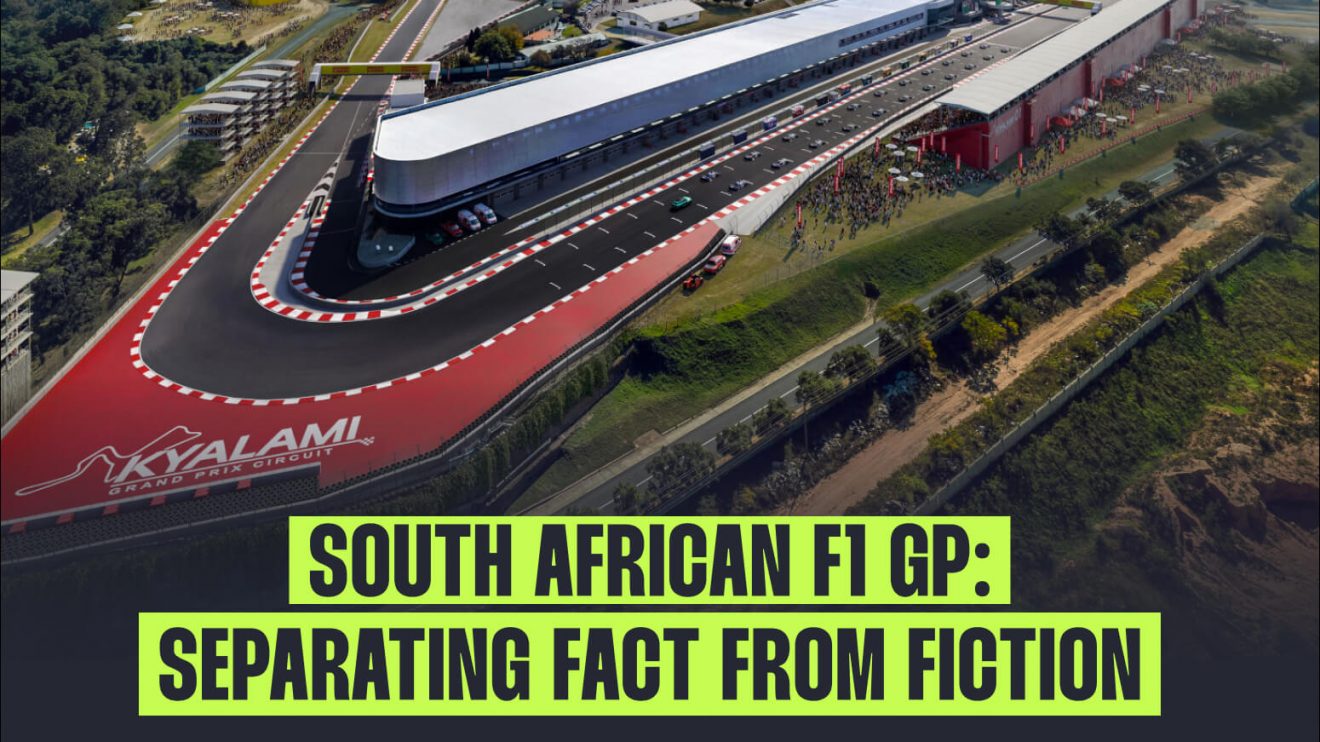
Can South Africa host a F1 Grand Prix?
‘South Africa moves closer to hosting Formula One race’, celebrated the headlines this week, with ‘Formula 1 lining up for a major comeback in South Africa’.
It was the news Formula 1 fans up and down the country had been waiting to hear for years, if not decades.
A Formula 1 Grand Prix in South Africa? Fact or fiction?
Kyalami, the last African circuit to host a Grand Prix, doing so in 1993 before finances and politics saw the race pulled from the F1 calendar, announced that it had been given the green light by the FIA, the International Automobile Federation, to implement design proposals to bring the circuit to up a Grade 1 facility.
“Today, we turn the page to a bold new chapter for Kyalami. We are ready for the return of Formula 1 to African soil,” said circuit owner Toby Venter.
“When we acquired Kyalami in 2014, we made a commitment to restore it, not just as a world-class venue, but as a beacon for motorsport across Africa.
“The acceptance by the FIA of our Grade 1 design is a major step forward in that journey.”
But reading between the lines, it’s not quite as simple as that.
‘The FIA’s written acceptance of the amended design marks a significant achievement. Once the capital works are completed and a final inspection is conducted, Kyalami will become Africa’s only FIA Grade 1 circuit, capable of hosting Formula 1 on the African continent.’
All sounds promising, right?
More on F1 circuits and the calendar
? Revealed: The 19 FIA Grade 1 circuits not currently used by Formula 1
? F1 2026 to begin in Australia, beloved circuit axed as 24-race calendar announced
But never let it be said that anything in life, especially in South Africa, is easy.
The press release continues: ‘Selected works will be actioned pending the successful outcome of South Africa’s place on the Formula 1 calendar and Kyalami being selected as the preferred hosting venue.’
So Kyalami is saying ‘pick me and I’ll do the work’, and the FIA are saying ‘do the work, pass the inspection and then you’ll be capable of hosting a Grand Prix’.
Not really much closer to a major comeback, is it?
Kyalami is, it’s understood, the preferred venue should Formula 1 return to South Africa, but it’s not the only candidate given Minister of Sport, Arts and Culture, Gayton McKenzie, has not announced who won the bidding process.
Back in January this year, the bidding deadline for that was pushed back to 18 March, at which time McKenzie’s department said, “We intend to evaluate the bids and conclude this phase of the process by the end of April 2025.”
Almost two months has passed since that April deadline and the country is waiting to hear the outcome. So too is Kyalami.
“The Bid Steering Committee is doing its work, and we can’t speak on its behalf. But unfortunately, for this to go forward government has to engage a Formula 1 map,” Venter said.
“That has not happened yet. Other countries have taken the lead around the world, where the government has paid a deposit to Formula One Management in entering a memorandum of understanding.
“We are waiting for government to play its part.”
“We will not be the roadblock,” added Clive Bowden, director and founder of Apex Circuit Design, which is involved in the Kyalami upgrade. “If the process is held up, it will be something outside our control.”
South Africans are waiting for the higher-ups to do something, I feel like this is a story I’ve read before. And it has far too many chapters. Chapters riddled with decades of political turmoil, equality struggles, poverty, and corruption.
You only have to look at this week’s headlines to understand the scale of the problem, as SA’s Minister of Justice and Constitutional Development has ordered all of her own prosecutors at the National Prosecuting Authority to undergo lifestyle audits.
The sour taste that leaves behind flavours every aspect of life in South Africa.
It also has one pondering why, three months after bidding closed and two months after an answer was expected, with three candidates submitting applications – Kyalami, Cape Town, and a yet-to-be-built circuit near the Fisantekraal airport, the winning bidder has not been announced.
Were none of the three good enough? Did they not meet government standards? F1 standards? Or…? Or is it simply that the money is just not there?
Formula 1 hosting fees are exorbitant, with Azerbaijan, Saudi Arabia, and Qatar paying the highest hosting fees of an estimated $55 million per year. In South African rands, that’s R993,679,500.
Without sponsorship, government support or subsidies of some sort, that means the average ticket at Kyalami would have to go for over 12k – half the average South African salary in a country where almost 20 per cent of the people live below the world’s poverty line. And that’s just taking only the hosting fee into account, not the added costs of hosting a Grand Prix such as extra police and traffic protection, which will definitely be needed in South Africa.
Interestingly, South Africa’s UFC star Dricus du Plessis recently spoke out about the cost of South Africa hosting international sporting events versus the rest of the world.
“The biggest problem that I see is that a UFC ticket in the T-Mobile Arena – I think the cheapest seat in that arena is $300. So that’s R6000. The ringside seat, where the fighters walk out, is $45,000. That’s R900,000,” Du Plessis explained on the Sias du Plessis Show.
“So let’s say we get an arena, we have a 14,000 seater, we definitely have that. But the prices are going to be… we don’t have that kind of money. Where are you going to get 14,000 people where the cheapest seat in the back is probably R10,000? That’s the biggest problem we have, and that’s why they need to make it big.
“[Hosting UFC Africa] is my dream, it’s South Africa’s dream, but the UFC’s dream is making money. They’re a business. They want to make it happen; they just need to find out how it’s viable.”
Simply put, South Africa cannot compete on a world stage when it comes to one-off sporting extravaganzas like UFC or Formula 1. We simply do not have the money.
And while one could argue that like a Taylor Swift concert, one-off huge events boost the economy, how many South Africans would be able to afford a ticket? Yes, F1 could have a South African round of the World Championship, but at the prices needed to cover the cost with the depreciating rand, once worth a rand to 50 pennies, the only South African in the crowd may be Dricus. A ‘local’ event with the locals priced out.
It’s a harsh statement coming from a South African dreaming of a home race, but the country cannot afford it; the local people, bar the top one per cent (maybe), can’t afford, and our political climate cannot afford it.
Iconic South African author Alan Paton once wrote ‘Cry, The Beloved Country’ a novel that explored political and social issues of the time. Eighty years on, ‘Cry, The Beloved Grand Prix’ would explore the same issues in a country that just cannot afford a Formula 1 Grand Prix. No matter how much we cry for it.
Read next: Huge crash at circuit Verstappen labelled ‘far too dangerous’ for F1