

The Mercedes data that will give Russell and Antonelli reasons to be cheerful


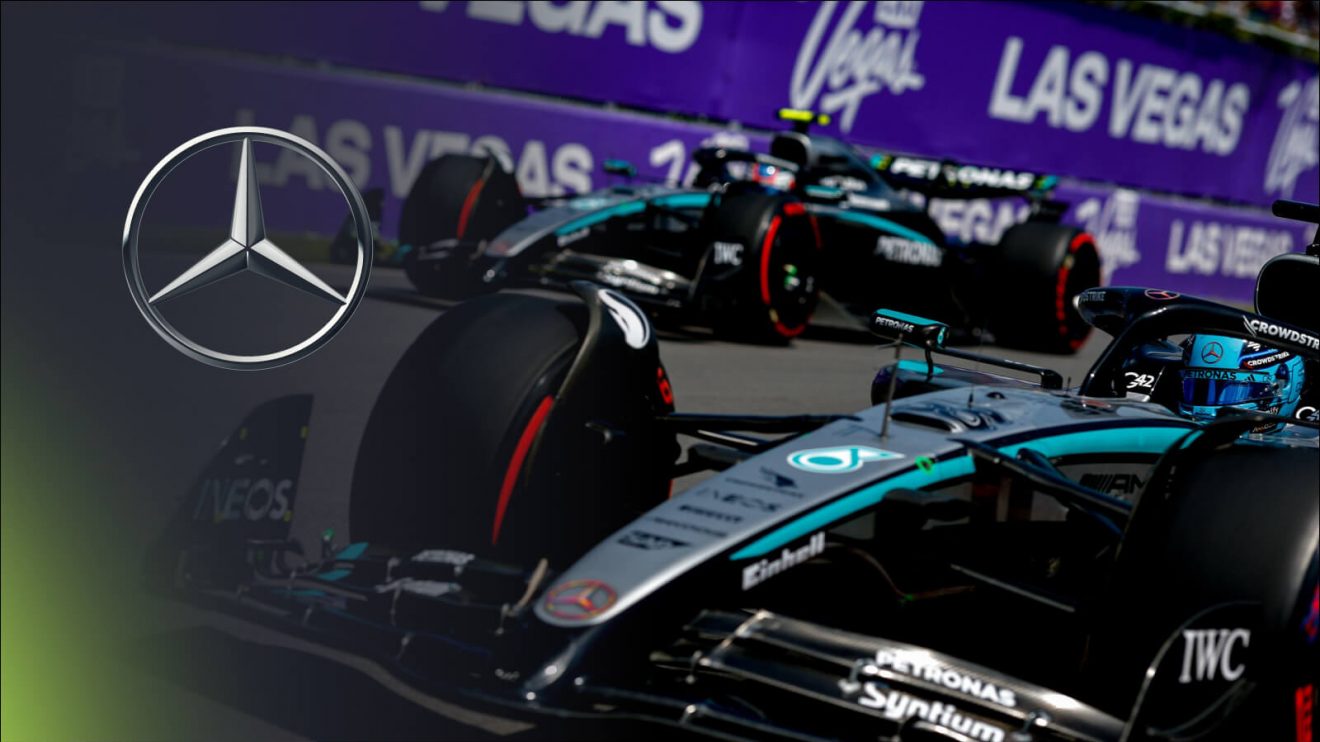
George Russell and Kimi Antonelli in Canada
Mercedes enjoyed a brilliant opening day at the Canadian Grand Prix in two very strong free practice sessions, particularly FP2, where George Russell set the fastest time overall.
This is clearly a track that suits the technical characteristics of the Mercedes F1 car, as we also saw last year. But can they challenge the dominant McLaren?
Can Mercedes surprise in Canada?
Last year, we noticed how the performance of the W15 was closely tied to track temperatures, with the car performing far better under cooler conditions. That trend seems to have carried over to the W16 as well.
But besides the cooler weather, there’s another factor working in Mercedes’ favour. The track surface in Montreal has very low abrasiveness, meaning it’s much smoother than most other circuits. This naturally reduces grip, and on top of that, it makes it harder for drivers to get the tyres into the right temperature window, especially at the start of a session or race.
And this is exactly the kind of environment where the Mercedes W16 thrives. In warmer weather, the car tends to overheat the tyres, which in turn prevents it from unlocking its full aerodynamic potential.
The FP2 results back this up, George Russell set the fastest time on the C5 (medium compound), while his teammate Kimi Antonelli, who is still getting to grips with F1, was third fastest, less than three-tenths off the top.
It’s also important to mention that this was Antonelli’s first time driving in Montreal. After a string of difficult races in Europe, this was an important moment for him to regain some confidence, and so far, he seems to be doing just that.
Since the conditions during FP1 weren’t really representative, especially with how slippery the track was early on, we’re focusing mainly on FP2 for this analysis. As a semi-street circuit, Montreal is used exclusively for F1, and when you combine that with its smooth asphalt, the surface tends to be very slick at the start of the weekend — and that’s something almost every driver struggled with during FP1.


When we compare the fastest laps from FP2 between Russell and Norris, what stands out is that McLaren has the edge in Sector 1, but then falls behind in Sectors 2 and 3.
Norris had noticeably more grip through Turns 1 and 2, which allowed him to pull ahead right at the start of the lap. But Russell, on the other hand, had a more stable rear end coming out of Turn 7, and from that point on, the advantage started to shift in his favour.
The Canadian GP circuit is what we’d call ‘rear-limited’, because of all the short, slow corners, you really need good stability at the rear of the car when applying the throttle out of turns. The telemetry shows that Russell is more consistent on the throttle, whereas Norris is making more minor corrections along the way.
That said, the lap time differences are still very small. Therefore, the team that manages to fine-tune their setup best ahead of qualifying will likely gain the upper hand. Tyre choice might also play a role here, especially considering the issues some teams had with the C6 softs in Imola and Monaco. So, it wouldn’t be too surprising if some decide to gamble with the medium compound instead.
It’s not just the qualifying pace that looked promising for Mercedes. In long-run simulations, they were also among the strongest — actually the fastest, if we look at the average lap times.

Russell and Antonelli both completed a solid number of laps on the medium tyres, and they seemed to suit the car very well. Russell came out as the quickest, while Antonelli was only about two-tenths behind him — an encouraging sign.
Verstappen in the Red Bull and both McLaren drivers are right there with them too, and once again, the differences are tiny. Since we don’t know the exact fuel loads or engine modes being used, the only thing we can confidently say is that it will be very close. Mercedes definitely seem to have the potential for a strong race performance, especially if the temperatures stay on the lower side come Sunday.
Still, McLaren remain the clear favourites, mainly because of how impressively they manage tyre wear. Even on a track that isn’t particularly hard on tyres, their ability to maintain pace without sacrificing grip continues to give them a clear edge. That gives them the freedom to push more aggressively without running into degradation problems.
And of course, we can’t forget about Verstappen. He’s won the last three races here in Canada, and we’ve seen how Red Bull’s engineers have been able to take what they learn on Fridays and turn it into a better setup for race day. Moreover, it’s Max who appears to have the most room for improvement when it comes to qualifying pace, as shown by the ideal lap times table from FP2.

One thing’s for sure — it’s shaping up to be a very tight fight.
Read next: Revealed: The weather forecast for 2025 Canadian Grand Prix