

Has F1 declared war on IndyCar with 2026 Indy 500 clash?


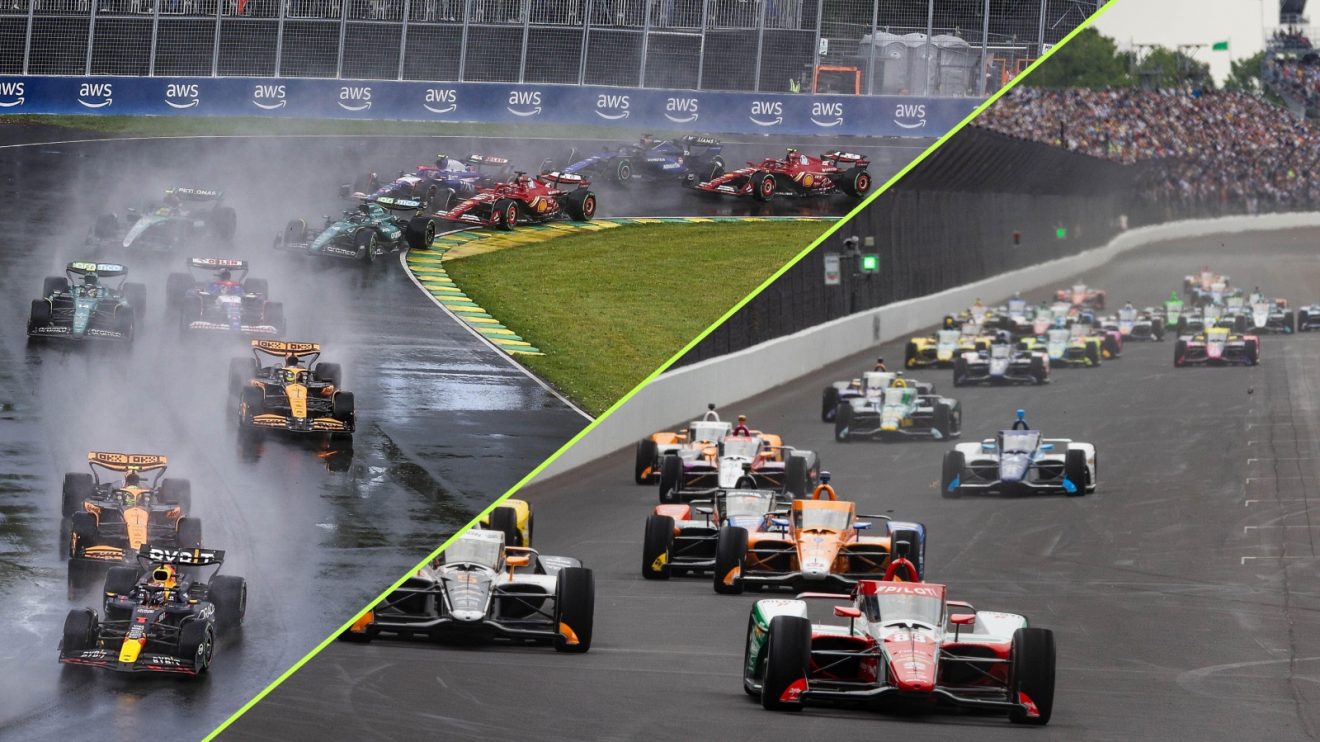
The clash between the Canadian GP and Indianapolis 500 was entirely avoidable.
The world’s two leading single-seater categories are on a collision course that has all the hallmarks of a deliberate assault on the American market.
Earlier this week, Formula 1 revealed its 24-event 2026 calendar with a number of subtle but critical elements contained within.
Why the 2026 Canadian Grand Prix and Indianapolis 500 will clash
The most significant of these is a date clash between the Canadian Grand Prix and the Indianapolis 500.
While it is not uncommon for F1 to race on the same weekend as ‘The Greatest Spectacle in Racing’, as it is billed, typically, time zones have meant there is no overlap.
Instead, motorsport fans have been treated to a blockbuster weekend of action, starting with the Monaco Grand Prix, followed by the Indy 500, and rounded out with NASCAR from Charlotte.
But for 2026, F1’s efforts to streamline its logistics, in line with its push towards Net Zero 2030, have seen the Monaco and Canadian Grands Prix effectively swap dates.
It’s a sensible and reasonable development given the sport has, in recent years, crisscrossed the Atlantic with the Miami Grand Prix preceding the opening European events, before F1 jetted back to Montreal for the Canadian GP, only to return to Europe thereafter.
Continuing with that schedule was utter madness, so pairing the two North American events makes good sense for all involved.
However, that has placed F1 on a collision course with IndyCar, with Penske’s race winner Scott McLaughlin suggesting “Motorsport Xmas” has been ruined.
And on the surface, it certainly seems that way. What’s more, it seems deliberate and cynical.
The Indianapolis 500 has long been held on the final weekend of May. In the 1950s and 1960s, F1 drivers would occasionally opt to skip the Monaco Grand Prix to participate in the American classic – and through the 1950s it was even part of the world championship, to the bane of F1 historians ever since.
To now deliberately schedule a competing event in the same timezone at essentially the same time is jarring, arrogant, and disrespectful to the core American audience.
But it’s more than that; it’s short-sighted and potentially leaves F1 in a weaker position in the United States than it might have otherwise been.
The US is a fast-growing market for the world championship, with the fan base embracing it like never before off the back of a new approach to social media, and behind-the-curtain opportunities created by the likes of Drive to Survive.
However, F1 is still a minor sport in the world’s largest economy. Television viewership remains comparatively small, with last year’s Canadian Grand Prix attracting an average of 1.8 million viewers. That was up from 1.76 million the year before.
By contrast, this year’s Indianapolis 500 boasted just over 7 million viewers, with a peak viewership of 8.5 million for its climax, according to Forbes. In February, the Daytona 500 drew 6.4 million viewers.
In 2024, F1 announced it had enjoyed a record television audience for the Miami Grand Prix, with 3.1 million tuning in. This year, ABC saw an average of 2.2 million viewers for the same event.
What’s not clear is how many of the typical F1 viewers in the United States would also watch IndyCar, it’s safe to assume a strong percentage would tune in for the 500 – America’s preeminent motorsport event.
At a time when F1 is working hard to grow its American fanbase, is it strategically the best move to compete with an event so culturally embedded as the Indianapolis 500 when it’s not absolutely essential?
More on IndyCar and the Indianapolis 500 from PlanetF1.com
? F1 v IndyCar: Top speeds, engines, formats, calendars and safety measures all compared
? How does IndyCar make itself relevant outside of the Indianapolis 500?
It’s understood the clash is somewhat unintentional, a by-product of the new regionalised calendar F1 has introduced, and not likely to happen every year. Instead, PlanetF1.com understands the clash is anticipated to be a one-in-five year occurrence.
And while that may be the case, with three weeks between the Miami Grand Prix and the race in Montreal, could it not have been avoided altogether? Moving the race just a week earlier would have avoided the situation entirely.
The argument against that is that the weather in Canada is a key consideration, with the track build taking several weeks ahead of F1’s arrival.
The average high in Montreal at the end of May is just over 20 degrees Celsius, rising from about 15 degrees at the start of the month – a week’s difference is therefore likely to make minimal difference on the race weekend.
Temperatures do rise throughout April and into May, but will preparations beginning a week earlier mean the weather is unworkable? And how can that be predicted with any accuracy years in advance? It’s a thin argument.
However, this doesn’t look like a deliberate attack or declaration of war on IndyCar but instead a clumsy solution born out of either arrogance or ambivalence on F1’s part.
We need only look at the impact on the US audience to see that. And while F1 is a global sport and can’t be beholden to the whims of an American audience, it’s perplexing to willingly put that growing market in a compromised position.
Extending on that, one can reasonably suggest there will be a commercial impact on the event, and F1, as a result.
The television rights contract in the United States is up for renewal at the end of this year, meaning whichever broadcaster (or platform) wins the rights to F1 going forward will essentially be guaranteed to lose the ratings race that weekend.
With fewer eyes, its ability to sell advertising would logically also be reduced, resulting in a weaker negotiating position. And with a bigger motorsport event on that weekend, are those looking for a TV spot likely to fork out twice?
The same goes for F1, which sells trackside signage and corporate hospitality for the event.
Given the choice, would those who can afford such luxuries partake in Montreal for a comparatively run-of-the-mill F1 event, or the most important motorsport event on the North American motorsport calendar?
Against these potential drawbacks, it’s difficult to find a logical reason to deliberately schedule an F1 event in competition with the Indy 500, leaving one with the impression that the clash was not a deliberate ploy.
It’s fair, therefore, to suggest that this is not a declaration of war or a play for the American market at the expense of IndyCar, this is a global sport that has set its calendar without stopping to consider the fact a world exists outside of F1’s own bubble.
F1 does not view IndyCar as a rival. There are some commonalities but they’re also sufficiently different that, with some collaboration or at least consideration, could prove mutually beneficial.
PlanetF1.com understands there is a willingness on F1’s part to have a conversation with IndyCar about start times and working together to minimise the impact. It’s a start, but there’s no guarantee.
Instead, motorsport fans will be forced to choose as a result of an unnecessary, entirely avoidable, scheduling choice that is not a declaration of war but the by-product of F1 being entirely self-absorbed.
Read next: Calls for F1 v IndyCar truce after ‘Motorsport Xmas’ was ‘ruined’