
Canadian GP conclusions: Lando’s silver lining, Ferrari sack fears, key Russell change


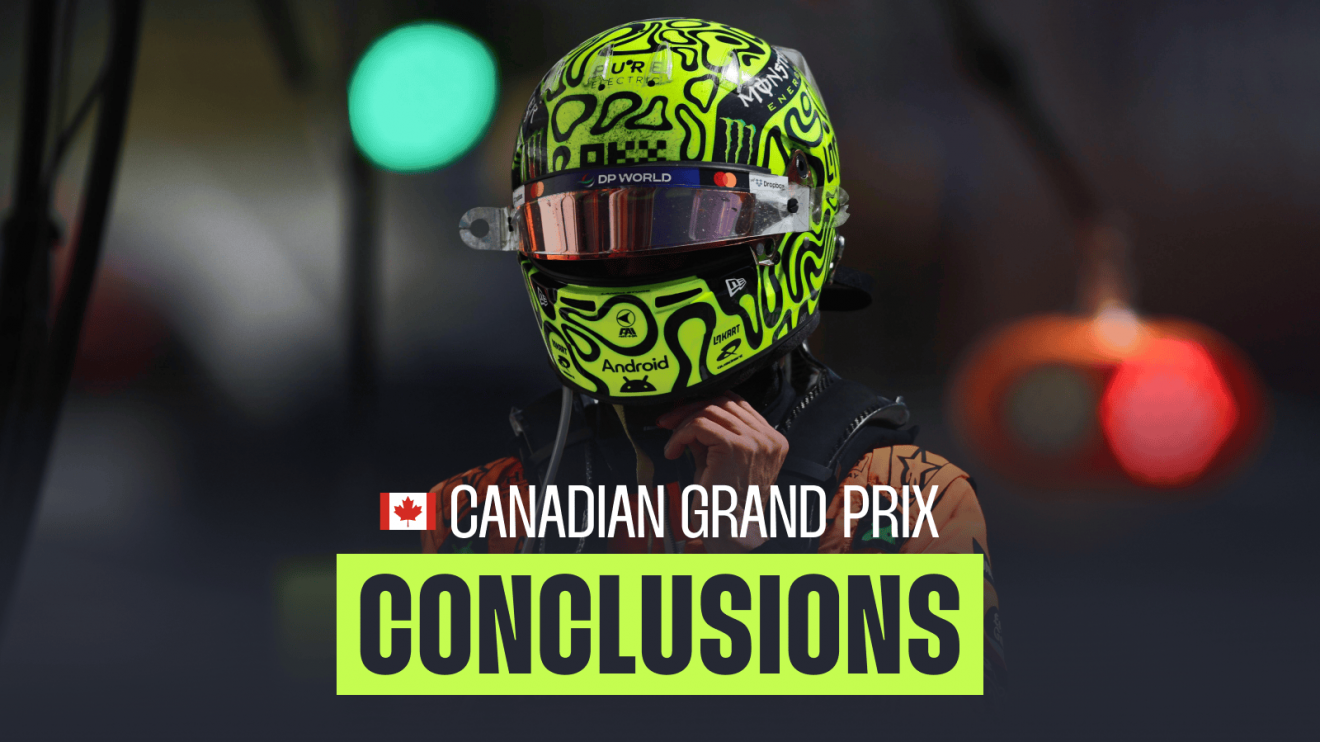
Lando Norris failed to see the chequered flag for the first time since Austria 2024 in Canada
Mercedes driver George Russell claimed his first victory of the F1 2025 season in the Canadian Grand Prix at the Circuit Gilles Villeneuve.
Russell dominated from pole position to collect his fourth career victory with Red Bull’s Max Verstappen second and Russell’s Mercedes team-mate Andrea Kimi Antonelli third. On the day McLaren pair Lando Norris and Oscar Piastri finally came to blows, here are our conclusions from Montreal…
Did Lando Norris’s big mistakes mask a major McLaren MCL39 breakthrough?
Charles Leclerc made a very unusual mistake during the sprint race in China last year. He forgot to turn his radio off.
It resulted in one of the most fascinating pieces of onboard footage you will ever find as Leclerc was heard panting – heavier than you might have expected from a driver in this era of tyre saving – in battle with Carlos Sainz, his Ferrari team-mate at the time.
Until his race engineer put an end to the intrigue and gave him a gentle reminder to switch the radio off.
If open team radios (listen up, FOM) were ever to become a permanent part of the F1 broadcast – every breath, every utterance and, yes, every curse heard by millions – Radio Norris would be essential listening.
Especially at that pivotal point on a race weekend when the end of Q2 bleeds into the start of Q3, there is no turning back and things suddenly become a whole lot more serious.
Bet your bottom dollar that Lando’s breathing turns noticeably shallower – considerably more so than, say, Max Verstappen and Oscar Piastri – as the tension rises, just as his steering inputs and footwork become jerkier and less precise.
Does he gee himself up – the occasional ‘come on’ muttered under his breath, maybe? – as he drives a crucial lap?
And if he’s so self critical when he’s out of the car, what on earth does he say to himself in the privacy of his crash helmet after moments like Saturday in Canada, when he messed up his Q3 banker lap at the final corner?
Not for the first time this season, not for the first time in his career, the complexion of Norris’s entire weekend turned completely on his inability to execute the big moments under high pressure.


If only he had treated Q3 like it was any other session.
If he had, Norris – not George Russell – may well have dominated the Canadian Grand Prix from pole rather than spending the closing laps chasing Piastri for fourth place at the tail of the leading pack.
For what happened between the McLaren drivers on the main straight on Lap 67 can be totally traced back to Norris’s underachievement in qualifying.
The clash itself?
Comparisons to the collision between Jenson Button and Lewis Hamilton at precisely the same spot in 2011 are inevitable, yet it was also remarkably reminiscent of Lando’s role in his own downfall against Verstappen in Austria last year.
By failing to seize the initiative and put a clean and decisive pass on Piastri early in the exchange, he allowed the pressure to build and build over a number of laps and several half-hearted overtaking attempts.
Until he started to become desperate, panicky and got lured into making a move he would soon regret.
Oscar Piastri vs Lando Norris: McLaren head-to-head scores for F1 2025
? F1 2025: Head-to-head qualifying statistics between team-mates
? F1 2025: Head-to-head race statistics between team-mates
It will help that McLaren have been fully prepared for a moment like this in 2025 and that Lando, as well as handily coming off worse in a collision caused by him, instantly owned up to his error.
Norris’s humility in a situation in which it is all too easy to point the finger, and the openness and transparency instilled by the team management at McLaren, should allow them to move on from this relatively quickly and with little lasting damage to internal harmony.
Yet did Norris’s latest cluster of mistakes in Canada, culminating in his biggest error so far this season, mask a genuine breakthrough in his understanding of the 2025 McLaren this weekend?
A breakthrough with the potential to shape the rest of 2025 and his title battle with Piastri, even if he now finds himself trailing by 22 points after this race?
Even when McLaren cemented their status as the team to beat in pre-season testing, even when he was winning from pole in Australia, Norris was open about the MCL39 not being to his liking. Certainly not in the way last year’s car was.
The leading theory was that McLaren’s decision to move the steering arm of the suspension further forward for 2025 – analysed in detail by PlanetF1.com’s tech editor Matt Somerfield – had the knock-on effect of dulling his feel for the front of the car.


Interesting, then, that when McLaren arrived in Canada armed with an upgrade to the front suspension, designed to enhance the feedback from the steering and brakes, Norris took it in a heartbeat while Piastri preferred to stick with what he knows.
Might that update be why Norris, now with the front end finally how he wants it, looked much the faster McLaren driver in Canada apart from those nervy Q3 laps, as though his team-leader status of late 2024 had been restored?
For all the talk of Piastri taking a significant step forward last winter, the great overhanging question of 2025 is whether Norris’s frailties – both his suspect temperament and his troubles with the current car – have to some extent flattered Oscar so far this season.
If the suspension upgrade has just moved the MCL39 more in his direction, making Norris’s irresistible Zandvoort/Singapore/Abu Dhabi 2024 peaks more accessible once again, we might be about to get the answer.
The night is darkest just before the dawn.
The key to George Russell’s success in F1 2025? He’s no longer forcing it
Last year’s Canadian Grand Prix did not reflect well on George Russell. And he knew it.
Rarely has a driver looked so distraught after collecting his first podium of the season, yet Russell could not shake the feeling that Canada was the one that got away – and that it was all his fault.
Mercedes did not get many opportunities to win in 2024 but Montreal, a circuit that somehow stays cold even when the weather is warm, was one such occasion as Russell started from pole.
Yet over the course of a rain-affected race he was scrappy, error prone and more than a little desperate en route to third place.
Only four seconds separated him from the victory in the end, yet he was lightyears away in terms of the quality of his drive.


Standing on the podium that day alongside Max Verstappen, fresh from performing yet another magic trick to sneak yet another unlikely victory at yet another circuit unsuited to the Red Bull, Russell looked decidedly second rate – the classic Plucky Brit with no shortage of spirit and enthusiasm but sorely lacking the talent and composure.
It was telling that after his fortunate victory in Austria a few weeks later, when the win had effectively dropped into his lap after the late clash between Verstappen and Lando Norris, Russell openly acknowledged that his “risk/reward dial” is not always calibrated how it should be.
As noted at the time, Austria had the potential to be a very valuable lesson for Russell, a win that fell from the sky proof that there is no need to drive any differently to normal when victory is on the line.
It is a lesson he has carried ever since, including his dominant win in Vegas last year, to the point that he is now maturing into one of the best and most consistent performers on the grid.


George Russell remains the same George Russell he always was – hugely self confident, relentlessly aggressive, always with two feet and 10 toes on the absolute limit – but has now developed a layer of maturity to keep him on the right side of that risk/reward line on most days.
It has helped enormously that he has at his disposal in 2025 the fastest and, by some distance, the most compliant car Mercedes have produced since he joined the team at the beginning of 2022.
No longer is he a man in a rush, forcing it, overreaching, overstretching himself and grasping wildly at opportunities on the exceptionally rare occasions they come along.
Now? Now he is a more self-assured driver – something altogether more powerful than mere self belief – and is allowing everything to come to him instead.
It shows.
Fred Vasseur will end up paying for the Ferrari mess with his job
Here’s the great unanswered question about Lewis Hamilton’s move to Ferrari: how much say did Fred Vasseur really have in the matter?
Much was made of the personal bond between Lewis and Fred upon the announcement of Hamilton’s switch from Mercedes last year and how these great friends from the GP2 days were to be reunited on the grandest stage of all in 2025.
Yet as noted in PlanetF1.com’s conclusions from the Bahrain Grand Prix, the signing of Hamilton was so completely at odds with Vasseur’s modus operandi that it surely could not have been driven by him.
This is not a leader prone to making emotional spasms for decisions.
Or for needlessly breaking up a winning team, at the heart of which in 2024 was the potent partnership between Charles Leclerc and Carlos Sainz.
Far more likely, it seems, is that Hamilton was, at least to some extent, imposed on Vasseur by John Elkann, the Ferrari chairman, who appeared to have made it his mission to bring Lewis to Maranello despite the evidence of his final years with Mercedes.
There is, to be clear, more that’s wrong at Ferrari right now than Hamilton’s own lack of performance.
The decision, for instance, to pursue a new design concept for the final year of the existing regulations, in an era when even the smallest changes risk taking a car completely out of its window, has backfired spectacularly and resulted in Ferrari falling into the same trap as McLaren back in 2013.
Yet the presence of a driver of such immense standing as Hamilton only adds to the pressure – the pressure Vasseur has worked so hard to insulate the team from ever since his appointment in late 2022 – coming from all sides in light of Ferrari’s underwhelming start to the season.
Not only from the upper Ferrari management – Hamilton let slip back in Jeddah that “the bosses are not happy” – but from Formula 1 itself, anxious to have the sport’s most famous driver in a competitive car.
There have been signs over recent weeks of Vasseur starting to lose control of the narrative, most significantly in Hamilton’s revelation that he had to tell his boss to “calm down” and “don’t be so sensitive” in the immediate aftermath of the Miami Grand Prix.
It is one thing to speak to the team principal of Scuderia Ferrari in that manner, especially after Hamilton’s series of disrespectful team radio messages throughout that race; quite another to share that private exchange with the watching world.
It was the driver/team boss inversion of Mattia Binotto waving his finger in the face of Leclerc in parc ferme at Silverstone in 2022 – and we all know how that ended.
So it was no great surprise, then, that the first concrete doubts over Vasseur’s future emerged from Italy as F1 landed in Canada.
For so long – and until very recently – it seemed Sergeant Fred could do no wrong at Ferrari, the man with the bulldog face and the disarmingly hearty laugh emerging as the team’s most effective leader this side of Jean Todt.
Yet now his authority has been challenged, and the inner peace and equilibrium he brought to Maranello has been disturbed, there will be no easy way of quieting down the house he has built.
Ferrari team principals do not tend to make it out of these situations in one piece.
What’s Fernando Alonso up to?
So what’s Fernando Alonso up to, then?
It was claimed over the Canadian Grand Prix weekend that he had visited Alpine’s hospitality unit on no fewer than four separate occasions by early Saturday afternoon in Montreal, sparking rumours that a return to Enstone (yep, another one) might be on the horizon.
As noted by this column after Australia, Alonso entered this season in quite an odd position, officially under contract with Aston Martin until at least the end of 2026 but with the spectre of the team’s ambitious pursuit of Max Verstappen awkwardly hanging over him.
If Aston were to prove successful in signing Max – be it for 2026, 2027 or even later – and the team’s ownership structure remains the same (in other words, Lawrence Stroll continues to call the shots), without question it would be Fernando forced to make way.
And being tipped into retirement by circumstances outside of his control would be no way for a driver of Alonso’s stature to end his F1 career.
So it would make perfect sense, if he remains committed to racing until at least the end of next season, for Alonso to scout the market and assess his options.
Y’know, just in case something happens with Max.
And what better option, if he cannot have a Newey-designed Aston Martin after all, than back at Enstone where his old friend Flavio Briatore is calling the shots once more?
The great tragedy for Alonso is that the Newey car could arrive just as his powers finally desert him, this year bringing the first tangible signs of decline (he’s making a few more mistakes than he used to) and coming after he battled various physical ailments in the closing weeks of last season.
And what if Max isn’t the only threat to his place at Aston?
Let’s pretend that Verstappen ultimately ends up at Mercedes and George Russell suddenly becomes available instead for 2026.
Would you overlook a driver approaching his peak for a 44-year-old Alonso without a race win to his name in almost 13 years?
It is no longer the clear-cut call it once was. It can’t be.
Already at an age that traditionally makes leadership figures in sport more than a little triggerfingery, Alonso’s lack of results over the course of 2025 (though plainly not his fault) and the difficulty in gauging his true performance level these days have made him more vulnerable to being replaced than he ever has been previously.
Both Alonso and Briatore, still acting as his manager after all these years, have dropped hints over the last 12 months that 2026 is very likely to be his final season.
Add to that the persistent rumours that Mercedes are highly likely to have the dominant engine of 2026 and a fourth and final stint at Enstone begins to hold some appeal.
If Fernando wants to end his career on a high and potentially sneak that 33rd win before it’s all over, a quick blast in a Merc-powered Alpine might actually be a better short-term bet than Aston Martin’s long-term project.
Derek Warwick’s suspension strengthens the case for professional stewards
To have one F1 steward sing like a canary to the media through the prism of gambling platforms might be considered unfortunate.
To have two? In less than a year? Now that begins to look like carelessness.
Yet after the Johnny Herbert affair of last season, the buildup to the Canadian Grand Prix weekend witnessed the birth of a new celebrity steward in Derek Warwick.
True, Warwick’s remarks on Lewis Hamilton’s predicament at Ferrari and Max Verstappen’s penalty in Spain lacked the sheer explosiveness of those of Herbert, who seemed to provide a stream of consciousness from the stewards’ room in 2024.
Let us not insult your intelligence, though, by detailing why an FIA official speaking in such a manner might not be ideal.
Unlike the situation with Herbert, who was allowed to run riot with his critique of Verstappen’s “horrible mindset” last year, the FIA acted swiftly and decisively on this occasion.
That Warwick was suspended almost before his feet touched the ground in Canada was at least a sign that the governing body has learned from its previous mistake.
In a statement issued to PlanetF1.com, the FIA confirmed that Warwick has recognised the error of his ways, apologised and is free to resume his role in Austria later this month.
Crisis averted, then.
Yet the uncomfortable question spreading around the FIA’s headquarters in Paris right now should be: why?
Why are these high-profile, ex-driver stewards so incapable of resisting the temptation to dip their toes into such murky waters?
Why are they so eager to earn a bit on the side?
It can only be that the incentive to say ‘no’ is not strong enough under the current system.
Indeed, Herbert himself told PlanetF1.com last year that stewards receive “$300 a day or something” for their work on F1 race weekends – a far cry, no doubt, from the remuneration he came to expect in his former life as a prominent television pundit.
Whenever the subject of professional stewarding has raised its head, it has always descended into the same old, classic F1 argument over who exactly is going to pay for it.
Now is the time to bang a few heads together, however, for the need to introduce professional stewards has never felt so pressing.
Hear that? Pro-fess-io-nal.
In every sense of the word.
Read next: Further turmoil for Alpine as CEO set to depart in shock announcement