

How aggressive strategy gave Verstappen a shot at victory in Spain


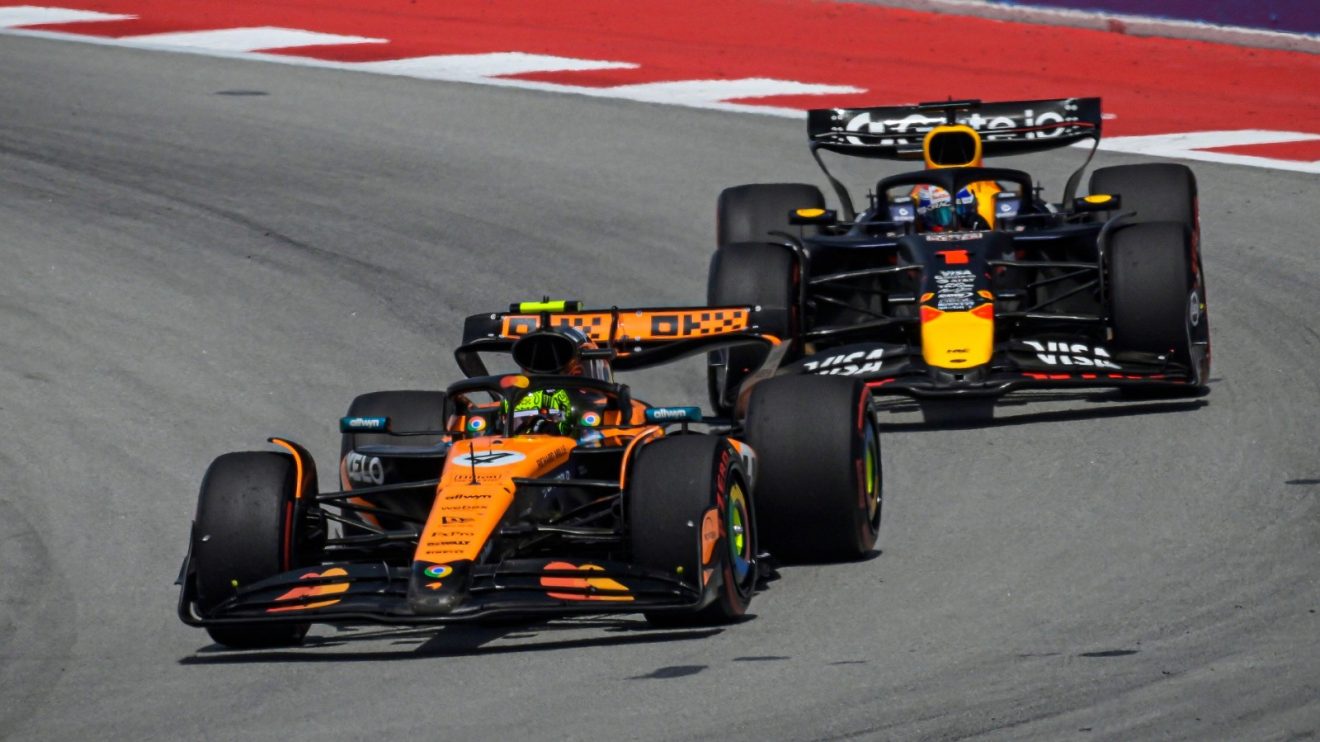
Lando Norris and Max Verstappen on track in Barcelona.
The Spanish Grand Prix evolved into a full-blown strategy battle, primarily between McLaren and Red Bull, who opted for contrasting approaches.
But could either team have done anything differently? What exactly drove their strategic decisions? Let’s dive into the telemetry data for answers.
Red Bull countered McLaren pace with strategic play
Following a thrilling Spanish Grand Prix, Oscar Piastri secured his fifth win of the season, delivering McLaren’s first 1-2 finish in 25 years.
As was the case last year, the soft and medium tyres were the preferred compounds throughout the race — apart from Max Verstappen, who was forced onto the hard tyres during the Safety Car period.
Despite Barcelona’s tyre-demanding nature, the hards proved to be too extreme even for this circuit. Teams struggled to bring them into the optimal temperature window, and the initial drop-off in performance was significant.
Thus, while we anticipated at least two pit stops, which ultimately became three when factoring in the Safety Car late in the race, Red Bull and Max Verstappen devised an alternative strategy.
That strategy was aimed at challenging the papaya cars despite starting behind them — and it was undoubtedly the right call.
As early as FP2, it was evident McLaren had outstanding pace on both the soft and medium compounds, and we already knew how exceptional their tyre degradation control was on Sundays. Moreover, both track and air temperatures were high, conditions that suited the MCL39 down to the ground.
Red Bull’s idea? To utilise Max’s and the RB21’s raw pace by adding an extra pit stop and attacking the race more aggressively.
More reaction from the Max Verstappen incident
? Max Verstappen ‘will bring the tissues’ for George Russell in reaction to Barcelona crash
? George Russell slams ‘deliberate’ Verstappen crash as ‘bizarre’ move backfires
The initial getaway from the four-time world champion was superb.
He reached 200 km/h a tenth quicker than Lando Norris, which was just enough to outbrake him around the outside of Turn 1 and claim second place. Once again, Norris had a relatively poor launch, something that troubled him last season as well.
Max managed to hold off Norris for 13 laps on used softs, while the Brit had started the race on fresh rubber. But once Max’s tyres began to fade, Norris made the pass and, just a lap later, Verstappen switched to a new set of softs.
During his second stint, Max was blisteringly fast — on average a second per lap quicker than the McLarens, who were still running on softs that had done nearly 20 laps. This allowed Verstappen to claw back substantial time.
When both McLaren drivers pitted for new medium tyres on laps 22 and 23, they emerged behind Max.
The medium tyre was the standout compound during this Grand Prix; whoever had preserved more sets gained a significant edge, just ask Charles Leclerc.
This tyre offered nearly the same pace as the softs but with far greater longevity, clearly reflected in the telemetry data.

Once Piastri and Norris switched to the mediums, their lap times matched Max’s pace. They maintained this for nearly 30 laps, with Piastri even extending his advantage toward the end of the stint.
Meanwhile, Verstappen began to suffer tyre degradation around lap 10 of his second stint. Max pitted again, this time for a new set of mediums, rejoining behind both McLaren drivers.
At that point, it became clear that Red Bull were committed to a three-stop strategy. Their plan was to leverage two aggressive stints on softs to gain enough time so that, after the second stop, Max could fully exploit the medium tyres to catch and pass Norris — perhaps even challenge Piastri.

However, it’s nearly impossible to go up against a car that manages tyres as well as the MCL39. The table below illustrates this perfectly:

Despite Verstappen only spending 19 laps on the mediums compared to 27 for both McLarens, the McLaren drivers were still 0.7 seconds per lap faster — a staggering difference. Their ability to conserve tyres under pressure was nothing short of remarkable.
To his credit, Max mounted a spirited attack. In the final stint — before the Safety Car — when all three leading drivers were on softs. He got close to Lando, he even had a chance to pass when the pair encountered backmarkers.

In the end, Red Bull’s strategy was solid — Verstappen found himself within DRS range of Norris despite making one more stop. If Red Bull mirrored McLaren’s strategy, it’s likely Max would have been further behind and never even had that one opportunity to attack.
The weekend we all hoped would deliver a genuine front-running battle ultimately ended in complete control by the papaya squad.
Following a late incident with Russell and the resulting penalty, Verstappen dropped down to P10 — an outcome that proved costly in the Constructors’ Championship fight.
Is there any team that can realistically threaten McLaren? Sadly, it doesn’t seem so — at least not in the near future. The performance gap looks set to widen.
Next up is the continuation of traditional venues, with classic racing circuits and high temperatures on the way—conditions that once again should play right into McLaren’s hands.
Read next: Data exposes bizarre Max Verstappen action in George Russell clash


