

What you can really expect to see from the FIA’s new flexi-wing test


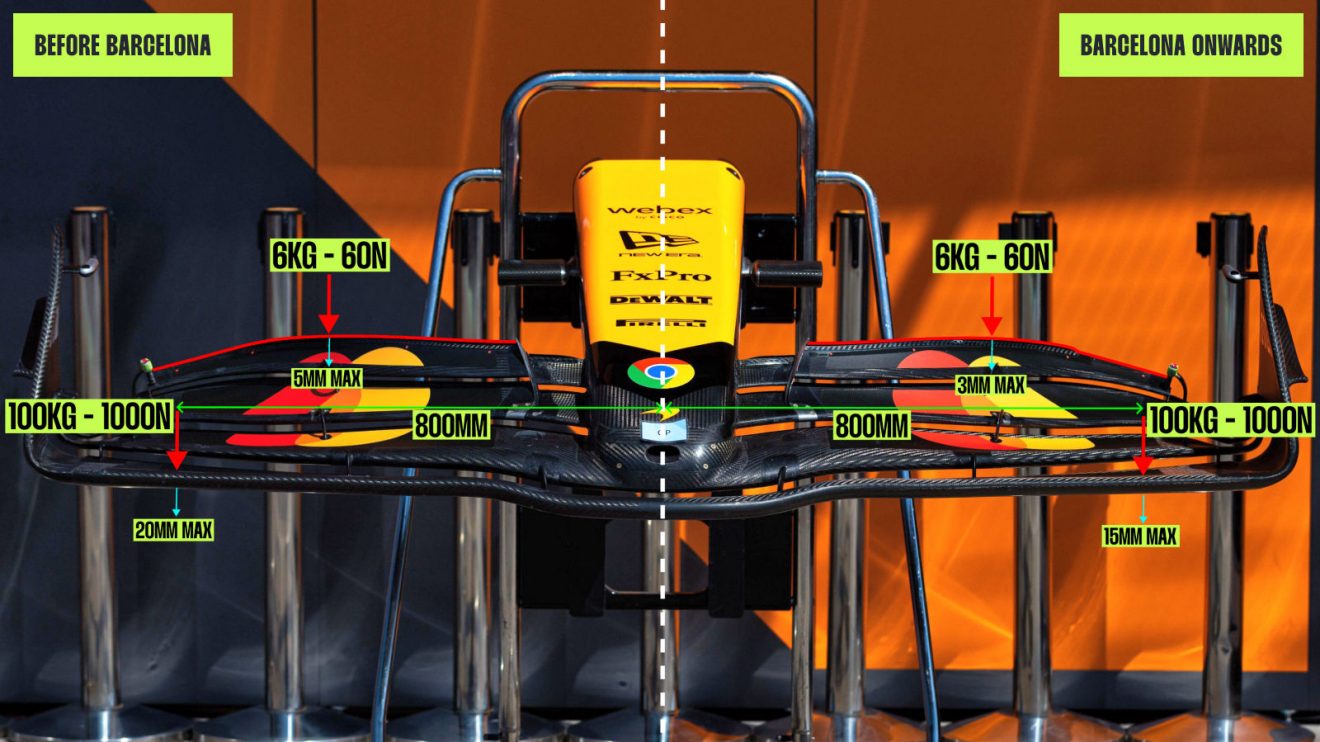
As Formula One heads to the Spanish Grand Prix the teams will face a revised challenge, with the technical directive issued at the start of the season regarding front wing flexure coming into force.
This revised version of TD018 looks to reduce the amount of flexion that’s present in the front wing and has been clear to see when being viewed from the onboard cameras.
Revised FIA tests start at the Spanish Grand Prix
The FIA have instructed teams that the loads being used during the tests will remain the same, however, the amount of movement that’s present when the tests are being conducted have been revised.
This will continue to be checked in three separate tests, as was already the case, with one of those tests resulting in a 60N point load being applied to the trailing edge of a flap (highlighted in red on the main image, above), with no more than 3mm of deflection being present, whereas previously there had been a 5mm tolerance.
The asymmetric load test on the main section of wing will still result in the application of a 1000N load at a point 800mm from the centreline but rather than being able to have vertical deflection of no more than 20mm, the wing must now deflect no more than 15mm.

The symmetrical variation of this test has also seen the amount of deflection that’s permissible reduced by 5mm, from 15mm to 10mm.
An age old problem
The debate around flexi-wings will likely rage on, even after this change by the FIA, as whilst there will clearly be an impact on the use of the designs seen from the teams, it’s an effect that cannot be completely nullified.
Furthermore, whilst many will be expecting the competitive order to be completely upended, it’s unlikely to play out this way, as all of the teams seem to have been actively incorporating flexion into their designs, in one form or another.
Therefore, it’ll likely be similar in effect to when other technical directives have been introduced, whereby there’s an overall loss in performance for everyone on the grid, rather than big deficits being closed.
What might be apparent though, is a sudden shift in how the cars perform on track, with some of the teams using the flexi-wings as a means to better balance the car between low and high speed states, rather than them simply being used to reduce drag, as might have been the case in the past.