

Explained: Why a ‘vigilant’ FIA will enforce different front wing rules from Spanish GP


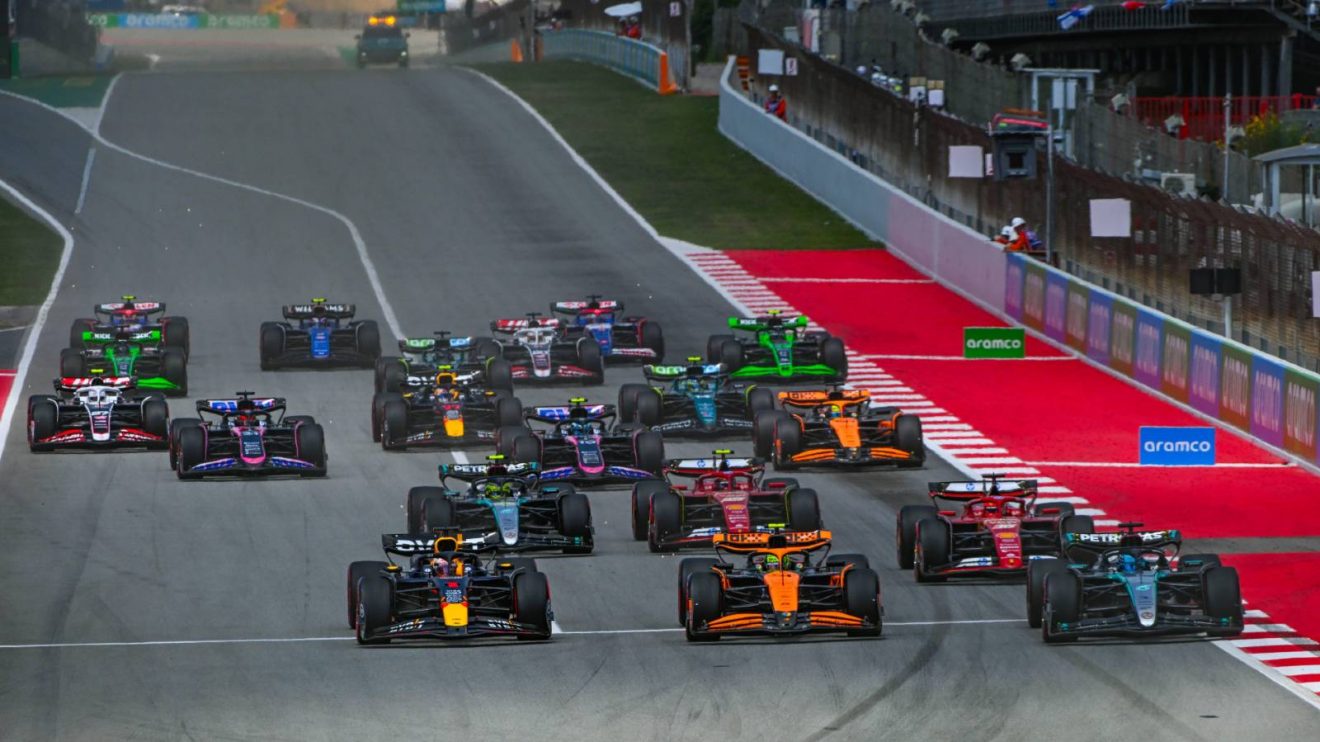
Technical Directive TD018 comes into effect at this weekend's Spanish Grand Prix.
The long-awaited front wing flexibility technical directive takes effect this weekend at the Spanish Grand Prix.
A technical directive, TD018, aimed at tackling the issue of front wing flexibility, comes into force this weekend at the Circuit de Barcelona-Catalunya, and will see the teams having to comply with far more strict front-wing static load tests.
What Technical Directive TD018 means for Formula 1
Over the winter, the FIA confirmed that technical directive TD018 would come into effect at the ninth round of the championship, the Spanish Grand Prix, despite indications being made towards the end of last season that the existing static load tests would remain in place until the end of the current regulations cycle.
Throughout 2024, examinations were carried out via high-definition cameras to monitor the levels of front and rear wing flexibility, under another technical directive, TD034G, in response to how some wings – such as on McLaren’s MCL38 – appeared to be clearly flexing at high speed, even to the naked eye.
While visible on television footage, the so-called ‘Mini-DRS’ effect of the rear wing had no impact on the legality of the McLaren as, just like all the rest of the teams, the wings passed all static load tests as defined under the technical regulations.
McLaren would go on to “proactively” alter the designs of its rear wings following discussions with the FIA, while revisions made to the technical regulations under Article 3.15.17 closed off the potential for ‘Mini-DRS’ loopholes as the level of flexibility of the ‘slot gap’ was reduced to 2mm under 75kg of vertical load.

Added to this, further examination of the levels of rear-wing flex at the 2025 Australian Grand Prix resulted in the levels of tolerance being reduced, via technical directive TD055A, to 0.75mm at the Chinese Grand Prix and, from Japan, reduced further still down to 0.5mm.
But while the rear wings were covered off by these changes, the front wings also commanded the FIA’s attention.
PlanetF1.com understands from several sources that the FIA informally made its intentions regarding the potential introduction of the new technical directive guidelines known in late November 2024, with the governing body working on the “ongoing” issue, and how to tackle it, throughout the winter.
The intention was made clear to the teams that a change, made via technical directive as an addendum to the regulations, was very likely – meaning that every team has been armed with the knowledge that wings designed to maximise the regulations under the old static load test requirements would have a very uncertain shelf life.
This technical directive TD018 comes into effect this weekend, following an announcement from the FIA in pre-season that, in response to concerns that some teams were pursuing designs that might reduce drag at high-speed, or even change the aero balance from low to high-speed, it would “introduce either new or more challenging load-deflection tests for the front wing”.
Speaking in the FIA’s preview of the Spanish Grand Prix, FIA single-seater director Nikolas Tombazis said, “When championship battles become intense, teams tend to focus on each other’s cars a lot, and naturally they raise concerns and over the latter half of the season we came to the conclusion that we needed to toughen a bit more the tests for 2025.
“The 2025 regulations were designed to counteract the so-called ‘Mini-drs effect’ that became quite a talking point in the autumn of last year.
“That test was applied from the start of the season, but it soon became apparent it was insufficient.”
But, given the teams competed in the first eight races of the season with front wings that would likely now not pass the new static load tests – a design change that comes with considerable costs – why is it only being enforced now, and not from the start of the year?
“Over a sequence of races at and following the [2024] Belgian Grand Prix we installed cameras on the front wings of all cars and again we concluded that the tests would need to be toughened,” Tombazis said.
“That conclusion was arrived at quite late in the year, however, and we felt that if we had introduced extra tests at the start of this season, it would have been tough on teams and may have led to existing front wings being scrapped, and extra expense.
“Therefore, we felt that deferred introduction was more sensible.”
The new flexibility tests will see vertical loads of 100kg applied symmetrically to both sides of the car, with deflection of no more than 10mm permitted. When the vertical load is applied to just one side of the wing, the deflection must be no more than 20mm.

On the front wing flaps, any part of the trailing edge must deflect by no more than 3mm when a 6kg load is applied – the previous limit throughout the first eight races of the year was just 5mm.
These changes in flexibility will have a “significant” impact on the levels of rigidity of the wings and, according to Tombazis, should end the saga of wing flexibility for this regulation cycle.
“Obviously it is fair for the FIA to add more flexibility tests or stiffness tests when it judges that a certain area may be getting exploited a bit too much,” he said.
“But yes, we hope it will be the last time we’ll do anything for this year.”
However, in its role as governing body, the FIA can carry out its own investigations and experiments in order to ensure its own testing methods are sufficient to keep abreast and ahead of what the teams are doing – it’s in situations where its own testing methods, such as in this situation, have fallen out of step with the teams’ abilities, that changes are needed.
Depending on who you speak to in the paddock, the impact of the changes on the F1 grid pecking order ranges from negligible to game-changing, but most of the teams will be running with more rigid front wings than they raced with over the first eight races of the year.
“I think Barcelona is on the calendar of everybody in the paddock with the new regulation for the front wing,” Ferrari boss Fred Vasseur said last weekend in Monaco.
“At least we are working on it for ages now and this can be a game-changer for everybody because we don’t know the impact on every single team of the new regulation.
“We’ll stick to this, be focused on this, to have the better exploitation of the new front wing.”
As for Christian Horner, whose Red Bull team was the last of the front-running teams to truly start exploiting the area of aeroelasticity, he said, “Maybe it will have zero impact on the running order but it’s a change and it’ll affect all teams.
“Maybe neutrally, but there will be an impact from it. What we don’t know is how it’ll affect [each team]. It’s a significant change, and so of course there’ll be some effect.”
Over the remaining 16 rounds, Tombazis explained, the governing body will be very vigilant to ensure compliance with the new tests.
“We check the teams at various points across the season and we ask them to bring certain components along and we’ll check them in isolation and sometimes test them on the whole car,” Tombazis explained.
“We frequently test in parc fermé conditions—either on Saturday after qualifying or Sunday morning, as obviously, in parc fermé teams cannot make changes to their car.
“That ensures that they’re not fitting a stiff wing for the test and running something else in the race. We also occasionally conduct checks after a race if we feel there is a reason to do so. Those tests would be static load tests, as defined in Article 3.15 of the Technical Regulations.”
Read Next: Toto Wolff in key Ferrari admission ahead of Spanish GP ‘game-changer’


