

Uncovered: Why F1 can no longer afford to race in Imola


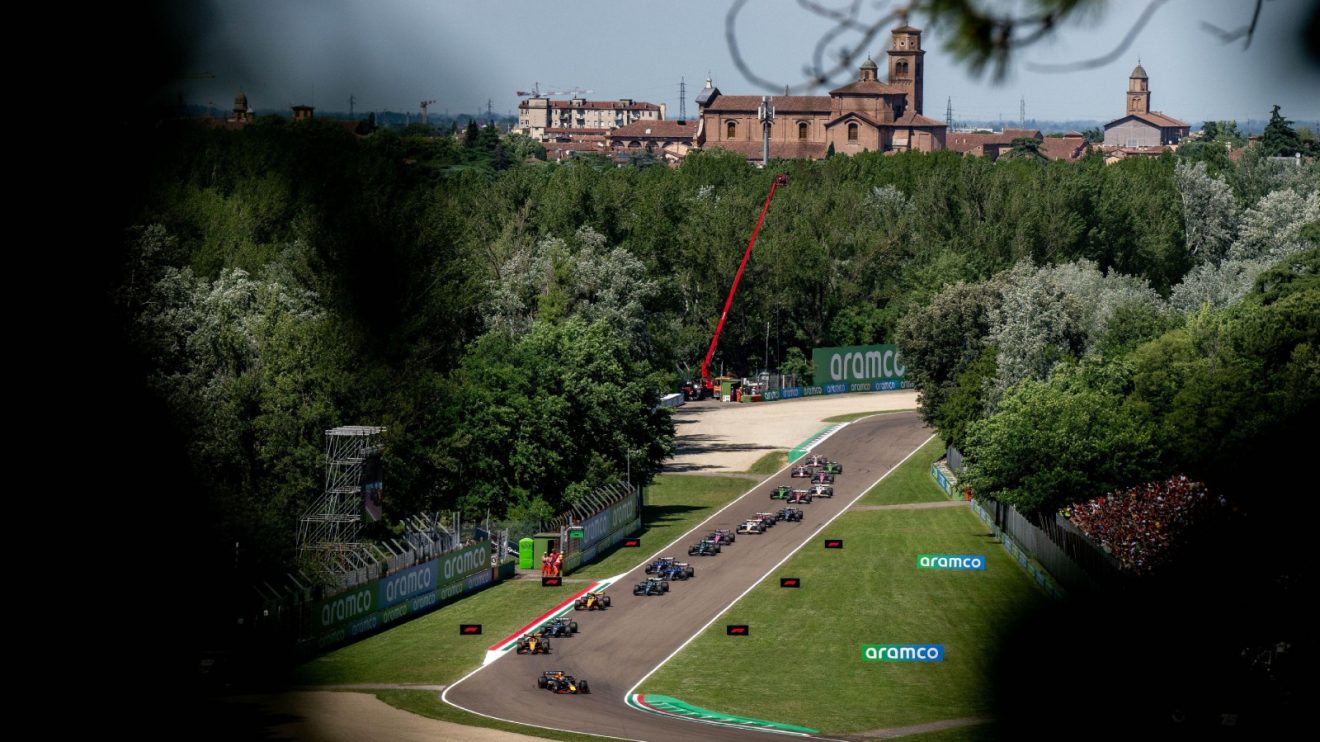
The growth of the F1 business means it can ill afford to continue racing in Imola.
Max Verstappen’s win in Sunday’s Emilia Romagna Grand Prix likely brought a curtain down on Imola’s place on the F1 calendar.
An iconic track, popular with drivers and steeped in F1 folklore, it’s also a venue the sport can simply no longer afford to visit.
The business of F1 has outgrown Imola
While the world’s leading form of motorsport competition, Formula 1 is ostensibly a business.
The commercial rights to the World Championship are owned by Liberty Media, whose task is to exploit its image globally for profit.
At times, that will place its objectives at odds with accepted practices or traditions. That’s been seen with the Monaco date shift and the introduction of sprint races.
The challenge Liberty Media faces is that there are only so many ways to make meaningful money before reaching the point of diminishing returns.
Underpinning everything is having close, exciting, racing which places an emphasis on regulations that encourage a comparatively open and unpredictable competition – no easy task when teams are staffed by clever engineers employed for their ability to read between the lines and exploit grey areas to the max.
The regulations do not fall under the control of Liberty Media, or F1 (as Formula One Management has come to call itself).
Instead, they are formulated via a number of FIA-led working groups, which feed into and are voted upon by the F1 Commission, a body that includes the FIA, FOM, and the teams.
From there, rule changes are passed to the FIA’s World Motor Sport Council for ratification into the regulations.
That governance process is outlined in the secretive Concorde Agreement but, outside of that, Formula One Management has a great deal of freedom.
Chief among the powers it does have is the ability to define the calendar. It also has the rights to set and collect hosting fees, negotiate television and licensing deals, and more.
Boiled down, FOM fundamentally has three main income streams; broadcast fees, race promotion fees, and a combination of corporate hospitality and trackside signage.
It is here that the Emilia Romagna Grand Prix organisers are simply powerless to save themselves in the face of high-paying rival promoters.
Under the Concorde Agreement, Formula One Management can schedule a maximum of 24 races.
With that event cap, making each pay handsomely is critical to FOM’s financial position, and therefore Liberty Media’s share price.
Hosting fees are critical to F1’s health
Concorde Agreement explained: Who signs it, what it means and why it’s vital for F1
The ultimate F1 2025 guide: Everything you need to know about the 2025 season
It’s estimated officials in Imola, home town of F1 boss Stefano Domenicali, contribute only $21 million for the right to host an F1 event annually, with last weekend’s event being the last under its current deal.
Put in perspective, the Spanish Grand Prix in Barcelona is thought to pay $25 million annually, while the new event in Madrid is on the hook for an estimated $52 million.
Indeed, the pass mark is around $35 million for existing races, which is what promoters in Monza, Suzuka, Circuit of The Americas, Mexico City, Zandvoort (which disappears after next year), Montreal, and Singapore are thought to pay.
It’s therefore clear that organisers in Imola are paying well under the market rate, to the tune of perhaps half what would be considered a ‘low’ rate for any new event.
Plus, with Madrid joining the calendar, and at a far higher rate, there is no sense in continuing to race in Imola from a financial standpoint – and there’s no space on the calendar, anyway.
But it’s also a shot across the bows of the likes of the Austrian Grand Prix, which is thought to only be worth $25 million annually.
Organisers there have a contract through until 2027 with the Red Bull Ring flagged as a possible candidate to join the likes of Belgium in rotating on and off the calendar.
And who knows; perhaps that is an avenue through which Imola might one day return.
While lower-paying events are clearly not viable as a staple of the F1 calendar, one or two dips each year are tolerable and perhaps even necessary to retain a connection to its history and traditions – elements that have an intrinsic value.
And that’s where Imola stands above the likes of Miami, Qatar, and Saudi Arabia; it was the scene for Ayrton Senna’s final days, for that glorious battle between Michael Schumacher and Fernando Alonso in 2005, and more recently, of Max Verstappen’s four wins on the bounce.
It’s an old-school venue that punishes drivers for the smallest of mistakes, a circuit oozing personality and folklore in a way its modern equivalents can only dream of.
But, financially, it doesn’t add up, and, when it comes to the murky underbelly of F1, there is an old saying: “Follow the money. Always follow the money”.
Read Next: Jeremy Clarkson weighs in as beloved F1 circuit faces the axe