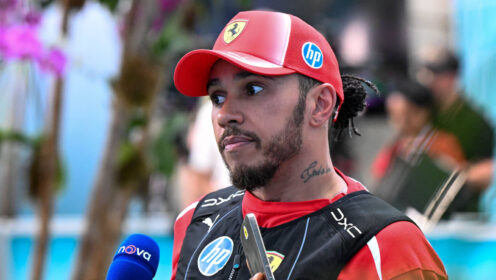

The five key reasons Lewis Hamilton hasn’t clicked with Ferrari


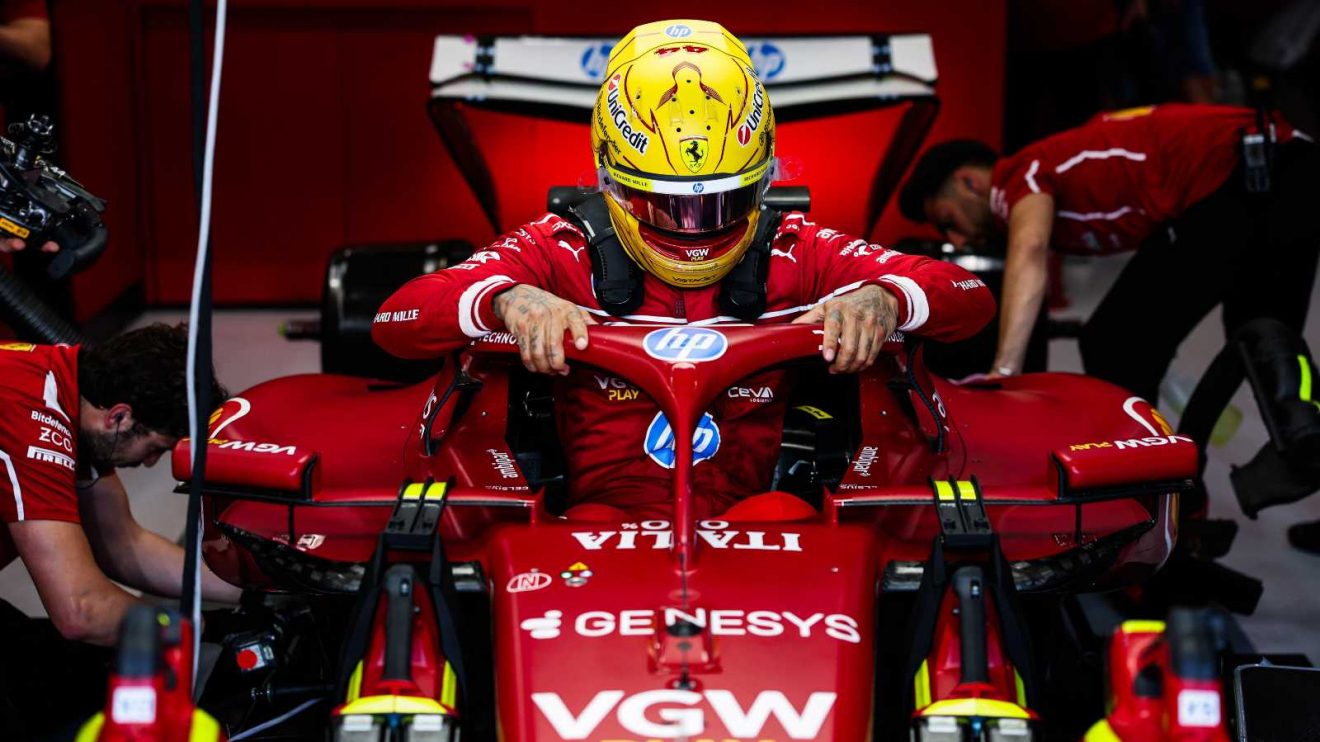
Lewis Hamilton's Ferrari transition hasn't been easy.
Sitting seventh in the World Championship while his teammate has found a place on the podium, Lewis Hamilton has not had a dream start to the F1 2025 season and his new era with Ferrari.
But why? What is it about the Ferrari SF-25 that doesn’t click with Hamilton?
Why has Lewis Hamilton struggled with Ferrari in 2025?
As things currently stand after the Saudi Arabian Grand Prix, Lewis Hamilton sits seventh in the world drivers’ championship with just 33 points to his name.
He had a tough start to the season in Australia, where he got into a verbal sparring match with his race engineer, but things looked like they were going to turn around in China.
There, Hamilton dominated the Shanghai sprint race from pole position and seemingly put to rest the idea that this Ferrari move hadn’t worked out… only to be disqualified from the Grand Prix itself for excessive skid plank wear.
Since then, his best finish has been fifth in Bahrain, sandwiched between two seventh-placed finishes at either end of the season’s first triple-header, and after the most recent race in Saudi Arabia, Hamilton sounded beaten.
He said there were zero positives for the team at Jeddah, that the race was “horrible”, and that he has no idea why his performance has slipped so dramatically since that impressive sprint race in China. And even worse, he told media after the race that there’s no immediate fix to these problems, so he’s expecting the rest of the season to be painful.
But is there truly no reason for the struggle? We don’t think so, and we have five reasons why that might be the case.
Lewis Hamilton doesn’t click with the ground effect era
First and foremost, Lewis Hamilton’s struggles didn’t start with his move to Ferrari. They started with the reintroduction of ground effect.
The whole goal of ground effect was that it would reduce the big performance gaps between the top-tier teams and the backmarkers. In reality, we’ve seen a lot of big problems.
Back in 2022, a lot of teams suffered from the ‘porpoising’ phenomenon, where ground effect would suck the car to the racing surface for a moment, then let go, then suck the car down again, then let go again.
That issue has largely been solved, but because ground effect is reduced when the car slows down, it means that these new cars handle differently in the corners than their predecessors. Namely, the grip shifts from the rear of the car to the front as the car goes through the corner, which means drivers can end up understeering or losing stability partway through the corner.
Hamilton developed his driving style prior to the introduction of ground effect. When he dives into a corner, he likes to do so late on the brakes, and he also likes to make minute directional adjustments with the steering wheel as he goes.
Add in the ground effect, though, and this driving style becomes way more difficult to manage. He’s not finding stability in corners like he used to.
If you’ve listened to Lewis Hamilton’s post-race interviews this year, you’ll hear him repeating the same things: He lacked balance. He lacked grip. He had to fight his Ferrari through the corners. He couldn’t feel his Ferrari underneath him. These are all signs that he’s having a tough time with the very concept of ground effect.
It was already tough for him at Mercedes — and it hasn’t gotten any easier now that he’s swapped to an unfamiliar team.
What the data says about Lewis Hamilton’s Ferrari era:
? Lewis Hamilton telemetry data exposes critical Ferrari issues in Saudi Arabia
? Uncovered: The reason behind Hamilton’s wild pace fluctuations
The start of the F1 2025 season has been brutal
The second reason Lewis Hamilton may be struggling at Mercedes is pretty simple: The start to the 2025 season has been brutal!
We’ve had five races in six weeks, with exactly one weekend off since the Australian Grand Prix, and we’ve had a ton of difficult circuits to start the year. For some drivers, that’s great: They love being able to take the lessons they learned from one race and apply them immediately to the next one. They’re thriving.
But other drivers like to have a chance to digest everything first. They like to consult the data, ask questions, talk to the team members involved in the areas where they might be struggling. They like to have a day or two where they don’t have to think of all the mistakes they made in the last Grand Prix.
Even though some drivers have enjoyed the rapid pace, much the grid admitted that they were glad they’d have a weekend to decompress and refocus after Saudi Arabia. That’d likely be even more important for the drivers and teams who have really struggled so far.
Whether one weekend is enough to make any substantial changes is a conversation for another day, but with five races done, there’s at least a decent enough pool of data to work from in sorting out issues heading into the rest of the year.
Ferrari is a whole new environment for Hamilton
With almost a century of history to its name, Scuderia Ferrari carries some steep expectations and some very specific traditions — and that new environment could be the third reason Lewis Hamilton has been having a tough go of 2025.
Luca dal Monte, one of Enzo Ferrari’s biographers, phrased it the best: “In Italy, there was the Pope, and then there was Enzo.”
We may have lost the team’s eponymous founder in the 1988, but that sense of grandiosity and expectation has remained with the team ever since. Italian motorsport is synonymous with Ferrari, and Ferrari is synonymous with passion, speed, and, admittedly, hard-headedness.
Enzo Ferrari was one of the last hold-outs on the mid-engined F1 revolution because, in his eyes, “The horse doesn’t push the cart” — or, the engine doesn’t push the chassis.
That revolution was decades ago, but the stubborn belief that the guy in charge of Scuderia Ferrari is always right has defined the team for better or for worse ever since.
In the modern era, Ferrari is much different. Team principal Fred Vasseur has introduced a more relaxed leadership style, one that isn’t dictated by the whims of his emotions, but he is admittedly only one man. And the foundations of the team is still built on that passion for racing that can sometimes also mean getting a little blindsided by your emotions.
It’s a big change from the more calculated but open management style Lewis Hamilton knew at Mercedes — the management style that he helped establish when he joined the team in 2013.
If you’ve ever moved from one job to a different one with a wildly different company culture compared to what you’re used to, then you know how long it can take to adapt!
There’s still so much to learn
The fourth big reason for Lewis Hamilton’s struggles? He’s still in the throes of a learning curve.
Before I dig in, though, I want to ask you a question: Have you ever swapped employers but still had to do the same job? Maybe you’re a car salesman who went from selling Audis to Fords, or you’re a writer who moved to a new publication. Did you adapt immediately?
I’m betting that the answer is ‘no,’ because even though you might technically be doing the same thing you’ve already done in the past, there are probably just enough differences to keep you on your toes. You can be an expert in your field and still have to learn email etiquette, how to talk to your boss, and all the unspoken expectations that dictate the flow of a workplace. It takes a while before that stuff is second nature.
We might be five races into the season, but Lewis Hamilton is still very likely in this phase of his tenure at Ferrari. He’s still learning how to communicate with Fred Vasseur, and how to compete alongside Charles Leclerc. He’s getting used to a new car that he didn’t have input in, and learning how to work with new crew members – including his race engineer.
Plus, he’s just moved to an Italian organization without speaking a lick of the language! These are all factors that just take time to get used to, especially if you’ve spent so long doing these things in a very specific way somewhere else.
F1 may no longer be Hamilton’s biggest focus
There are a lot of naysayers out there who are quick to say that Lewis Hamilton is struggling because he’s just not cut out for Formula 1 anymore, pointing to his age or claiming that his success was all down to the car.
I do not subscribe to those beliefs. But I do think Lewis Hamilton may very well be reevaluating the role that F1 plays in his life.
On top of his seven drivers’ championships, Hamilton has also become a celebrity who has transcended the world of car racing. He’s a co-chair of the Met Gala, which is probably the world’s biggest and most influential fashion event.
He’s a producer of the new F1 film starring Brad Pitt, and also said he was really disappointed that he didn’t get a chance to star in Top Gun: Maverick because filming would conflict with his racing schedule.
He has founded Mission 44, which is designed to encourage folks to achieve their goals in disciplines where they’ve been critically under-represented. He’s a partial owner of the Denver Broncos NFL franchise, and he’s got more brand deals than I can list here.
Some people might see those diverse accomplishments and claim that they only highlight the fact that Hamilton is trying to be in too many places at once, which means he’s not giving his all to Formula 1 anymore.
But I think we can look at this in a different light: Lewis Hamilton now sees himself as more than an F1 driver. Motorsport is just one star in the constellation of interests that define his global recognition, and, maybe, it’s no longer the one that brings him the most fulfillment.
Let’s return to the new-job analogy I brought up before. Sometimes, you leave your job because you’re feeling stuck, because you think a change of scenery might be just what you need to spark that pep in your step again.
But sometimes, you move to a new employer and realize that it wasn’t your old boss or your old workflow that was driving you crazy — it was actually the very nature of the job itself. You might realize it’s time to do something totally different, but you wouldn’t have known if you hadn’t tried working somewhere else.
Maybe Formula 1 just isn’t doing it for Lewis Hamilton anymore. Maybe it took the move to Ferrari to figure that out.
Read next: Time waits for Carlos Sainz, so why is Lewis Hamilton declared finished?