
Why you shouldn’t fully blame Lewis Hamilton for a flat Ferrari debut


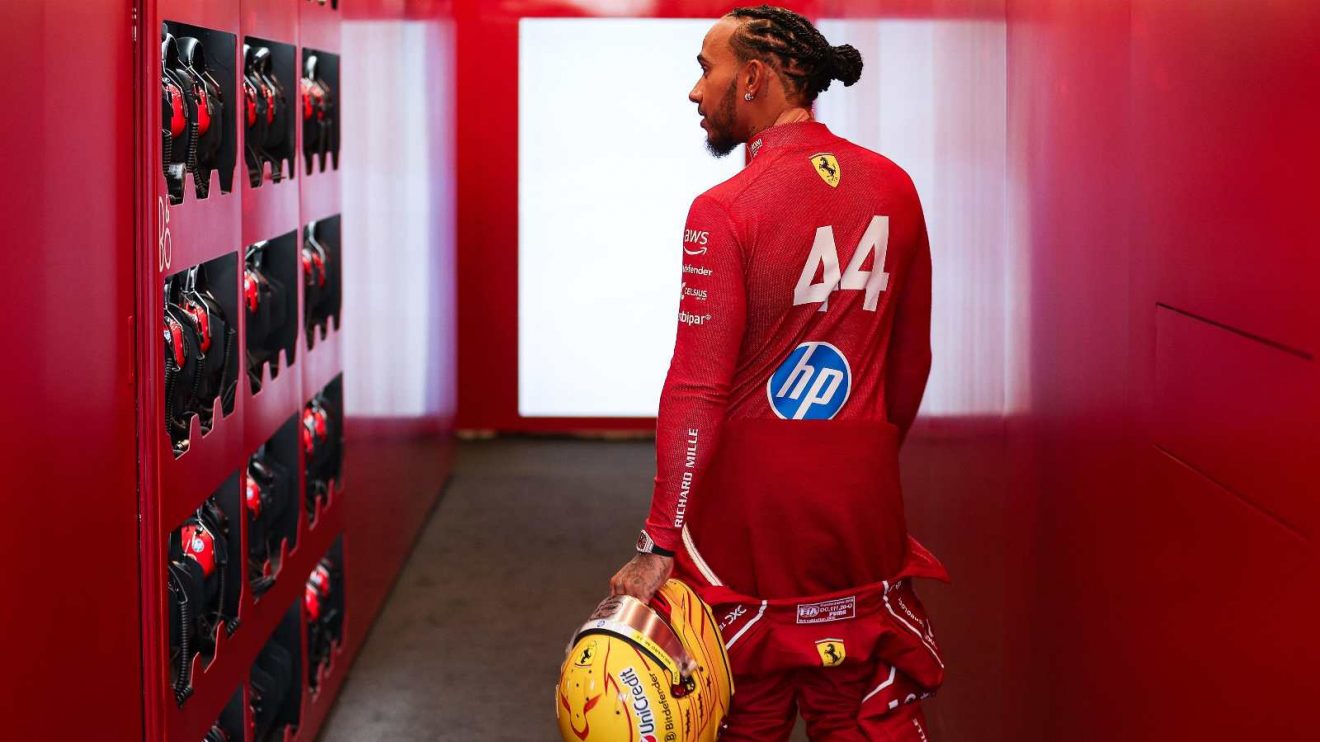
Lewis Hamilton's first Grand Prix weekend with Scuderia Ferrari didn't go to plan.
After over a year of hype following Lewis Hamilton’s announcement that he’d be racing for Scuderia Ferrari in 2025, we’ve finally seen how the driver/team pairing functions on the track — and it’s left many fans and pundits a little disappointed.
Many critiques seem to center explicitly on Hamilton — his age, his attitude, his skill — with a strong sentiment that the driver alone is responsible for on-track performance. But Ferrari plays a massive role in this new era of Hamilton’s, and if this partnership is going to work, both parties need to step up.
Ferrari needs to step up for Lewis Hamilton, too
From the moment Lewis Hamilton announced that, in 2025, he’d leave behind his long-time partnership with Mercedes and step into a new era with Scuderia Ferrari, the pressure has been on. A generational talent is joining a team that has spanned generations; the storylines practically write themselves.
Unfortunately, not all those storylines have been positive.
Firm believers in Hamilton’s skill are asking if this team swap will net him a record-breaking eighth World Championship, while detractors have wondered if, at 40 years of age, Hamilton is past his prime and can only meet with disaster at Ferrari.
And with the driver’s performance at the Australian Grand Prix, many of those more cynical storylines have bubbled to the surface.
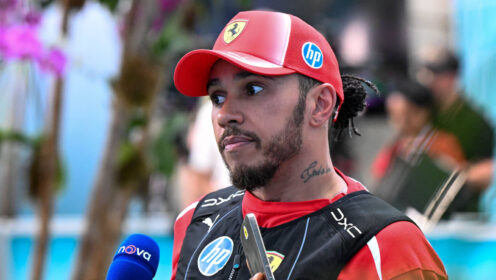
After qualifying, Hamilton admitted to the media that he was having a harder time than expected in adapting to the Ferrari, which saw him struggling in a way that seemed to entirely bypass longtime Scuderia driver Charles Leclerc.
“It’s been a lot slower process for me to really feel the confidence in the car,” he admitted. “Like, if you look at the high speed everywhere, I’ve been down all weekend to Charles, and just had it from the get-go.”
He even added, “I honestly thought I was further along than I was and then I got here for P1, and I was like, ‘I still got a way to go.’”
Such were the words of a man who lined up eighth on the grid. Naysayers looking for another chance to argue their pessimism was perfectly warranted pointed to Hamilton’s quotes as proof that the seven-time champion is out of his depth — forgetting, or possibly ignoring, that Hamilton was lining up alongside his teammate.
And if qualifying was messy, then the race itself was closer to a disaster. While teammate Leclerc was able to quickly dispose of Alex Albon’s Williams at the start, Hamilton spent lap after lap trapped behind a car he was expected to soar by with ease.
As the Grand Prix progressed, Hamilton routinely asked his new race engineer Riccardo Adami to leave the driving to him, to stop chiming in with suggestions or driving tips. As Ferrari fumbled the all-critical pit stop timing as rain came in the latter stages of the race, the Briton was quietly furious, saying, “Thought you said it wasn’t going to rain much? Missed a big opportunity there.”
After a pit stop, Hamilton emerged back on track in ninth. In the closing stages, Oscar Piastri nipped by, leaving the new star in scarlet to finish in 10th place.
As he lamented to Sky Sports F1 after the race, “For me, I’m just grateful that I kept it out of the wall, because that’s really where it wanted to go most of the time. But a lot to take from it, and also just getting acclimatized to the new power unit in the wet conditions, all of the settings that it requires, a different way of driving, a different setup on the steering wheel.
“Obviously I hung out as long as I could, got in the lead at one point, and I think just the guidance in terms of how much more rain was coming was just missing there. So I think we missed out.”
In the aftermath came the critiques: Lewis Hamilton is not only letting Ferrari down, but he’s clearly past his prime.
But where is the recognition that Formula 1 is a team sport? That Ferrari has just as much to learn about Hamilton as Hamilton does about Ferrari?
More analysis on Lewis Hamilton’s first weekend with Ferrari:
? Lewis Hamilton’s Ferrari fairytale becomes a familiar story of failure
? Uncovered: The inside story of Lewis Hamilton’s Ferrari debut
Regardless of his performance, Hamilton was in a double bind — damned if he won the race (well, he’s a seven-time World Champion, the GOAT; winning on debut with Ferrari is a base-level expectation), damned if he didn’t (he’s a seven-time World Champion, the GOAT; surely he should be able to get up to speed immediately).
What both of these assessments leave on the table is the fact that racing is a team sport, and that Scuderia Ferrari is just as responsible for turning up to Australia with a race-winning mindset as its drivers — and that both team and driver will need time to understand how to best work with one another.
Preparations for the Scuderia’s 2025 operation kicked off last year, during a period where Hamilton was still contractually employed by Mercedes and therefore was unable to offer input into car design. Early sketches evolved in anticipation of Hamilton joining the team, but without his direct input.
Naturally, there will be a learning curve as Hamilton understands what the SF-25 can do, and as the design and engineering crews progressively update the car throughout the year based on his and teammate Charles Leclerc’s feedback.
Because he’s joining a new team for the first time in over a decade, Hamilton is not just learning a new car — he’s learning how to work with an entirely new group of people, which means understanding their processes, routines, quirks, and general temperament. At the same time, all of those Scuderia employees are also learning how to work with a man who inevitably has more specific expectations than the younger drivers who have competed with the team in recent years.
Mechanics and engineers must learn how to prepare a car that provides Hamilton with the intuitive ability to maximize performance, and Hamilton must learn how to communicate what he needs.
Riccardo Adami, Hamilton’s race engineer, must learn what kind of information Hamilton is looking for during a race, and when to deliver it to the driver, while Hamilton must learn how this new voice on his radio conveys performance metrics and then ask for any alterations he may need.
Scuderia Ferrari’s strategists must learn how to craft a pit strategy around Hamilton’s specific driving style, while Hamilton must know when to question that strategy or suggest a different way forward.
Ferrari must also learn to set aside any ego it may have thanks to its longevity and success in Formula 1, while Lewis Hamilton will have to do the same.
With such strict limitations on pre-season testing, there is no way for anyone on Scuderia Ferrari to understand one another until the lights go out on race day.
Two parties with high expectations and well-defined operating procedures are learning feeling each other out in the heat of battle, and instead of trying to pin the blame on one party or the other, fans and pundits should focus instead on the historic fusion we’re witnessing in these two titans of motorsport attempting to understand one another.
Lewis Hamilton is a seven-time World Champion. He’s a driver who has soared to astonishing heights in large part due to his ability to extract the most from a Formula 1 machine — but, critically, he isn’t a magician, nor is he the only man on his team who must deliver on race day.
When the technological marvels that are modern Formula 1 cars hit the race track and the spectacle of the season begins, it can be easy to forget the deeply human elements of the sport amid all the spectacle. Yes, the car must be quick — but perhaps even more important, the driver and his team need to speak the same language. In fact, it goes even further: The driver and his team must anticipate what the other is going to say, do, or think.
Data, telemetry, and the weight of expectation can only carry you so far in Formula 1. Success is found in the subtleties of human interaction between the driver and the hundreds of team employees who create the infrastructure that puts the driver on the race track every weekend.
It shouldn’t come as any surprise that two monoliths of the sport are finding it harder than anticipated to come to grips with one another. It’s as if Lewis Hamilton has moved to a different country; would you really be astonished to learn there was still a little culture shock lingering after just 10 weeks?
I’ll leave you with this: When Lewis Hamilton first joined Mercedes in 2013, he did so as a World Champion desperate to regain a winning streak that had defined him on the world stage, then slipped through his fingers. It took Hamilton until the 10th race of the season to win a race, and even then, his performance throughout the rest of the season was nothing to write home about.
But when 2014 arrived with a regulatory sea-change, Lewis Hamilton and Mercedes had an intimate understanding of one another. They’d come to anticipate one another’s moves. They’d built a new program that fizzled out with a season-opening retirement, leaving critics to ask, “Shouldn’t Hamilton and Mercedes be better than this by now?”
Over the next seven years, Mercedes and Hamilton made history.
Let’s not be so quick to write off the Lewis Hamilton/Scuderia Ferrari marriage just yet. Not when the story has only just begun.
Read next: Lewis Hamilton rues ‘missed opportunity’ on ‘very tricky’ Ferrari debut