

The wildest penalties in NASCAR history, from race bans to team-killing fines


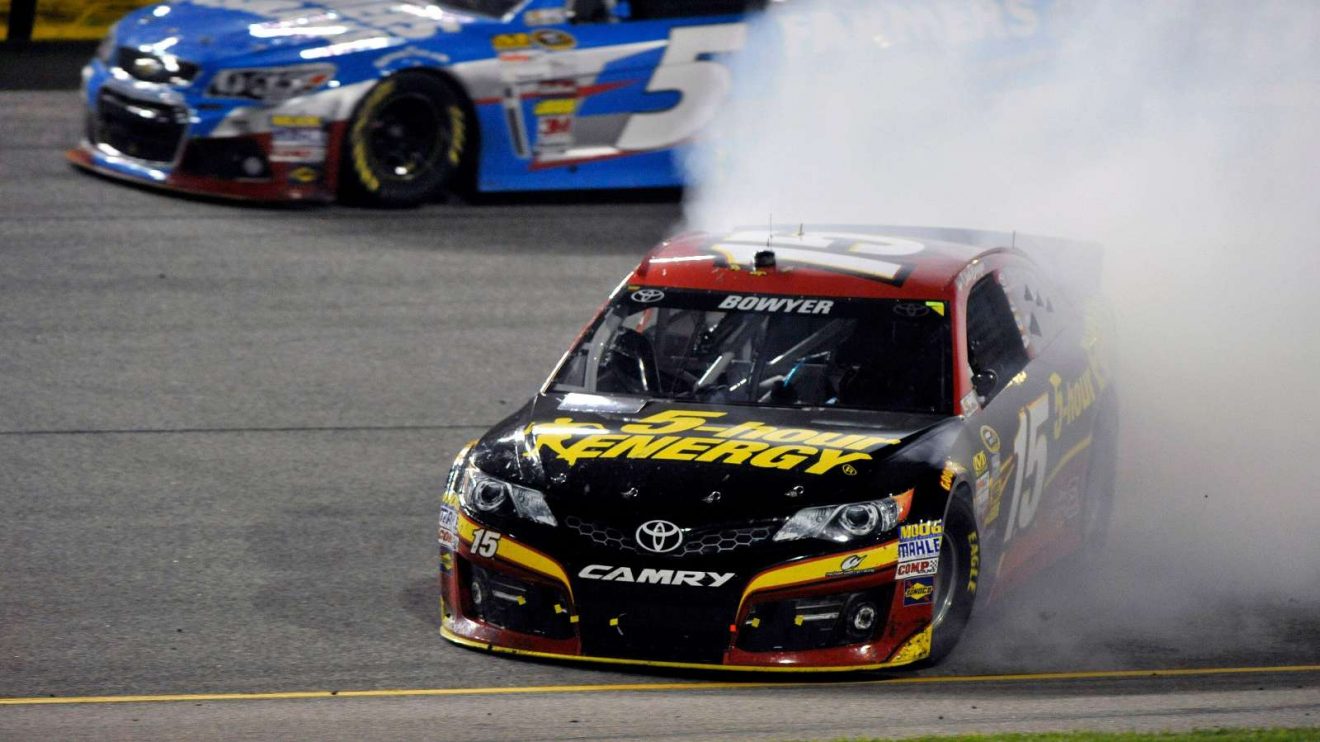
Clint Bowyer's intentional spin during the 2013 Federated Auto Parts 400 led to a penalty that killed his team.
After the chaotic 2025 Daytona 500, NASCAR issued a massive penalty to the No. 19 of Chase Briscoe due to the use of an illegally modified spoiler — and now, Briscoe has a negative amount of points as he heads into the remainder of the season.
Despite NASCAR’s lawless, moonshine-running foundations, the series has created a series of strict rules — and today, we’re looking at some of the wildest penalties in Cup Series history.
NASCAR’s wildest penalties
A lawsuit for the first penalized driver
The first-ever NASCAR penalty ever issued was done in the first official NASCAR race — what was then known as the Strictly Stock series, but that we’d now know as the Cup Series.
That race, held on June 19, 1949, was hosted at Charlotte Speedway, a 0.75-mile dirt oval track. Bob Flock took pole position and led the first few laps until his engine malfunctioned, and the first driver to cross the finish line was a man named Glenn Dunaway.
But NASCAR officials were skeptical; Dunaway’s car seemed to be too steady on the rutted dirt track. An investigation revealed that the car owner had spread the rear springs — an old moonshine running trick to improve handling. Dunaway was subsequently penalized by losing his win and being classified 33rd. The second-place finisher, Jim Roper, was handed the win despite finishing three laps behind Dunaway.
Car owner Hubert Westmoreland was furious that his machine had been disqualified and that he hadn’t been awarded the prize money, and he promptly took NASCAR to court to seek $10,000 in damages — the equivalent of over $130,000 today when adjusted for inflation, and double the overall prize purse.
The judge ruled in NASCAR’s favor, saying that the organization had a right to enforce its own rulebook.
Curtis Turner and Tim Flock banned from NASCAR for life
Curtis Turner honed his driving talents behind the wheel of his family’s moonshine-running cars and was able to turn that into a racing career in the late 1940s. But in the 1960s, Turner was banned from NASCAR for life.
Why? He’d wanted to unionize.
Turner and his business partner Bruton Smith had asked the Teamsters Union for help assembling a driver union in hopes of advocating for better prize purses, but NASCAR boss Bill France adamantly refused. Only two drivers remained on the side of the union: Turner and Tim Flock. Both were subsequently banned from NASCAR for life.
In reality, Turner’s ban was overturned after four years, with Flock returning a year later.
The $100,000 fine that killed Petty Enterprises
On October 9, 1983, Richard Petty won his 198th race at Charlotte Motor Speedway; four hours later, NASCAR announced that Petty would be penalized because his engine was far too big, and because he’d fitted left-side tires to the right side of his car.
NASCAR determined that Petty’s win would still stand, but that he would be docked 104 points and fined $35,000 — or, about $110,000 today when adjusted for inflation.
The impact was immediate. Petty’s team, Petty Enterprises, paid the fine, but doing so meant that it didn’t have enough money to field two cars in 1984 ad it had done in the past. Richard Petty opted to leave the team, while Kyle Petty remained for a while — until he felt that he’d have a better shot racing somewhere else.
Losing Kyle Petty had a further impact on Petty Enterprises, and in 1985, it only contested four events.
While the team stuck it out for decades after, the team has since been bought out and transformed into Legacy Motor Club. It might have taken a while for the outfit to finally dissolve, but all signs point back to that 1983 penalty.
A big ban for a big engine
In May of 2009, driver Carl Long was fined a whopping $200,000 when the engine he used during that year’s practice session for the All-Star race was found to be 0.17 cubic inches over regulation size.
On top of that, Long was penalized 200 driver points, with his team being fined 200 owner points; Long was also suspended for 12 Cup races, suspended from all NASCAR racing until August 18, and placed on probation until the end of the year.
Long wasn’t able to pay that hefty fine, so he was banned from competing in the Cup Series. That was effectively the end of the Cup road for Long, who kept his career alive in the lower divisions of NASCAR racing but whose only further Cup Series appearance came in 2017.
More from NASCAR history:
? From moonshine running to land speed records: The unlikely history of NASCAR
? Explained: NASCAR Cup Series points and championship format
Mark Martin’s career-changing points penalty
Despite being one of the most consistent Cup Series drivers for much of his career, Mark Martin never won a championship. History could have looked much different, though, if he hadn’t been penalized at the second Richmond race in 1990.
There, Martin was penalized for using an illegal carburetor spacer. It didn’t enhance his performance, but it did break the rules, so NASCAR hit him with a $46,000 financial fine as well as a loss of 46 points in the championship.
When the season came to a close in Atlanta, that penalty ultimately decided the championship. Mark Martin and Dale Earnhardt had duked it out all season long and were miles ahead of the rest of the competition — but Earnhardt was ultimately crowned the champion.
The gap to second-placed Mark Martin was just 26 points. Without his Richmond penalty, Martin’s career would have looked much different.
Spingate
Every good scandal comes equipped with a “-gate,” and that’s the case with Spingate — the name given to what happened at the 2013 Federated Auto Parts 400 at Richmond Raceway.
The race was the last qualifying event for the Playoffs, and in the closing laps, three teams were accused of colluding to manipulate how drivers and teams finished: Michael Waltrip Racing, Team Penske, and Front Row Motorsports.
But the big penalty came to MWR. With less than 10 laps remaining, the team’s three drivers colluded to ensure Martin Truex Jr. would make the Playoffs. To do this, Clint Bowyer spun, bringing out a caution flag. Immediately after, Brian Vickers pulled into the pits. This put teammate Truex into position to make it into the Playoffs.
In reviewing audio between the drivers and crew chiefs, it was clear that Bowyer’s spin was intentional, and that Vickers had been ordered into the pits for no reason. As a result, NASCAR fined MWR $300,000. Truex was bumped from the Playoffs because all three drivers were docked 50 points, all three cars were docked 50 owners points, all three crew chiefs were placed on probation for the rest of the year, and the team’s general manager and vice president Ty Norris was suspended.
Oh, and many of the team’s key sponsors, including NAPA Auto Parts, severed ties with MWR. The team managed to last two more seasons before it bit the dust. It sold its charters to Stewart-Haas Racing (now the Haas Factory Team) and Joe Gibbs Racing.
Race manipulation in 2024
After 2024’s Cup Series race in Martinsville near the end of the season, nine race manipulation penalties were issued for a total fine of $600,000.
Tensions were high heading into the penultimate round of the Cup Series championship; in that race, four of eight Playoff-eligible drivers would be knocked out, while the final four drivers would duke it out for the title at the next race in Phoenix.
Enter: race manipulation. William Byron was the only Chevrolet driver with a shot at making the Championship 4, but near the end of the race, if anyone passed him, he’d lose that spot. Chevy drivers Austin Dillon and Ross Chastain seemed conspicuously stuck just behind Byron — and also managed to prevent any other driver from passing him.
Nine total team personnel were suspended between three teams. Each driver was docked 50 points and told to pay $200,000 — leading to a total $600,000 fine when all was said and done.
The Hendrick Smackdown
All four Hendrick Motorsports team cars were fined $100,000 in March of 2023 when NASCAR discovered the team had outfitted its cars with illegal hood louvers.
Hood louvers are effectively vents in the hood; they’re designed to spit air out of the radiator in such a way that it “decouples engine performance from aero performance,” per NASCAR.
Hood louvers are a stock part for NASCAR, meaning that making alterations from them would be illegal. It’s not fully clear exactly what HMS did to the louvers, but it was enough for NASCAR to fine car $100,000.
The Next-Gen era’s only L3 penalty
In NASCAR, there are three levels of penalties. L1 penalties include things like failure to meet minimum weight after a race; L2 penalties include things like modifications to single-sourced parts (as in the Briscoe case at the 2025 Daytona 500), while L3 penalties involve instances like counterfeiting single-sourced parts or modifying engine performance.
The only L3 penalty issued in the Next-Gen era came in May of 2023, when the No. 14 Stewart-Haas Racing car of Chase Briscoe was found to be using counterfeit parts. NASCAR stated that the issues were found in the engine panel and related to counterfeit NACA ducts that pump air to the remainder of the car.
SHR chose not to appeal the hefty penalty levied by NASCAR: The docking of 120 points from the driver and owner, as well as the loss of 25 Playoff points. Briscoe’s crew chief Johnny Klausmeier was suspended for six Cup Series races, and SHR was fined $250,000.
Read next: The $100,000 penalty that sees one NASCAR driver with negative championship points