

Winners and losers from the 2025 NASCAR Cup Series Daytona 500


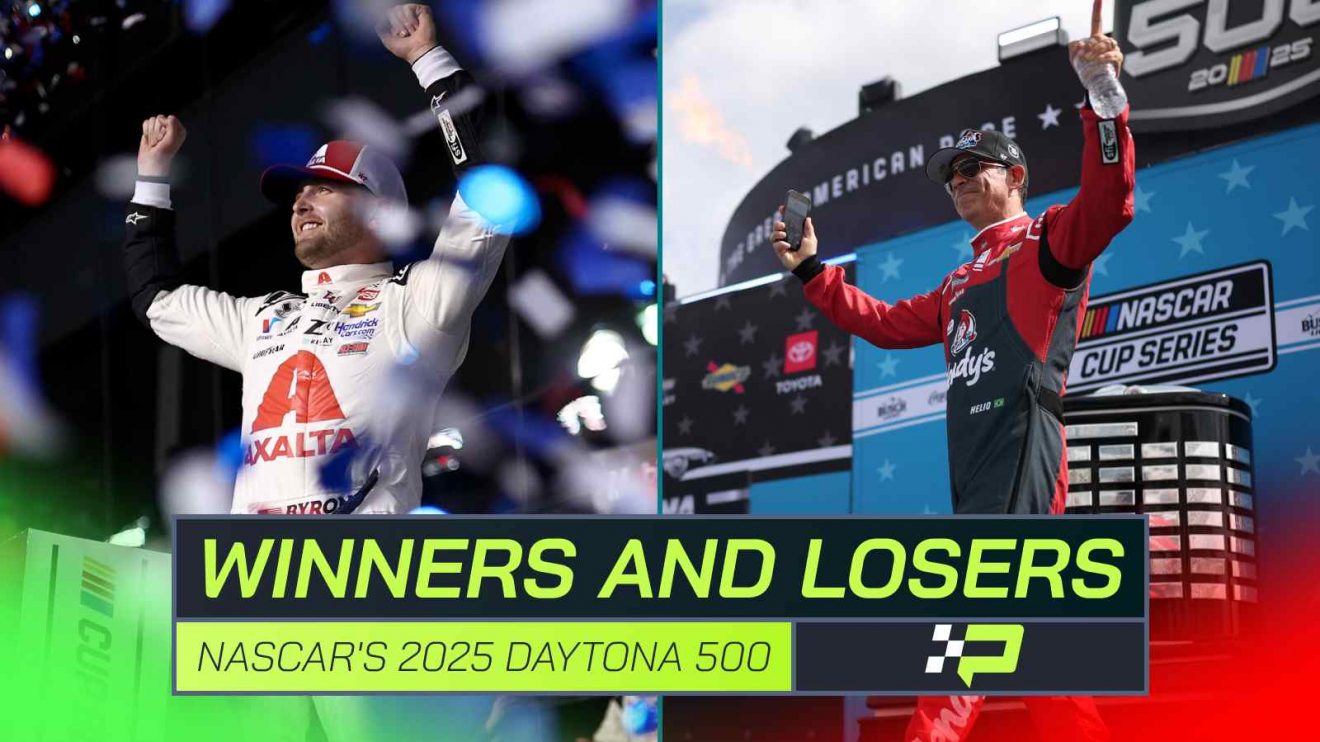
William Byron and Helio Castroneves represent opposite ends of the winner/loser spectrum at the Daytona 500.
William Byron took the checkered flag at last night’s Daytona 500 to become the event’s fifth back-to-back winner, as well as the first winner of the 2025 NASCAR Cup Series season. But there were plenty of wins — and losses — up and down the grid.
From Byron to Helio Castroneves, these are PlanetF1.com’s winners and losers for the 2025 Daytona 500.
Winners and losers from the 2025 Daytona 500
Winner: Legacy Motor Club
Don’t worry, our moment of celebration for back-to-back winner William Byron is coming — but first, let’s take a moment to give a shout-out to Legacy Motor Club. Driver Jimmie Johnson also serves as the primary owner of the team that used to be Petty GMS Racing, and at the Daytona 500, he took a third-place finish against all odds.
Of course, with seven NASCAR Cup Series championships under his belt, you’d generally expect Jimmie Johnson to finish well, but that hasn’t been the case since he retired from full-time Cup competition. Since founding LMC, Johnson’s best finish was 26th at last year’s Phoenix finale.
The road has been rough, particularly after Legacy moved from Chevrolet to Toyota power, but the team was legitimately impressive at Daytona.
Johnson’s third-place finish was bolstered by the rest of the Legacy crew. No. 42 driver John Hunter Nemechek finished fifth while No. 43 driver Erik Jones’ 12th-place finish isn’t representative of his pace; Jones had been fighting toward the front of the pack until a crash wiped him out of contention.
Loser: Hélio Castroneves (and Trackhouse Racing)
Not one Trackhouse Racing car emerged from the Daytona 500 unscathed, and one-off driver Helio Castroneves failed to make the most of the provision that guaranteed him an entry into the race.
Let’s start with Castroneves. The Brazilian driver is a legend in IndyCar, but since retiring from full-time competition a few years ago, he’s been trying his hand at other forms of motorsport — and this year, he inked a one-off deal with Trackhouse Racing for the Daytona 500. But the whole ordeal felt… off.
Castroneves took advantage of a new-for-2025 rule called the “Open Exemption Provisional.” Because the NASCAR field is limited to 40 cars, this rule states that a driver with sufficient international importance will be given a 41st-place starting spot if he doesn’t otherwise make the race via qualifying. Castroneves failed to qualify, triggering the 41st-entry clause. Then he was caught up in a crash and retired to be classified 39th.
NASCAR’s exemption rule brought a lot of controversy, and Castroneves’ lack of performance in the Cup Series only served to further highlight the fact that NASCAR racing is tough, and that being a star in one series doesn’t always translate to success in another.
As an organization, Trackhouse didn’t fare much better.
The team kicked off the weekend with the sudden announcement that former co-owner Pitbull would be leaving the team, effective immediately. No reason was given for the split, but for an organization already on shaky footing courtesy of rumors about WeatherTech’s backing going away, it was bad news.
Trackhouse No. 1 driver Ross Chastain was the driver responsible for knocking Castroneves out of the race. No. 99 driver Daniel Suarez looked strong all night until his car was wrecked during one of the final multi-car crashes of the night (though he was still classified 13th). Meanwhile, No. 88 driver Shane van Gisbergen was collected early on, to be classified 33rd.
Castroneves, Suarez, and van Gisbergen all sustained enough damage in the Duels heat races on Thursday that they were forced to swap to a backup car before the race. For an organization already on thin ice, financially recovering from the Daytona wrecks may become a season-long affair.
Winner: William Byron
Now it’s time to celebrate William Byron, driver of the No. 24 Hendrick Motorsports Chevrolet and back-to-back winner of the Daytona 500.
While some fans felt let down by the finish of the race — a big crash at the front of the field wiped out most of the race’s key players just before the final corner — Byron was one of just a handful of cars to escape significant damage during the event’s numerous multi-car crashes. By keeping his nose clean, he was able to be in the ideal position at the checkered flag.
Byron is only the fifth NASCAR driver to win the Daytona 500 two years in a row. Before him were Richard Petty (1973 and 1974), Cale Yarborough (1983 and 1984), Sterling Marlin (1994 and 1995), and Denny Hamlin (2019 and 2020).
Another fun fact: Byron has only finished higher than 21st in two of the eight Daytona 500s he’s run — and in those two races, he won.
Loser: Martin Truex Jr.
Martin Truex Jr. retired from full-time NASCAR competition at the end of 2024, but despite an otherwise successful career, he admitted that he’s still chasing after a coveted win at the Daytona 500. When he announced he’d be contesting the Daytona 500 with Tricon Garage’s No. 56 Toyota, it was no surprise — though it may have been his best chance at success.
It should go without saying that competing in the Daytona 500 is difficult enough, but that challenge grows even greater when it’s the only Cup Series event you contest in a year. Truex soldiered through the chaos of qualifying to make the field, only to be wiped out early on in the race.
It’s likely we’ll see Truex back at the Daytona 500 in 2026, but it’s almost assured that his skills will have grown rustier, and that it’ll be that much more difficult to make a win work.
Winner: Toyota
Of the three manufacturers that currently compete in NASCAR, Toyota fields the fewest cars, yet four of the top five cars to finish the race were Toyotas. Chevy driver Byron won, followed by Tyler Reddick, Johnson, Chase Briscoe, and Nemechek.
To understand how huge that is requires a little context. Even though foreign marques competed in NASCAR’s earliest days, the last time one did so before Toyota was in 1963, when MG Motors fielded a car in what is now the Cup Series. It wasn’t until 2007 that another international manufacturer joined the grid: Toyota.
Since then, Toyota has won the Daytona 500 three times, all with Denny Hamlin. Kyle Busch and Martin Truex Jr. are the only Toyota drivers to win a championship. And Toyota only just secured its first pole position at the 500 this year. There’s a lot for Toyota to be proud of.
Understanding NASCAR:
? Explained: NASCAR Cup Series points and championship format
? NASCAR Playoffs explained: Format, rules, tracks, and schedule
Loser: Joey Logano
Team Penske’s No. 22 driver Joey Logano had everything going for him: A strong car, a great flow with his teammates, and a race strategy that seemed destined to win despite suffering from throttle issues courtesy of some debris caught in his machine.
Then he got hasty.
With 15 laps remaining in the race, Logano attempted to use a big push from John Hunter Nemechek to form a third lane and swing his Ford into the lead. Ricky Stenhouse Jr. darted in front of Logano several times in order to block him, and Logano had had enough. When Stenhouse tried to block him again, Logano ran into the No. 47 machine.
It was a “hail Mary” move that had very little chance of working as it stood, since Logano was trying to force his way into a gap that was too small for him. He may have been able to make it work had he not run into Stenhouse; after he did so, Logano’s car began to wiggle, and the Penske driver turned into teammate Ryan Blaney, setting off a wreck that collected a large portion of the field.
Logano is no spring chicken; he’s competed in the Daytona 500 17 times and should understand the unspoken rules of restrictor plate racing. Unfortunately, he seemed to let his frustration get ahead of him, and a day that should have ended in glory instead trashed his entire team.
Winner: JR Motorsports
JR Motorsports, the NASCAR Xfinity Series team run by Dale Earnhardt Jr., made its Cup Series debut at the 2025 Daytona 500 under frankly chaotic conditions — and emerged on the other side with a top-10 finish.
JR’s No. 40 Chevy was piloted by Justin Allgaier, and because the car only intends to compete on a part-time schedule, it was one of nine “open” cars that entered the Daytona 500. The 36 chartered machines were all guaranteed a starting spot, leaving four slots for the open cars.
That Allgaier made the field was impressive enough, as was his 19th-place starting position — firmly in the upper half of the 41-car grid. That he survived a multi-hour wreck fest to be classified ninth at the end of the race was even more exceptional.
After the event, Dale Earnhardt Jr. admitted that he’s now “striving” to more regularly compete in Cup Series racing after seeing what his team was capable of at Daytona.
Loser: Front Row Motorsports
Right now, two Cup Series teams are attempting to sue NASCAR, alleging that the sport operates as a monopoly. Those two teams are Front Row Motorsports and 23XI Racing — and before the season, a judge ordered that NASCAR continue to afford both teams with the privileges given to them by their charters.
It was a win for both teams, and at Daytona, FRM drivers Todd Gilliland and Noah Gragson both did well to keep their noses clean in a series of wrecks. A win — or even a strong finish — for a team in active litigation against NASCAR could have done a lot not only to boost morale but also to line the pocketbooks of an outfit worth an estimated $25 billion.
It wasn’t to be. No. 38 driver Zane Smith was wiped out for good in one of the first crashes of the day, but both Gragson and Gilliland seemed to have something for the leaders.
Then Gilliland’s No. 34 and the No. 4 of Gragson were both wiped out by Joey Logano. Gilliland was classified 27th, Gragson 28th.
With all three cars sustaining heavy crash damage, FRM is going to have a hefty repair bill alongside its mounting legal fees.
Winner: MAX in-car driver cameras
NASCAR fans who have The CW app on their television were able to pull up a variety of in-car cameras — one for each of the 36 full-time chartered cars, with several multi-view options that showed the onboards from four cars at once. Select the single-car view, and you’ll also have access to the driver radio
A new introduction this season, the drivers cam feed includes a live ticker featuring the full field of drivers, lap count, and elapsed time, as well as a panel of information about the driver whose onboard you’re following, including speed, gear, RPMs, and live location on the track.
The only drawback here is that you either already need to have a MAX streaming subscription, or you have to pay $9.99 per month for a package that only shows the in-car feeds.
I alternated in-car cameras throughout the race and noticed that the in-car feed generally runs a few seconds ahead of the official FOX broadcast, but I really enjoyed the access. Overhead camera shots may convey the field-wide action, but the in-car footage provides a constant visual of the chaos that comes from the mid-pack scrum — and the fact that it’s possible to rewind the stream meant that fans were able to review the in-car footage from some of the bigger wrecks of the night.
NASCAR’s ability to organize this for the full season is a huge win, and it added an extra layer of depth to the Daytona 500 broadcast.
Loser: FOX
FOX moved the start time of the Daytona 500 to a time several hours earlier in the day in order to avoid a rain storm, only for a lengthy delay to follow as President Donald Trump arrived at the circuit for a brief promotional stint. The race took the green flag at its originally scheduled hour, then was red flagged 15 minutes later for rain.
The rain delay broadcast was packed with awkward filler as the pit reporters were tasked to scrounge for interviews; after about two and a half hours, the network finally decided to re-air the 2024 Daytona 500.
Up in the booth, the commentary trio of Mike Joy, Kevin Harvick, and Clint Bowyer seemed more like they were in a verbal sparring match, hoping to get a word in edgewise in and amongst stories from the former drivers’ careers and increasingly heavy-handed attempts at banter.
From a broadcast perspective, FOX left a lot to be desired, with Saturday night’s Xfinity Series broadcast on The CW feeling more polished, professional, compelling, and informed.
Read next: William Byron takes back-to-back victories in a crash-heavy Daytona 500