

The ultimate F1 beginner’s guide: Everything you need to know to watch a Grand Prix


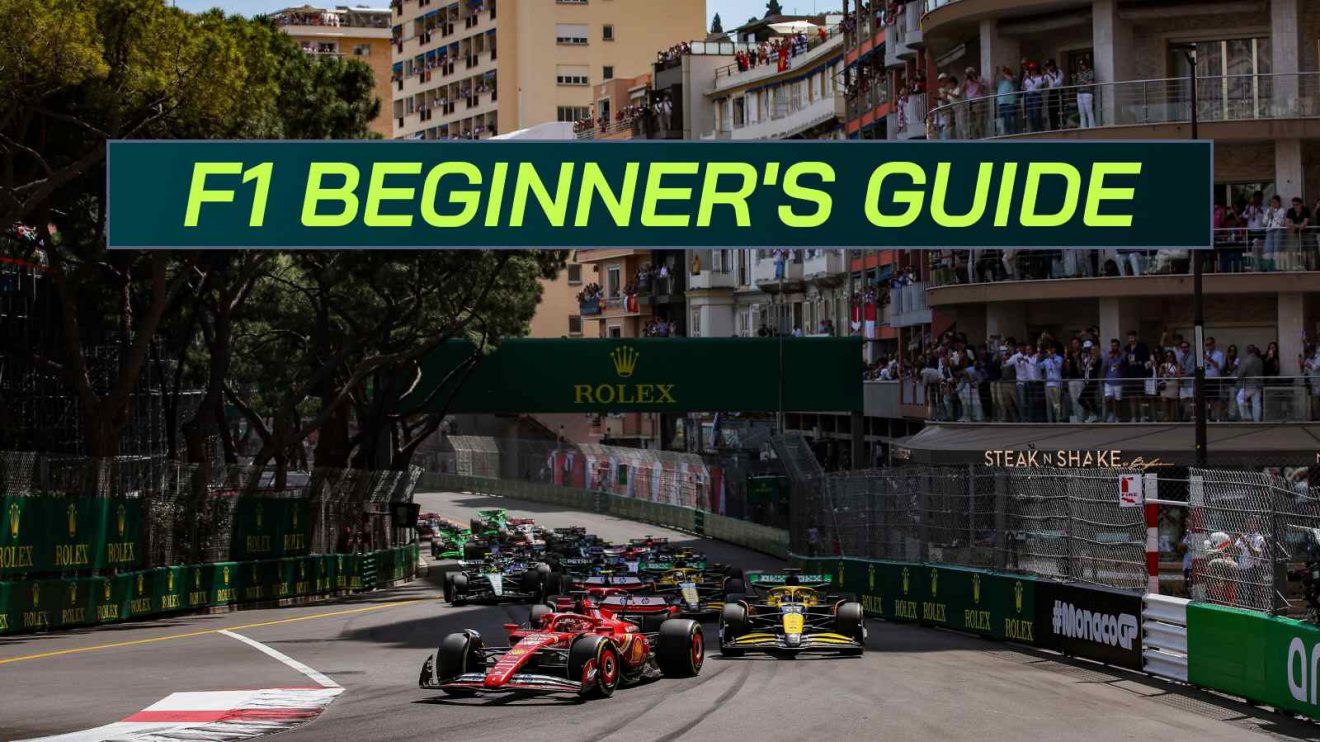
Formula 1's most iconic team (Ferrari) leads the way at the series' most iconic race (the Monaco Grand Prix).
Are you thinking about tuning into your first Formula 1 race, but you’re not sure quite where to start, or how to get up to speed with what has long been described as the “pinnacle of open-wheel racing?”
We here at PlanetF1.com have you covered with our ultimate F1 beginner’s guide; everything you need to know to tune into a Grand Prix is compiled here in one place. You’ll be an expert in no time!
What is Formula 1?
Formula 1 is a form of open-wheel motorsport that is organized and operated by the Federation Internationale de l’Automobile, or the FIA. The first race, the 1950 British Grand Prix, paved the way for the sport to become the truly international and high-tech circus it is today.
Each weekend, both drivers and their teams compete to earn the most points — and, therefore, the Championships at the end of the year. For over seven decades, F1 has produced the most exceptional drivers and technology known to the automotive world, jetting between the tree-shrouded classic tracks of Europe to the streets of Las Vegas.
More than that, though, F1 is a sport of technological innovation. Each car lining up for a race in this modern era has cost millions of dollars to make, and it represents the most advanced level of thinking, software, and design.
Who is in charge of Formula 1?
Formula 1 is sanctioned by the Fédération Internationale de l’Automobile, better known as the FIA.
The FIA is an international governing body for various motorsport disciplines ranging from go-karting to Formula 1
It is the FIA that determines the rulesets by which F1 competes — so when you hear about the “incoming 2026 regulations,” then you can rest assured it was the FIA who wrote up those rules. The FIA is also in charge of enforcing those rules during a race via a race director and a cast of revolving race stewards.
That being said, Formula 1 teams do have some say in the rules as a result of something called the Concorde Agreement. In effect, this agreement is forged between F1 and the FIA every few years, and it outlines things like how many teams are allowed in the sport, what procedures a new team needs to follow to enter Formula 1, and what a prospective team would need to do in order to enter F1.
Formula 1 is owned by an American company called Liberty Media, which purchased the sport from a consortium of sellers led by Bernie Ecclestone in 2017.
Two championships: Explained
In Formula 1, there are two different championships: The World Drivers’ Championship and the World Constructors’ Championship — and every weekend, drivers and teams are competing to amass as many points toward these championships as possible.
Each individual driver amasses points for the World Championship; any time they score a point, it counts toward their ranking in the overall WDC standings. For teams, they’re able to count the points scored by both drivers in the race toward their total for the Constructors’ Championship.
The WDC has existed since the very first F1 race in 1950, but the WCC was established in 1957 as a way to reward car makers for creating a variety of impeccable machines.
While drivers don’t officially receive payments from the FIA based on their finishing position in the Drivers’ Championship, their finishing position can impact any performance bonuses that may be part of their contract with the team or sponsors.
Unlike the Drivers’ Championship, the Constructors’ Championship results directly in prize money; at the end of the season, each team is awarded a certain amount of money from an overall prize purse based on its finishing order at the end of the season. Constructors’ standing points also determine a financial payout at the end of the year, while select teams gain incentive payments to reward their longstanding participation in the sport.
How to score points in Formula 1
Formula 1 drivers only score points for their finishing position in a race — either a sprint race (which we’ll dig into below) or a proper Grand Prix. In a Grand Prix, only the top 10 drivers score points; in a sprint race, only the top eight drivers will score points.
Points are scored in a Grand Prix as follows:
- 1st place: 25 points
- 2nd place: 18 points
- 3rd place: 15 points
- 4th place: 12 points
- 5th place: 10 points
- 6th place: 8 points
- 7th place: 6 points
- 8th place: 4 points
- 9th place: 2 points
- 10th place: 1 point
Points are scored in a sprint race as follows:
- 1st: 8 points
- 2nd: 7 points
- 3rd: 6 points
- 4th: 5 points
- 5th: 4 points
- 6th: 3 points
- 7th: 2 points
- 8th: 1 point
More on who’s in charge in Formula 1:
? Who owns F1? All you need to know about Liberty Media and how F1 has changed since
? FIA explained: What does it stand for and how does it govern F1?
What does a Formula 1 Grand Prix race weekend look like?
Each race weekend is composed of three different elements: practice, qualifying, and the race. Three short practice sessions prepare drivers for the mad dash of qualifying, where your fastest lap time determines where you’ll start for the race.
Practice sessions allow drivers to get a feel for the race track and test out their car before truly pushing themselves to the limit. Drivers have inevitably prepared for the event by logging countless laps in race simulators, but even the most accurate simulation can’t replicate the exact and unique conditions of a particular race weekend.
Each practice session lasts one hour, with two sessions taking place on Friday and one on Saturday. During that time, drivers test out upgrades and get a feel for the track; later in the sessions, they’ll begin different “runs” that allow them to get a feel for how the car will handle during either qualifying or the race, depending on the way they have set up the car.
In order to set the starting lineup for the race, each driver must qualify — or, set the fastest lap possible compared to the competition. Qualifying position often translates to race finish; the higher you qualify, the more likely you are to finish better in the race.
Formula 1 qualifying takes place in three sessions, known as Q1, Q2, and Q3. In the first 18-minute session (Q1), all drivers hit the track in an effort to set the fastest laps. At the end of Q1, the five slowest drivers are eliminated from qualifying and will comprise the five final slots on the grid. In the 15-minute Q2 session, five additional drivers are eliminated, filling grid places 11 through 15. The final session, Q3, lasts for 12 minutes; here, the 10 fastest drivers vie for pole position, which is the first spot on the grid — and the best place to start from.
Finally, there’s the Grand Prix itself!
Every Grand Prix begins with a formation lap, where drivers slowly circulate the track to warm up tires and engines while team personnel clear the grid. Drivers will line up in their starting positions, and when the race director confirms that the track is clear and safe, five lights will illuminate over the start line.
When those lights go out, the race has begun. The run into the first corner is often one of the most exciting, as closely packed drivers battle for position, but as the race continues, the field will spread out, and different strategies will begin to form.
Strategy really comes into play in the form of pit stops; every driver is racing as hard as possible while also maximizing the performance of their tires in the face of competition, variable track conditions, and potential yellow flags or safety cars, which slow down the pace of the race. Strategies often differ between teammates, as both racers may be chasing different goals due to qualifying position or a poor race start.
When the checkered flag falls, the top 10 drivers will be awarded points, and the top three will celebrate with trophies and champagne on the podium.
What is a Formula 1 sprint race?
In 2021, Formula 1 introduced something called a “sprint race.” As the name suggests, this is a shortened version of a full Formula 1 Grand Prix; generally, it is scheduled to last around 100km (or 62 miles) to avoid any mid-race pit stops.
There are now six sprint races per season, and the addition of a race in the midst of a Grand Prix weekend naturally changes the format of the weekend.
On Friday, there is one practice session followed by a Sprint Qualifying session that sets the grid for Saturday’s Sprint Race. The Sprint Qualifying sessions is composed of three segments: SQ1, SQ2, and SQ3, lasting 12, 10, and eight minutes respectively. It otherwise follows the format of Grand Prix qualifying.
On Saturday, drivers hit the track for their sprint race. Then, later that afternoon, they’re tasked with qualifying for Sunday’s main Grand Prix. Then, on Sunday, they race as normal!
The teams and drivers in F1 2025
In 2025, there will be 10 Formula 1 teams, with an 11th added in 2026. Each team has two drivers — no more and no less! Each driver is also allowed to choose their own number. Occasionally, drivers may be fired, demoted, promoted, or hired during a season.
We have denoted World Champions with a (W) and rookies with an (R).
- McLaren
- No. 4 – Lando Norris
- No. 81 – Oscar Piastri
- Scuderia Ferrari
- No. 16 – Charles Leclerc
- No. 44 – Lewis Hamilton (W)
- Red Bull Racing
- No. 1 (or, No. 33) – Max Verstappen (W)
- No. 30 – Liam Lawson
- Mercedes
- No. 63 – George Russell
- No. 12 – Kimi Antonelli (R)
- Aston Martin
- No. 14 – Fernando Alonso (W)
- No. 18 – Lance Stroll
- Alpine
- No. 10 – Pierre Gasly
- No.7 – Jack Doohan
- Haas
- No. 31 – Esteban Ocon
- No. 87 – Oliver Bearman (R)
- Racing Bulls
- No. 22 – Yuki Tsunoda
- No. 6 – Isack Hadjar
- Williams
- No. 55 – Carlos Sainz Jr.
- No. 23 – Alex Albon
- Kick Sauber
- No. 27 – Nico Hulkenberg
- No. 5 – Gabriel Bortoleto
Learn the jargon of an F1 race weekend
It might seem like the world of Formula 1 is conducted in a foreign language — but don’t worry! It won’t take long before you’re a master of F1 jargon. We also have a handy list of terms here for your reference.
- Lights Out: Formula 1 races are started via an automated light system. Five red lights will blink on in slow succession; when all five lights go black, that indicates the start of a race!
- Green flag: A green flag waves to signal that the track is clear for drivers to compete at full speed. “Green flag racing” is the term for racing done under normal conditions.
- Yellow flag: A yellow cautionary flag requires drivers to slow down to avoid a hazard on the track. This can be localized to a specific section of track, or can encompass the whole track. Overtaking is prohibited under yellow-flag conditions.
- Safety car: Sometimes, a hazard on track warrants the deployment of a safety car — or, a car that paces the field and slows down speeds until the hazard is cleared. When the safety car returns to the pits, drivers are free to begin racing at full speed.
- Virtual safety car: Sometimes, a hazard may appear on track that warrants drivers slowing down but that doesn’t require cars to bunch up on the grid. Then, race control will turn on a “virtual safety car,” or a VSC. Drivers retain their track position and gaps to other drivers, but simply slow down.
- Red flag: A red flag signals that a session has stopped, generally as a result of a serious crash or unsafe weather conditions. Drivers must return to the pit lane, where they are able to exit their car until the race or session is ready to resume.
- Blue flag: Slower cars at the rear of the field may be lapped by frontrunners during a race. The blue flag is shown to the slower cars to indicate that they must move over to allow the faster car by. A driver will be shown three blue flags before being penalized.
- Black flag: In the rare event that a driver is acting recklessly, he will be shown a black flag, which indicates that they have been disqualified and must immediately exit the track. This flag is rare in Formula 1.
- Checkered flag: The black-and-white checkered flag indicates that the race is complete and that the tallying of the finishing order may begin.
- DRS: DRS stands for “drag reduction system.” When a driver is within one second of a car in front, he can activate DRS in certain DRS Zones on the track to gain an extra boost of speed to help facilitate a pass.
- DRS Zone: A DRS zone is a dedicated area on a track, usually along a straight, where drivers are allowed to activate DRS and make a pass. Each track has two to three DRS zones.
- Racing Line: The “racing line” is the name for the fastest route around each race track, from start to finish. It is an imaginary line, and some drivers may prefer different racing lines than others due to unique driving styles.
- Downforce: Downforce is the name for the air and gravity forces that press a car closer to the ground as it travels at higher speeds — the opposite of what you see happen with airplanes. The front and rear wings of F1 cars are designed to make the most of the aerodynamic property of downforce, which helps improve traction and handling — or, in simpler words, makes the car go faster!
- Oversteer: Oversteer occurs when a car seems to steer more aggressively than the inputs dictated by the driver, resulting in the rear tires sliding out behind the driver. This causes the car to lose stability, or possibly even spin. It is difficult to correct.
- Understeer: Understeer occurs when a car doesn’t seem to steer much at all, despite more aggressive inputs from the driver. In other words, the front tires don’t seem to turn. Understeer is easier to correct than oversteer.
- Dirty Air: Any driver following another car will be subject to “dirty” air, the name for the turbulent air generated by the front car that buffets the following car. The inconsistency of dirty air means following cars lose out on downforce, which slows the cars down and also limits the impact of cooling systems.
- DNF: Racers who DNF are those who Did Not Finish the race, perhaps due to a crash or mechanical failure.
- DSQ: This represents a disqualification, which happens when a driver has broken the rules and is not allowed to be classified at the finish. It is very rare.
- Pits: The “pits” are the name for a team’s garage as well as the area in front of the garage where cars pull in for mid-race tire service.
- Pit Stop: A pit stop is the name for a car pulling into a small zone in front of the team garage for service: new tires, repairs, or mechanical adjustments. Pit stops take an average of 2.5 seconds, and slower stops can significantly impact the time already lost by slowly driving down the pit lane. Teams may also stop to serve pit-stop time penalties, which usually run about 5 to 10 seconds.
- Box: Used as a noun, the “box” refers to the space in front of a garage where an F1 car is serviced. If a race engineer asks a driver to box, he is asking that driver to make a pit stop.
- Parc Fermé: After qualifying, teams are required to leave their vehicles in parc fermé, which is a secure area in the circuit. This prevents anyone from accessing the vehicles and making changes before the race, which is strictly prohibited. FIA stewards allow teams to service vehicles in certain occasions, such as when a car is damaged during qualifying. Otherwise, the car must remain in parc fermé until about five hours before the race.
- Sector: Each circuit is divided into three sectors, or sections, that comprise about one-third of a lap. Sectors are used for timing purposes and allow drivers to determine where, exactly, they can improve their lap.
- Compounds: A tire compound is the blend of the materials that comprise the tires. F1’s tire supplier, Pirelli, will select three compounds from its six available options to determine the dry-weather soft, medium, and hard tire compounds at each circuit. This is done using data from previous years and anticipated weather forecasts to determine which compounds will work best at a given track.
- Degradation: Tire performance declines as a race goes on due to the wearing away of the rubber. That loss of performance is referred to as “degradation.”
- Blistering: As tires overheat, air bubbles can form between the layers of rubber. The bubbles cause the tire materials to strip apart, leaving behind marbles.
- Graining: If a driver doesn’t adequately warm up his tires before trying to extract their maximum performance, those tires can grain, which means small bits of rubber break away from the tire’s surface. Those bits of rubber actually stick to the tire, creating a thin but significant barrier between the tire itself and the race track. Graining slows a driver down, but those grains can wear away after a few laps.
- Flat spot: When a driver locks up his tire, it results in uneven wear on the rubber that can create a “flat spot.” A specific patch of rubber will lose its curvature after the tire rubs on the ground, which then impacts all performance going forward.
- Marbles: As tires wear, they shed small pieces of rubber that are known as marbles. The marbles often collect on the side of the track, off the racing line. Drivers aim to avoid them, as they can be slippery and cause significant grip issues.
Do F1 drivers pee in their seats?
It’s the million-dollar question that fans around the world want to know: Do Formula 1 drivers pee in their seat?
The answer is yes — but only if they have to!
Lewis Hamilton and Daniel Ricciardo have both claimed that they haven’t been able to convince themselves to relieve themselves in the middle of a race (and, with events capped at two hours, it’s less likely they’d need to!), but others like Mark Webber and David Coulthard have confessed that they’ve succumbed to nature’s call!
Urinating behind the wheel is admittedly rare in Formula 1, but other series like NASCAR and IndyCar have longer races that mean a driver is more likely to use the bathroom. For long-distance off-road races like the Baja 1000, drivers may also be fitted with a catheter!
How do I follow Formula 1?
The best way to follow Formula 1 is to join us right here on PlanetF1.com! We’ll have the latest news — both during a race weekend and away from it — paired with technical deep-dives, historical tales, and all the explainers you could need to help you go from rookie to World Champion in your very first season of watching Formula 1. For some other explainers to get you started, try:
- F1 FAQs: The most popular questions about Formula 1 cars answered
- F1 jargon decoded: Breaking down what key Formula 1 words mean
- Explained: F1’s points system and how drivers earned points in the past
- F1 qualifying format: What is the current system used in Formula 1?
- F1 Sprint explained: New rules, format and how it differs from standard F1 races
- F1 tyres explained: All the technical info and key Pirelli compounds
- F1 flags: What does each flag mean in Formula 1?
Read next: How to become an F1 driver: Money, dedication, talent and more