

Phil Hill: America’s anxious and unlikely Formula 1 World Champion


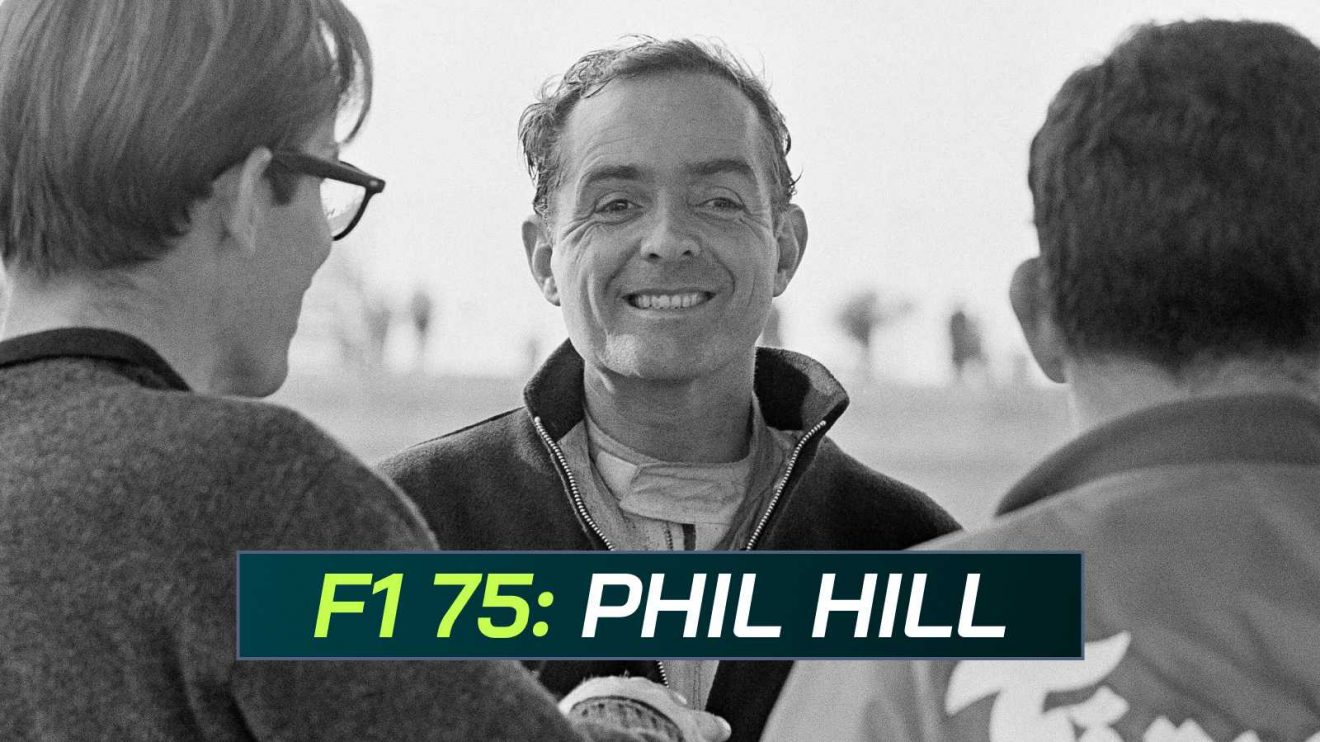
1961 World Champion Phil Hill smiles after competing in Can-Am.
Riddled with anxiety and at odds with the expectations of the machiavellian Enzo Ferrari, California racer Phil Hill was never the kind of driver you’d expect to win a Formula 1 World Championship — and yet in 1961, he did just that.
In celebration of Formula 1’s 75th anniversary, PlanetF1.com is looking back at the most influential American drivers to compete in the sport. Today, we remember Phil Hill, America’s first F1 WDC.
Phil Hill: America’s unlikely F1 champion
If you laid eyes on a young Phil Hill, the last thing you’d expect from him was skill behind the wheel of a race car.
Philip Toll Hill Jr. was born on April 20, 1927 in Miami, Florida before moving to Santa Monica soon after he was born. He came from a wealthy family that served as a pillar of his California community, and he spent most of his childhood ill;when a polio outbreak swept through town, Hill’s mother pulled all of her children out of school to teach them at home instead.
Phil Hill wasn’t good at sports, and as he grew up, he became the sort of person who found comfort in collecting, of all things, player pianos. He wasn’t quite the “race car driver” type.
But motorsport became a way for Hill to escape a family ruled by a disciplinarian father and an alcoholic mother. The only place he was encouraged to be himself was in the family garage or on the streets.
He’d stand on the sidewalk with the local boys and challenge them to rattle off names of approaching cars faster than he could — a losing battle against Hill, whose love of cars quickly bordered on obsession, and whose obsession alienated him from his peers.
“It was as if I was trying to divorce myself from the presence of the people around me and focus only on the cars,” Hill is quoted as saying in The Limit: Life and Death on the 1961 Grand Prix Circuit by Michael Cannon.
There was solace to be found in his wealthy aunt Helen Graselli, who spent her vast fortune on spoiling her nieces and nephews, and on amassing an impressive car collection.
Graselli was the type of person who enjoyed the physicality of driving those early cars — her Pierce-Arrow LeBaron Convertible Town Cabriolet particularly — and she never hesitated to dismiss her chauffeur to the passenger seat when there was a particularly challenging piece of road she’d like to conquer. When Hill was 12, she bought him his first car, a Model T Ford that she picked up from a used car lot for a mere $40 — or, about $900 today when accounting for inflation.
In that Model T, Hill found purpose.
“I’ve always expressed myself via the automobile,” Hill said, as reported in The Limit.
“I guess I sensed that I was in an insane environment and that my only escape was in something that had structure. Cars gave me a sense of worth. I could do something — drive — that no one else my age could do. I could take cars apart, too, and when I put the nuts and bolts back together again and the thing worked, no one could prove me wrong.
“That kind of technology was fathomable, made sense in a way people never did. Cars are easy to master; they hold no threat; and, if you’re careful, they can’t hurt you like people can.”
Hill headed off to the University of Southern California to study business administration and was able to avoid being drafted in the Korean War due to those recurring childhood illnesses. Nothing really spoke to him, though, until he joined the crew of a midget car team.
Midget car racing should have been a shock to Hill’s system. He’d grown up reading about the continental exploits of drivers like Alberto Ascari and Luigi Villoresi; his current discipline was far more blue collar, more down to earth.
Yet it was exactly what Hill needed; the smell of gasoline and burnt clutch spoke to him, and he soon turned his focus to buying a British MG sports car in the hope of competing in some races himself. His first event came in January of 1948, where he finished second in a rally.
When the midget car driver he worked for broke a leg, Hill subbed in — but he learned that he much preferred the European way of doing things, which he’d come to truly appreciate in his role as a salesman at a foreign car dealership.
He convinced his boss to send him over to Europe to study the fine art of repairing that unique kind of machinery, taking on month-long apprenticeships at auto firms like Jaguar, Rolls-Royce, and MG. He attended the first-ever Formula 1 British Grand Prix.
He had fallen in love, but Hill still wasn’t quite sure how to break into that world.
In late 1950, he returned home to New York and road tripped his new Jaguar XK120 across the country. That November, he competed in the Pebble Beach Cup, where he stalled at the start and still managed to battle his way through the field to secure his first victory.
More on Americans in Formula 1:
? Mario Andretti: The American racer who rocked the world of Formula 1
? US F1 drivers ranked: Logan Sargeant 18th and Phil Hill beaten to No.1 spot
When Hill was 25 years old, his mother and father both died within a span of three weeks. Hill was left alone in the world, but he found relief in that; the two people who most tormented him — who least understood him — would no longer have control over his life.
Plus, he was left with a large inheritance. To celebrate, he funneled his inheritance money into a brand-new Ferrari, a blue barchetta that he paid a mere $6,000 for. The salesman, Luigi Chinetti, had supposedly cut him a deal that saw Hill pay half price for the vehicle thanks to his promising motorsport talent.
Chinetti perhaps declined to mention that the exact vehicle Hill drove had been involved in an accident at Le Mans that beheaded its driver. There was even a hole still drilled in the floor of the car; it had been bored there to drain the blood.
Whatever the provenance of his car, Hill quickly became a familiar face on the top step of the podium as European-style road racing soon threaded its way through the United States. He was invited to join the Carerra Panamericana with a Ferrari factory team that included Giovanni Bracco, Alberto Ascari, and Luigi Villoresi.
All the while, though, he was plagued by a debilitating case of imposter syndrome that he’d fail to shake during the whole of his racing career. The stress resulted in ulcers so bad that Hill was reduced to eating jars of baby food, the only thing his body could tolerate.
After witnessing a 50-year-old driver named Eric Forrest-Greene burn to death in front of him at the 1954 Buenos Aires 1000, Hill retired from racing and took a job as a part-time mechanic at a foreign car dealership. He had determined that his racing career was over.
Then, in October, Hill received an envelope from Dallas. It included a photo of a white Ferrari 375 MM and one simple note: “Guaranteed not to cause ulcers.”
His passion for racing had been revived — and when he finished second in the 1954 Carrera Panamericana, he knew that he had found his calling.
He was destined to race.
When Europe calls, Phil Hill answers
In 1955, Hill and fellow California racer Richie Ginther were on a freighter to Europe when they received news that legendary Grand Prix driver Alberto Ascari had died.
The two had intended to compete in a handful of overseas races with their own cars, but plans quickly changed thanks to a memo from Luigi Chinetti, the dealer who had sold Hill his first Ferrari.
See, Chinetti wasn’t just a car dealer; he was Enzo Ferrari’s primary American liaison, tasked not only with creating an American demand for Ferraris but also with spotting impressive talent. Chinetti advised Hill and Ginther to get off the freighter early and head directly to Modena, the little town that Enzo Ferrari called home.
With Ascari dead, Ferrari needed, essentially, to replenish his driver stock. He showed Hill a gorgeous Ferrari 121 LM that had been prepared for Ascari at Le Mans and asked Hill what he thought. Then, he asked Hill if he would like to drive it in the iconic 24 Hour race.
Hill agreed, not knowing that he would witness the greatest tragedy in motorsport history, when Pierre Levegh’s Mercedes would scythe through the crowd and kill over 80 spectators. It would take place just in front of Hill, on his very first lap behind the wheel.
“At this point I was numbed by it all, shocked that all this could be happening at once and on my first-ever Ferrari racing lap of Le Mans,” Hill said, after recounting how he witnessed a body burning atop a hay bale. “But then Stirling Moss went by me like a streak in a Mercedes 300 SLR, and that woke me up. That was a lesson I never forgot: when something happens, get on the gas.” Unfortunately, he wouldn’t finish the race; after just 7 of Le Mans’ 24 hours, the Ferrari’s clutch gave out.
In the wake of the 1955 Le Mans disaster, races around Europe were canceled — which meant that Hill’s plans to show his racing merit in the country were put on hold. He went home, competing in events all across America.
In 1956, he ventured to Buenos Aires once again for the 1000 kilometer race, where he finished second. In the pits after the race, Ferrari’s team manager asked Hill if he’d like to join the iconic marque for the rest of the season. Weeks later, he had set up his temporary home in Modena.
It wouldn’t be an easy place for Hill to find his footing. Enzo Ferrari was notorious for the way he ruled over his domain, never hesitating to pit one driver against another if it meant they’d both drive a little faster, with a little more desperation. Ferrari didn’t hesitate to play favorites, and he let Hill know almost immediately that he was not one of them. Ferrari, Hill said, was “a man I respected, from whom I wanted nothing more than affection and for him to be a good daddy to me.”
But he wouldn’t get that affection. Hill was a shrewd driver, the kind that tried to win races by driving as slowly as possible and nursing the machinery home the whole way. Enzo Ferrari, on the other hand, preferred gutsy showmanship and a tinge of desperation. Ferrari much preferred the other rookie on his team that year, Count Wolfgang von Trips.
Von Trips grew up in luxury, but the onset of World War II effectively crushed the dynasty he was set to inherit. Instead, Von Trips turned his passion to cars; in pre-war Germany, Adolf Hitler poured government money into German racing programs, both to become a beacon of automotive technology and also to create a focal point around which spectators could rally, full of national pride.
Von Trips admired those prized German racers as a child, but after spending his teenage years picking through air-raid debris to find and remove mutilated corpses, he had become inured to the horrors of mankind. When the war ended, the Von Trips family was destitute, and Allied soldiers took over the family castle.
Though he was expected to attend agricultural school to revive the family property, Von Trips instead fell in love with racing. He took a class win at the Mille Miglia, then was discovered by Alfred Neubauer, the portly manager of Mercedes-Benz’s racing team, and later Huschke von Hanstein, who led Porsche. In September of 1956, Enzo Ferrari offered him a single-seater to race at the Italian Grand Prix.
By the mid-1950s, Enzo Ferrari had put together an exceptional slate of racing talent that competed in everything from sports car races to Formula 1 Grand Prix. He didn’t hesitate to swap drivers from one discipline to another, depending on how he felt they’d performed. He picked favorites and made those favorites known.
While Wolfgang von Trips was one of Enzo’s favorites, despite the fact that he was prone to making silly errors and crashing, Phil Hill was not. Nevertheless, the two rookies struck up an unlikely friendship.
“Anyone as intense as I was at the time was a bit skeptical of those like von Trips, who seemed, at least on the surface, a bit lackadaisical,” Hill said of his teammate, who had quickly earned the nickname Count von Crash.
But that was just what Enzo Ferrari wanted.
“I began to feel that perhaps I was not ever going to be a really first-rate driver, that something in my makeup prevented me from reaching the ultimate stage in motor racing,” Hill said of Formula 1.
“There are several drivers who do well in sports cars but can’t seem to do well with a Grand Prix machine. I was beginning to be haunted by the fear that maybe I’d be one of them. I had to find out.”
And to find out, he was forced to defect. Hill turned to Maserati, one of Ferrari’s biggest rivals, to make his racing debut at the Reims Grand Prix in 1958. With the outdated machine, he finished in seventh place, a lap down from the winner and his Ferrari teammate Mike Hawthorn.
It’s possible that Hill never would have gotten a shot with Ferrari’s Formula 1 team had it not been decimated by tragedy. Luigi Musso and Peter Collins were both killed in races during the 1958 season, and after securing the championship, Mike Hawthorn retired.
Hill was signed for the 1959 season out of necessity, but Ferrari began to treat him seriously after more of his drivers dropped like flies.
Hill performed well. That year, he took two second-place finishes and one third place, leaving him fourth overall in the Championship. The only Ferrari driver who outperformed him was Tony Brooks, thanks to Brooks’ two wins. Hill, however, was far more consistent in terms of scoring points.
Then came 1960. Hill and von Trips served as Ferrari’s two primary drivers, with a handful of others joining for a race or two. The Cooper and Lotus teams were frankly unbeatable that year, which left Phil Hill finishing fifth overall in the World Drivers’ Championship. He was the highest-placed Ferrari driver, and he also secured his first Formula 1 win at the all-important Italian Grand Prix.
Heading into the 1961 season, Ferrari debuted its first-ever mid-engined race car, known as the Sharknose. The vehicle was shockingly quick and a dream to handle thanks to its balanced weight, and it was clear from the start that it would be quick.
Heading into the new year, Hill and Von Trips would be joined by a third full-time driver, Richie Ginther.
Enzo Ferrari would have been forgiven for promoting Phil Hill to team leader; the American racer had proven himself to be an exceptional wheelman, the kind of driver that any team owner would adore to have.
But that wasn’t Ferrari’s style. Instead, he made it clear that his drivers would be entering 1961 on equal footing.
“The tension was excruciating and could not be relieved by a frank expression of competitiveness, not acceptably anyhow, between friends and teammates,” Hill said. It was a mindset that both he and Von Trips would be forced to carry into 1961.
Phil Hill’s championship year — and its tragedy
The 1961 racing began with the iconic Monaco Grand Prix. While it looked as if the Ferraris of Richie Ginther and Phil Hill would be the dominating forces of the day, Stirling Moss instead took victory in his Lotus. Ginther took second place, with Hill finishing third. Wolfgang von Trips was classified in fourth place, despite crashing on the final lap of the event.
The Americans were devastated. Phil Hill allegedly looked so broken during post-race interviews that it seemed as if he would cry at any moment. When a Ferrari aide hugged Richie Ginther after the event, he reported that it seemed as if Ginther’s overalls were empty, saying, “He was shattered, all in, he had really given everything.”
The Ferrari crew didn’t have to wait long to respond, though. Eight days later came the second Grand Prix of the season in Zandvoort, and von Trips took the lead almost immediately and held that position to the end of the event.
Phil Hill had to content himself with a Ferrari-mandated second place; when it became clear that Hill could catch von Trips, Enzo Ferrari told the team to give his drivers team orders. According to Hill, “They just didn’t want us ripping each other up once the thing was stabilized.”
Hill was ready to respond at the next race of the year, the Belgian Grand Prix. He qualified on pole position and managed to fend off von Trips’ challenge until a blinding rain slowed the pack and Ferrari issued team orders to prevent the two from fighting unnecessarily. It was Hill’s first win of the season, and it rocketed him up to first place in the championship standings — just one point ahead of von Trips.
The French Grand Prix was a bust for the full-time Ferrari drivers; Hill was classified ninth, two laps behind the winner, after an overconfident move at the Thillois hairpin saw him skid to a stop.
Moss crashed into the nose of his Ferrari, and Hill had to push-start his car to get it moving again. Von Trips retired with a blown engine. Ferrari, though, still took victory with one-off driver Giancarlo Baghetti.
Then came the British Grand Prix. Hill qualified on pole with von Trips back in fourth place, but heavy rains plagued the start of the race, and Hill had adjusted his brake balance to accommodate a drier track.
On the seventh lap, he lost control; while he still maintained his lead for a while, the experience had shocked him enough that Von Trips was able to slip by for victory. The German ascended to the lead of the Championship, with 27 points to Hill’s 24.
It was the kind of momentum that Hill wouldn’t have wanted to give von Trips, because the next race was the German Grand Prix.
However, both drivers were worn down, both physically and mentally. They were both in their mid-30s, and the close battle had begun to erode their friendship. Before the German Grand Prix, Hill joined Von Trips at his family castle for a mid-season break, but at the track, it was a different story.
Reflecting on the season, Hill later wrote, “As I had feared, Trips and I became involved in an increasingly bitter competition for Championship points. Because the championship was at stake, I was not able to be reasonable and sensible about every race.
“After all these years, I should have been, automatically, but there was this continual counting of points. By midseason, my concentration was suffering.”
That struggle was made clear in Germany, when Stirling Moss took victory. Von Trips had had no rest before the race thanks to increasing media demands, and reflected at the start of the event that “there were so many people around, so much excitement in the air. I would have preferred to crawl into a hole, to get away. But I had to be there in the thick of it. There was no other way.”
The tension got to both men. Hill spun and lost 30 seconds trying to right himself. It gave von Trips a chance to pass his teammate, but Hill recovered the time to surge past von Trips near the end of the race. The German pushed his way forward, and the teammates drove side-by-side; on the final straight, von Trips managed to push past for second place, 1.1 seconds ahead of Hill.
Von Trips was sitting at 33 Championship points. Phil Hill had 29.
Then came the fateful Italian Grand Prix at Monza. It would be a difficult one; Hill had won that race the previous season, while Von Trips had been involved in two nasty wrecks at the high-speed track. Hill was twitching with anxiety ahead of the start; in practice, his Ferrari had begun to malfunction. When he tried to switch from second to third gear, the gearbox would actually drop him back into first — and somehow, no one at Ferrari would take his word for it.
Meanwhile, Von Trips was reflective, telling journalist Robert Daly that “Every driver has a place deep inside him where he’s afraid of death. This could all end tomorrow. You never know.”
The start of the race, though, told two different stories. Von Trips looked relaxed, munching on pear as his team rolled his car out to his pole position starting position. Hill’s mechanics, meanwhile, had spent the night changing Hill’s engine; the gear issues meant the American would start in fourth place. Hill was agitated knowing that he would have to push hard to keep hold of his Championship hopes.
But when the flag flew, von Trips faltered. He had a long history of struggling at the start, and this was no different; by the time the German driver launched into the pack, he was in sixth position while Hill launched into the lead. Von Trips passed two cars on the first lap, desperate to reach Hill by passing new Ferrari racer Ricardo Rodriguez.
Perhaps he was distracted by the car in front. Perhaps that’s why he washed sideways into Jim Clark, who was attempting to make a pass. Clark’s front wheels collided with Von Trips’ rear wheels. At 150 miles per hour, it was a fatal move.
Von Trips’ Ferrari slung into the five-foot tall embankment that separated fans from the action. The only thing there to slow his momentum was a chicken wire fence and a row of spectators. The Ferrari scythed through 10 feet of the crowd before it came to rest.
Five spectators died immediately. Ten more died later from their injuries. Over 50 others were injured. Von Trips flopped over his steering wheel. He died of skull fractures before an ambulance could arrive.
The 1961 Italian Grand Prix carried on. Phil Hill passed the wreckage 41 more times from the lead of the race, trying to decipher each time who that wreckage belonged to. Then, he noticed Von Trips’ name had disappeared from the scoreboard.
The nine points that Hill earned with his victory was enough to give him the World Driver Championship. No one told Hill that his teammate was dead; Ferrari allowed him to celebrate with crowds and bottles of champagne. It was only after the podium that they told him the news. Wolfgang von Trips had been killed in a brutal crash.
Phil Hill was World Champion, but at what cost?
The tragedy of America’s first World Champion
Phil Hill never had a chance to truly enjoy his World Drivers’ Championship. After his victory at Monza, there was to be one final race, the first United States Grand Prix to take place at Watkins Glen in upstate New York.
Ferrari pulled out of the race; there was no need to continue its pursuit of a Championship it had already won. Phil Hill was denied the opportunity to take a victory lap in front of his home crowd.
He had no one else to celebrate with. He had no family. He was unmarried. His closest friends were racing drivers, and they were busy preparing for the next race. Headlines were dominated by the horrific death toll at Monza. It was as if Hill had not existed at all.
Phil Hill served as a pallbearer for Wolfgang von Trips at a funeral that represented the death of both a racing driver as well as the hopes and dreams of a nation.
“For all the Germans, Trips was going to be the new world champion,” Hill reflected later. “I had to go on as this terrible disappointment.”
Schools closed for the day, and thousands of people turned out to watch von Trips’ casket ride through the streets atop his Ferrari roadster. There were several masses, and as von Trips’ casket was placed in his family tomb, rain poured.
Hill was full of conflicting emotions. Yes, he was mourning the death of a friend and compatriot, but the most of his career had been entirely overshadowed.
When he returned home to Santa Monica, it was as if he didn’t even exist. Reflecting on Ferrari’s refusal to participate in the US Grand Prix, Hill said, “I was really sick about that, for that day should have been the crowning glory of my career, the biggest day of my life.”
As if to further drive home his obscurity, Hill appeared on the game show To Tell the Truth in December. The whole purpose of the show was that a group of panelists had to guess the guest’s achievement.
There, Hill was asked if his life had changed thanks to that achievement. He said, “Not at all. If you mean, do people recognize me and stop me on the street, they don’t.” It was as if he didn’t even exist.
Hill continued to race in Formula 1. He re-signed with Ferrari for 1962, taking three podium finishes in a row before his performance quickly dropped off. He raced in a handful of events for the next three years, where his best finish was a sixth place.
His true talents were found in the sportscar realm; Hill would go on to win the 24 Hours of Daytona and the 24 Hours of Le Mans, with a class win at the 12 Hours of Sebring. He retired and took up roles as a classic car restorer, a commentator for ABC’s Wide World of Sports, and a contributor to Road & Track magazine.
He died on August 28, 2008 at 81 years old — an icon of American motorsport, and a tragic figure all the same.
Read next: How Watkins Glen truly defined F1’s place in the United States