

Why motorsport is so critical in Cadillac’s plan to take over the auto market


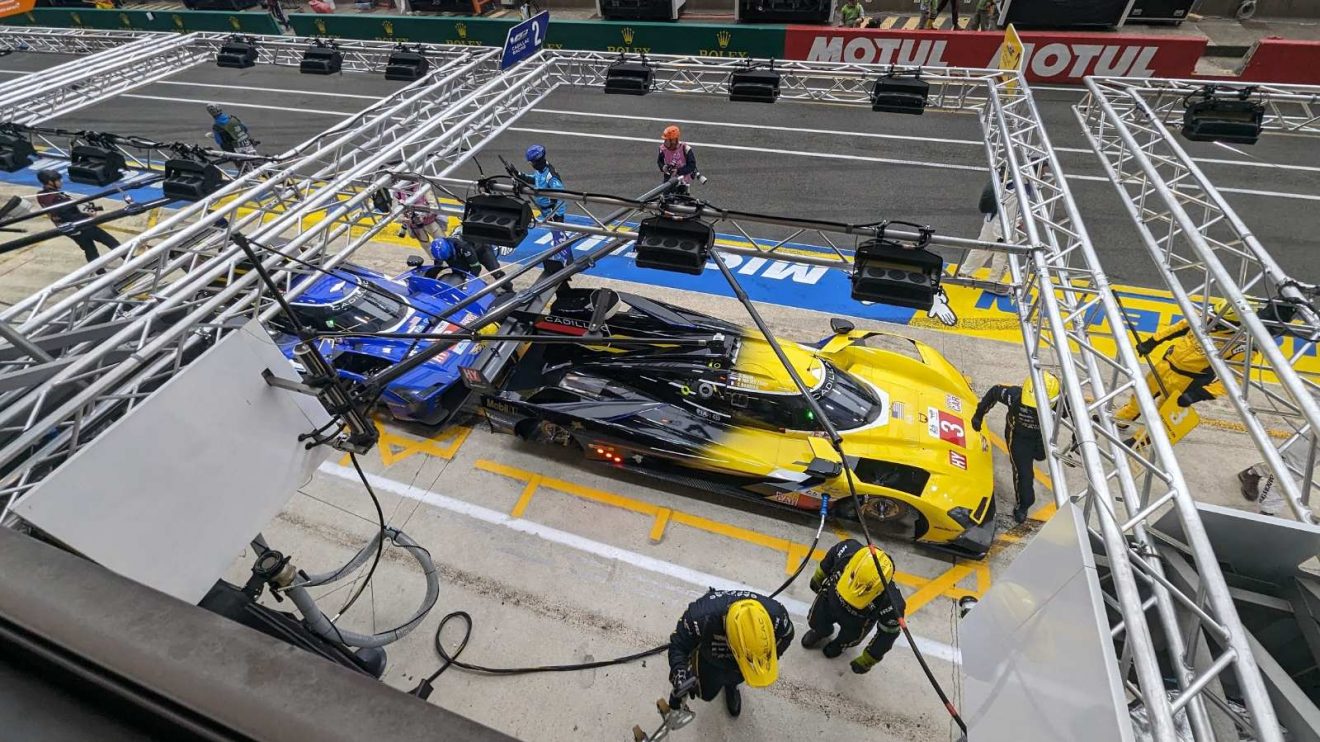
Cadillac practices pit stops at the 24 Hours of Le Mans.
The very first Cadillac race cars in the world competed in the 1950 24 Hours of Le Mans. Both were based on the Series 61 chassis, with one retaining its production looks and the other being modified into a wedge shape that affectionately became known as “Le Monstre.”
The General Motors brand has competed in racing in fits and starts throughout the years, since the days of the “win on Sunday, sell on Monday” ethos. Now, Cadillac is returning to the global racing scene in hopes of creating an ever-broader market for its cars.
Cadillac moves to Europe to “compete where the game is”
Founded all the way back in 1902, it took nearly five decades before Cadillac turned up at the race track — and when it did, it went for the biggest race in the world, the 24 Hours of Le Mans.
In 1950, American entrepreneur and racing icon Briggs Cunningham assembled a team and shipped two Cadillacs off to the Circuit de la Sarthe. One was a production Series 61, while the other was heavily modified into a wedge shape, with the hope being that its shape would make it all the more aerodynamic.
Today, as the American car company looks to expand into the European automotive market, Cadillac has once again looked to the global racing scene as a way to promote its products.
This current evolution first began in 2023, when the World Endurance Championship and the IMSA SportsCar Championship implemented a converging prototype category we now know as GTP.
Under these regulations, manufacturers had the freedom to design race cars with visual and auditory cues hearkening back to their road cars, so long as they comply with a very loose set of rules dictating the construction of its hybrid powertrain.
As Cadillac committed to expanding its electric vehicle lineup, and as it began to target new markets over in Europe, the ability to promote its cars in motorsport became all the more appealing.
More on Cadillac in Formula 1:
? Cadillac F1: Everything you need to know about the new 11th team
? Six classic US mistakes Cadillac should learn from
“The F1 car, when you look at it, you don’t see Cadillac,” Eric Warren, Executive Director for GM’s global motorsports competition, told PlanetF1.com in an exclusive interview, “whereas with the LMDh, we get the opportunity to inspire some direct design cues with customers to build that brand.
“It’s good that the sports car has led Cadillac in Europe, because it is more identifiable, and it helps built that brand and that awareness. That’s allowed us to attract global fans and customers to Cadillac.”
Warren told PlanetF1.com that the goals here are multifaceted. Yes, Cadillac wants to be successful on the global motorsport stage — but it also intends to use its racing program as a way to establish itself as a reliable luxury brand for consumers.
“We’ve done a lot of research, and we know that motorsports fans index much higher on buying our products than non-motorsports fans — significantly,” Warren explained.
“We’ve learned that racing fans are stronger considerers of EVs than non-motorsports fans because motorsports fans are very aware of technology. They’re very aware of the brands.
“And so when you tie the affinity of the brands to an understanding of the technology, racing is the ultimate test bed.”
While you may not be able to go to a Cadillac dealership — which are increasingly popping up in European cities like Paris, Zurich, Dresden, and Dublin — and purchase the exact car you saw win a race last weekend, you can buy a car that you know was built with the same dedication to technology and engineering, Warren explains.
“They understand the engineering that goes behind our vehicles on the racetrack,” he said of motorsport fans, “and it naturally translates into understanding the quality of engineering and technology at GM as a whole.”
And to target new groups of motorsport fans turned potential Cadillac buyers, GM needed to look to the global racing scene.
“In European racing, there’s been a long history of multi-manufacturer technology, where some of the American series, there’s a little bit less exploring technology and more trying to manage cost,” Warren explained.
“When you look at the elegance of the brands that we’re competing with in Europe — some of our American race series don’t have them.
“And so a lot of it is to compete where the game is, where the competitors are.”
It’s a smart strategy. On the consumer market, Cadillac’s primary competitors are luxury brands like BMW, Porsche, Aston Martin, Audi, and Mercedes. In order to push the Cadillac name into the European marketplace, it first has to place its cars in competition with those rivals — which it can do in a very literal sense by competing in WEC or F1. Then, Cadillac has to prove it can beat them.
The Cadillac V-Series.R, the LMDh machine competing in both IMSA and WEC, is the first step in that direction.
With wins at races like Long Beach, Sebring, and Petit Le Mans, Cadillac has proven it can compete here in America. And with a debut podium at the 24 Hours of Le Mans, it has proven it can bring the fight to Europe.
Now, it’s time to see what Cadillac’s F1 team can do.
Read next: 24 Hours At The Motorsport Olympics: The inside story of Cadillac’s heartbreaking 2024 Le Mans


