
Ranked: Lewis Hamilton’s Mercedes F1 cars from worst to best


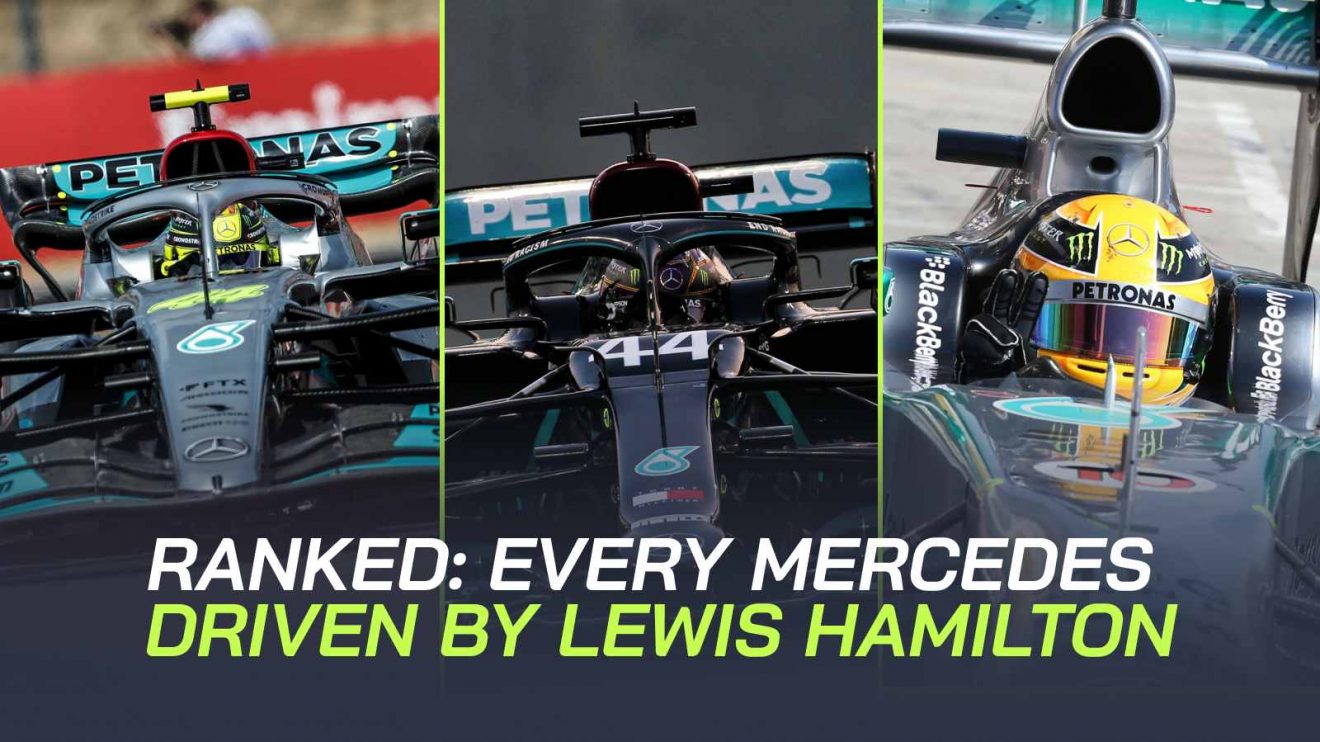
We have ranked every Mercedes car driven by Lewis Hamilton as he departs the Silver Arrows.
Lewis Hamilton and Mercedes will part ways from the F1 2025 season. After 12 years together hand in hand, the most successful and longest relationship in the history of the category comes to an end after having shared moments… and unique cars.
Hamilton is swapping Mercedes for Ferrari and leaves behind highlights that will go down in the history of the sport. In his hands he has had some of the most dominant machines in F1, but also some of the most difficult cars to drive, especially in the last three seasons with the Silver Arrows.
Ranked: Every Mercedes car driven by Lewis Hamilton in F1
With that in mind, we wanted to rate the cars Hamilton has had the opportunity to drive for Mercedes.
From worst to best, we’ve ranked them according to the overall performance of each machine, and we’ve also taken into account the level of competition and rivalry each car has faced.
12: Mercedes W14 (2023)
Wins (0/22)
Lewis Hamilton: 0
George Russell: 0
Win percentage: 0%
Podiums: 8
Pole positions: 0
Fastest laps: 5
The W14 addressed some of the W13’s issues but failed to close the gap to Red Bull. While more stable and consistent, it still lacked the raw pace to challenge consistently for victories and podiums. A key weakness was its limited adaptability to varying track conditions.
Despite incremental improvements throughout the year, it marked the team’s first winless season since their dominance began in 2014 and the second consecutive season without a Lewis Hamilton win.
The car underlined the need for a new design direction after failing to make the zero sidepod aerodynamic concept work.
11: Mercedes W04 (2013)
Wins (3/19)
Nico Rosberg: 2
Lewis Hamilton: 1
Win percentage: 15.8%
Podiums: 9
Pole positions: 8
Fastest laps: 1
The W04 marked the beginning of Mercedes’ rise in F1, showing impressive one-lap pace but struggling with race-day performance. Its main weaknesses included poor tyre management and inconsistency on Sundays, often leaving it outmatched by Red Bull, Ferrari, and Lotus.
Despite these issues, it laid the groundwork for future success.
Early in the season, the W04’s performance was inconsistent, but upgrades improved its competitiveness. Nico Rosberg delivered key wins in Monaco and Britain, while Hamilton took a brilliant victory in Hungary, showcasing the car’s potential. Mercedes ended the season second in the Constructors’ standings, a major step forward.
10: Mercedes W13 (2022)
Wins (1/22)
George Russell: 1
Lewis Hamilton: 0
Win percentage: 4.5%
Podiums: 17
Pole positions: 1
Fastest laps: 6
The W13 was plagued by porpoising, a consequence of an aggressive aerodynamic concept. While it was reliable and improved over the season, its main weaknesses were a lack of outright pace and difficulty competing with Red Bull and Ferrari. Despite this, the car’s performance on high-downforce circuits showed promise.
Mercedes worked tirelessly to understand the porpoising issue, and by mid-season, the W13 showed significant improvement. The team’s perseverance was rewarded with George Russell’s win in São Paulo, Mercedes’ sole victory of the year.
Though Hamilton went winless, using the first half of 2022 to run experimental setups to help Mercedes understand their new car, the late-season pace hinted at a stronger future.
9: Mercedes W15 (2024)
Wins (4/22)
George Russell: 2
Lewis Hamilton: 2
Win percentage: 16.6%
Podiums: 9
Pole positions: 3
Fastest laps: 4
The W15 was a significant improvement over the W13 and W14, bringing better balance and downforce especially from the Monaco GP onwards after the introduction of a new front wing spec.
While it still lacked the outright speed of Red Bull and the constant and strong progress of McLaren and Ferrari, it was competitive enough to fight for wins at specific circuits. Tyre degradation and straight-line speed deficits remained minor issues.
The car secured four victories, with George Russell winning in Austria and Las Vegas – and crossed the line first in Belgium, but got disqualified for not complying with the minimum weight – and Hamilton winning a frantic home race at Silverstone as well as inheriting Russell’s Spa victory.
These wins marked Mercedes’ return to competitiveness, although they were still not championship contenders. The W15 showed signs of a brighter future for the team ahead of what is expected to be a thrilling 2025 season.
8: Mercedes W12 (2021)
Wins (9/22)
Lewis Hamilton: 8
Valtteri Bottas: 1
Win percentage: 40.9%
Podiums: 28
Pole positions: 9
Fastest laps: 10
The W12 had strong straight-line speed and adaptability, excelling at many circuits. However, it struggled in high-downforce configurations, where Red Bull’s RB16B was stronger. Early setup difficulties and inconsistent performance placed the team under immense pressure in a tight title fight.
The W12 peaked in the latter half of the season after the introduction of key updates to the car, with Hamilton delivering stunning wins in Brazil, Qatar, and Saudi Arabia.
The car played a vital role in Mercedes securing their eighth consecutive Constructors’ Championship, though Hamilton narrowly missed the Drivers’ Championship in controversial circumstances in the final lap of the Abu Dhabi GP against Max Verstappen.
7: Mercedes W09 (2018)
Wins (11/21)
Lewis Hamilton: 11
Valtteri Bottas: 0
Win percentage: 52.4%
Podiums: 25
Pole positions: 13
Fastest laps: 10
The W09 was quick and reliable, excelling on high-speed circuits. However, it struggled in hot conditions and at high-downforce tracks, where Ferrari and especially Sebastian Vettel posed a significant challenge. The car’s balance and power unit were key strengths.
Ferrari’s early-season pace pushed Mercedes to develop the W09 aggressively, improving its handling and tyre management. Hamilton’s wins in Germany, Singapore, and Russia proved decisive in securing his fifth Drivers’ Championship. The car ultimately delivered 11 victories, cementing another dominant season for the Silver Arrows.
6: Mercedes W08 (2017)
Wins (12/20)
Lewis Hamilton: 9
Valtteri Bottas: 3
Win percentage: 60%
Podiums: 26
Pole positions: 15
Fastest laps: 9
The W08 was fast but temperamental, earning its “diva” nickname due to its sensitivity to setup changes. It excelled on circuits requiring power and low-drag configurations but struggled at tight, twisty tracks where Ferrari was more competitive.
Throughout the season, Mercedes refined the car to maintain its edge in the title fight. Hamilton’s victories in Belgium, Italy, and the USA were critical.
With 12 wins (nine by Hamilton and three by Bottas), the W08 secured Mercedes’ fourth consecutive Constructors’ title and Hamilton’s fourth Drivers’ Championship.
More on Lewis Hamilton and his career to date
? PlanetF1’s Hall of Fame: Lewis Hamilton – the superstar F1 was looking for
? What is Hammer Time? Lewis Hamilton explains origin of iconic radio message
5: Mercedes W10 (2019)
Wins (15/21)
Lewis Hamilton: 11
Valtteri Bottas: 4
Win percentage: 71.4%
Podiums: 32
Pole positions: 10
Fastest laps: 8
The W10 combined exceptional balance, downforce, and reliability, making it competitive across all circuits. Its only minor weakness was occasional vulnerability on low-grip surfaces. The car was a well-rounded package.
Early dominance saw Mercedes secure eight consecutive 1-2 finishes. Hamilton’s victories in France, Britain, and Abu Dhabi were highlights, and the car helped him claim his sixth Drivers’ Championship.
The W10 symbolised Mercedes’ adaptability and consistency after the change in the regulations that simplified the aerodynamics of the cars after two years still being at the top of their game and once again delivering a dominant performance.
4: Mercedes W11 (2020)
Wins (13/17)
Lewis Hamilton: 11
Valtteri Bottas: 2
Win percentage: 76.5%
Podiums: 25
Pole positions: 15
Fastest laps: 9
The W11 was arguably the fastest F1 car ever, combining unmatched downforce, power, and tyre management. Its main weakness was occasional sensitivity to unpredictable conditions, such as Hamilton’s struggles in wet Turkey qualifying.
The W11 dominated the shortened COVID season, winning 13 of 17 races. Hamilton’s wins in Portugal (breaking Schumacher’s all-time win record) and Turkey (securing his seventh title) were historic. Bottas also contributed with two wins, showcasing the car’s dominance.
3: Mercedes W05 (2014)
Wins (16/19)
Lewis Hamilton: 11
Nico Rosberg: 5
Win percentage: 84.2%
Podiums: 31
Pole positions: 18
Fastest laps: 12
The W05 ushered in the turbo-hybrid era with unprecedented dominance and unseating Red Bull as the benchmark since 2010. Its power unit, ERS efficiency, and aerodynamic balance were unmatched.
The W05 won 16 of 19 races, setting new standards for dominance. Highlights included Hamilton’s iconic Bahrain “Duel in the Desert” victory over Rosberg, one of the greatest on track battles of the last 10 years, and a dominant streak that clinched his second Drivers’ Championship. The car established Mercedes as the team to beat in F1’s new era.
2: Mercedes W06 (2015)
Wins (16/19)
Lewis Hamilton: 10
Nico Rosberg: 6
Win percentage: 84.2%
Podiums: 32
Pole positions: 18
Fastest laps: 13
The W06 built on the strengths of the W05, adding better reliability and aerodynamic refinements. Its dominance was only occasionally challenged by Ferrari, but it remained far ahead of the competition.
This car won 16 of 19 races, with Hamilton taking 10 wins and securing his third Drivers’ Championship. Key moments included Hamilton’s wet-weather mastery at Silverstone and his title-clinching win in Austin. The car redefined dominance for a second consecutive year.
1: Mercedes W07 (2016)
Wins (19/21)
Lewis Hamilton: 10
Nico Rosberg: 9
Win percentage: 90.5%
Podiums: 33
Pole positions: 20
Fastest laps: 8
The W07 was the pinnacle of Mercedes’ hybrid era dominance, combining incredible speed, reliability, and adaptability. Its only proven weakness was the reliability issue that affected Hamilton’s title bid with a DNF in Malaysia when he was comfortably leading the race.
This car won 19 of 21 races, making it statistically the most dominant car in F1 history. Rosberg’s title win in Abu Dhabi and Hamilton’s back-to-back victories in Austria, Silverstone, and Brazil highlighted the car’s brilliance. It remains unmatched in terms of dominance.
This car was also the fuse for the boom in the internal rivalry at Mercedes between Hamilton and Rosberg in 2016 with their famous crash at the Spanish GP.
Read next: F1 schedule: When is the next F1 race and where is it being held?