
Why Zak Brown deserves more credit for McLaren title glory



McLaren won the 2024 title - will it be Lando Norris's turn in 2025?
McLaren lifted their first Constructors’ title in 26 years at the end of F1 2024, with Lando Norris and Oscar Piastri claiming a combined total of six victories across the season. The secret to the team’s success? People power.
To appreciate the significance of McLaren‘s first Constructors’ title in more than a quarter of a century, it is worth recalling the state the team were in when Zak Brown arrived in late 2016.
McLaren end long wait for title success in F1 2024
A version of this article originally appeared in PlanetF1.com’s conclusions from the Abu Dhabi Grand Prix
As he explained in a recent interview, Brown found a place lacking just about everything required to make a successful F1 team.
There was no structure, insufficient investment, an ancient wind tunnel and simulator, hardly any sponsors, a dissatisfied workforce, a dispute in the boardroom and, to top it all off, an uncompetitive car.
It was, in other words, a team that had lost all semblance of self-respect.
McLaren domination? How the F1 2024 title race would have looked without Max Verstappen and Red Bull
? The F1 2024 Drivers’ Championship standings without Max Verstappen
? Revealed: The F1 2024 Constructors’ Championship without Red Bull
McLaren’s place on the F1 landscape had effectively been seized by Mercedes, who first came along to take their star driver, then their technical director, then their major sponsor before finally replacing their former partners as a regular race-winning, title-contending force.
Ron Dennis, it had long become clear, had stayed too long for all the good he had done.
Not that Brown has been perfect.
There were times in the first couple of years when he carried the air of a superfan that got lucky, too willing to kneel at the Temple of Fernando Alonso, who for all his skill was afforded a little too much power and influence for his team boss to be taken seriously.
There have been signs of that naivety this year, too, Brown reacting emotionally – disproportionately so – to the clashes between Lando Norris and Max Verstappen, as if trying slightly too hard to present McLaren as a serious and sustained threat to Red Bull.
As if trying to convince himself – everyone – that the world had finally righted itself on its axis to this time make McLaren the new Mercedes, a decade after Mercedes became the new McLaren.
His fellow team principals have often poked fun at the fan sitting just below the surface, remarking that Brown would not recognise the front of a Formula 1 car from the back of one even if he tried.
Invariably it is intended as an insult, but doesn’t that actually highlight Brown’s great strength?
To recognise the limits of his own knowledge and expertise? And to plug those gaps by finding, and sufficiently empowering, the right people?
An overarching, interfering team boss – the worst kind of team boss – Brown is not.
It requires a certain humility, and good control of one’s own ego, to delegate successfully in the way he does.
Most of the credit will go to Andrea Stella but spare a thought also for his predecessor Andreas Seidl – last seen leaving the Audi F1 operation in undignified fashion – credited for igniting McLaren’s recovery by leading the strategic decisions to return to Mercedes engines and commit to the construction of a new, standard-setting wind tunnel in 2019.
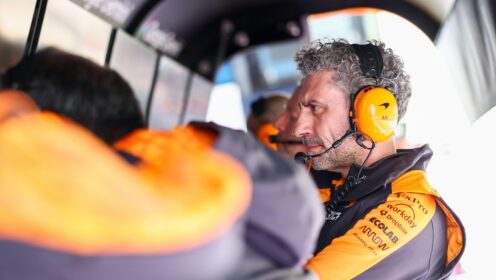
Here’s how it works at McLaren these days: Stella, like Seidl before him, is given total freedom to run the race team as he sees fit while Brown stays in his lane and does his thing of dealing with the shareholders, charming the pants off potential sponsors, courting the media and acting as team mascot on Sundays.
It is a two-man job yet essentially no different to how Toto Wolff and Christian Horner have insulated the Mercedes and Red Bull race teams from their respective boards over the years (Fred Vasseur, with a similar feel for how things should be done, is in the process of implementing an identical structure at Ferrari).
F1 teams, after all, are at their best and most agile when they operate more like oversized F3 teams, focused entirely on the essentials and protected from the machinations of the global organisations to which they are attached. Motor racing is complicated enough without getting in your own way.
By being McLaren’s shield, in other words, Brown allows Stella to be the sword.
The results have been spectacular, the team’s trajectory so encouraging over recent years that the title triumph they had been craving for so long, and feared might never happen again back in those darkest days, has felt inevitable for some months.
The McLaren revival is finally complete. Even sweeter, maybe, that they did it by blowing away their old friends at Mercedes with their own engine.
The real magic in this sport?
It is found not in the technical trickery, the nuts and the bolts, the ride heights and the tyre pressures.
It is found in the people. Relationships. Bonds. Human chemistry. Flesh and blood.
Get that bit as right, as McLaren have, and you’ll always have a chance.
Read next: Ranked: All 11 F1 team bosses with a surprise top-three entry