

Las Vegas GP conclusions: Verstappen unbeatable, Hamilton v Leclerc clues, Red Bull warning


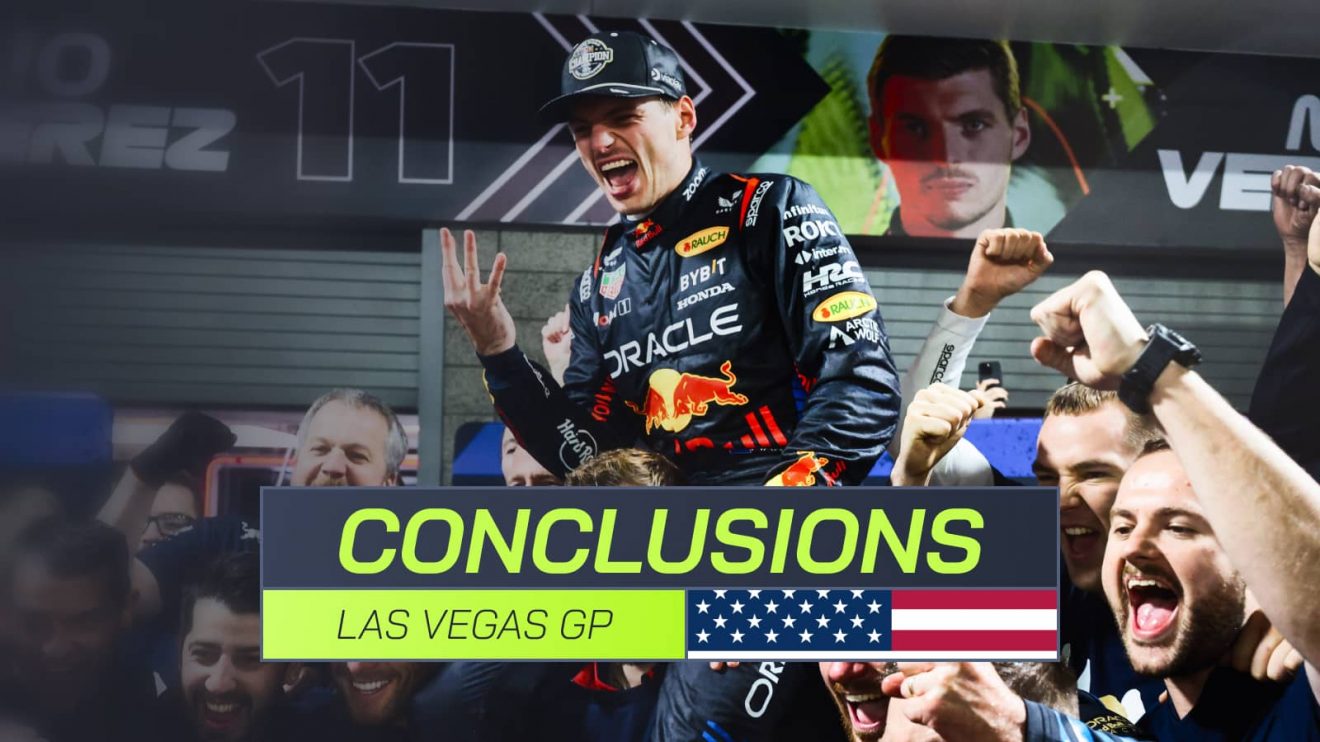
Max Verstappen: King of the F1 world for the fourth time
Mercedes driver George Russell claimed his second victory of the F1 2024 season at the Las Vegas Grand Prix as Red Bull’s Max Verstappen secured a fourth consecutive World Championship.
Russell dominated from pole position as Lewis Hamilton helped seal a one-two finish for Mercedes, with Verstappen‘s fifth place enough to see off the threat of McLaren’s Lando Norris and secure a fourth straight title. Here are our conclusions from Vegas…
Conclusions from the 2024 Las Vegas Grand Prix
Max Verstappen: Unbeatable?
It always seemed certain that 2021 would stand forever, alone and untouched, as Max Verstappen’s greatest work.
How could it not be? The ferocity with which he took the fight to a champion of Lewis Hamilton’s stature, the poise with which he handled the biggest test of his career up to that point…
Even the most gifted drivers tend to wilt when they are exposed for the first time to the unique pressures and scrutiny of a title battle.
Max? He took to it as though his entire life had been building right up to that moment.
Which, of course, it had.
More so than any driver to have come before, in fact, such was the certainty from his earliest days that he was heading straight to the summit.
Go deeper: Understanding Max Verstappen
? Jos Verstappen: The F1 racer turned ruthless mentor behind Max Verstappen’s supreme F1 talent
? Revealed: The three rules introduced by the FIA because of Max Verstappen
Forget, if you can, the way 2021 ended. It was the sheer nervelessness – that apparent immunity to pressure – that truly marked Verstappen’s first title triumph.
With the overall talent level so high in modern sport, that quality – of your technique remaining firm and accessible even in the most crucial moments – is of immense worth to an elite athlete.
It has been a very different, unique set of pressures he has been operating under in 2024, when those closest to him have sometimes seemed the greatest obstacle to even more success.
Having lost Adrian Newey and more along the way, and seen the RB20 rapidly fade from a position of such strength, Verstappen’s father Jos did not appear to be wrong when he warned that Red Bull, whose stability had previously been their biggest advantage, could “explode” this year.
The great trick pulled by Max, though, has been to make the blast happen in slow motion, holding back the tide just for long enough to seize a fourth World Championship, one to at least match – potentially surpass – 2021.
Yet like Sebastian Vettel, the only previous driver in F1 history to go from zero to four titles in a single great step, will the crowning glory also come to signal the end of an era?
Certainly, there was little chance of Verstappen sinking to his hands and knees in tribute to the RB20 at the end in Vegas as Vettel did so memorably with his dominant Red Bull back in 2013.
And if the car’s current vulnerability carries into next year, it is hard to envisage Verstappen and Red Bull repeating the feat without a 60-point headstart to play with in F1 2025.
Perhaps more than anything, though, this season has hit home what first occurred in the afterglow of his defeat of Hamilton three years ago.
As talented as Lando Norris, Charles Leclerc, George Russell, Oscar Piastri, Andrea Kimi Antonelli and the rest might be, how are they ever meant to compete with this?
How will they ever close the gap in experience and title-winning nous Verstappen’s background, combined with his early start to life in F1 a decade ago, gifted him?
Without a clear car advantage – clearer even than that enjoyed (spurned) by Norris and McLaren this year – who could possibly outmanoeuvre, outsmart, outmuscle, outrace, outscore and ultimately overwhelm Verstappen across a full season?
Max, remember, was already winning grands prix with Red Bull when Norris and the rest of his peers were still navigating their way through the junior categories (recall that famous photograph of Verstappen meeting a young Lando half his size).
There has been more than a few occasions in 2024 when that has showed.
Unless the situation is taken out of his hands – either through circumstance or the competitiveness of his car – he is simply too advanced, too complete now to be toppled by a generation of drivers who, for all their own qualities, may never quite bridge the void.
He is, in other words, the closest thing to unbeatable F1 has ever seen.
Let this be a line-in-the-sand moment for ‘nice’ guy Charles Leclerc
Never trust your team-mate.
Especially one who’s just three weeks away from leaving the team anyway, has absolutely nothing to lose and quite fancies adding one more victory to his collection – quite feasibly the last victory he will ever achieve in F1 – before his next adventure.
Charles Leclerc was caught out by that in Las Vegas when he was reassured by his race engineer on his way out of the pit lane that Carlos Sainz had been told to stay behind him – only for Sainz to sail by on the very next straight to pip his team-mate to the podium.
You will likely have heard by now Leclerc coming down with a nasty dose of the F-bombs over team radio during the cooldown lap.
How apt, the thought occurred, that on the day Verstappen was crowned World Champion for the fourth time Leclerc should be heard caning himself for “being nice” to his competitors.
That, after all, has been one of the great debates of F1 2024 with Lando Norris routinely accused of being too nice to win – especially against that nasty Verstappen fella, as the more partisan elements of the British media have decided Max must be portrayed.
Norris himself flirted with the dark side during what shall be known henceforth as Lando’s Brat Summer, finally deciding to stand up to Verstappen (albeit briefly) as they raced for the lead in Austria before daring to ignore team orders just weeks later in Hungary. Good boy gone bad.
When it came down to it, though, Cuddly Little Lando – the same Cuddly Little Lando who quickly backtracked on his public warning that he wouldn’t be friends with Max anymore if he didn’t apologise for Austria, thankfully stopping short of threatening to take his ball home too – just couldn’t bring himself to go through with it.
Why, you ask, is Verstappen unbeatable? Partly because of stuff like this.
Max is the only driver under the age of 30 with the principles of a tough, uncompromising, old-school competitor, prepared to put aside completely his relationships with his fellow drivers the very second the visor shuts.
In an era of corporate kindness and sickly ‘Carlando’ bromances, in which the personalities are so bland that rivalries have to be concocted and forced onto them by Netflix each winter, Norris and Leclerc are symptomatic of the inherent softness shared by the latest generation of drivers.
It is not only pally to the point of pathetic, but gives a streetfighter of Max’s ruthless nature a psychological advantage before the engines start up.
There is, at least, still some hope for Charles, whose inner steeliness has revealed itself on a few notable occasions during his career to date.
It’s time to embrace it fully. Let this betrayal by Sainz be a line in the sand as he prepares to ‘welcome’ Lewis Hamilton to Ferrari next year.
Never trust your team-mate? No.
Never trust no one.
George Russell deserves more respect
Some would have you believe that George Russell is not long for this world at Mercedes. And not without reason.
If, after all, Andrea Kimi Antonelli is the face of the team’s future, and Toto Wolff really has made it his mission to sign Max Verstappen over the next 12 months, where exactly does Russell fit in?
With George’s current contract due to expire at the end of F1 2025, the timelines appear perfectly aligned for Max to make the move next year and live happily ever at Mercedes.
Russell?
A career in midfield mediocrity, they say, awaits as F1’s nearly man, another plucky Brit with an abundance of vim and vigour but ultimately a telling lack of talent. That’s how people see him.
It is true that Russell has been his own worst enemy at times, his determination to impose himself on each and every situation – taking excessive risks on a qualifying lap, gambling on strategy, having a go with a bold overtake and pushing his tyres too hard at the start of a stint only to pay for it later – has often been his undoing.
His self-confidence has occasionally crossed into the territory of arrogance, his pompous delivery over team radio not exactly helping the watching world warm to him.
Yet to dismiss him as a Mercedes driver for the long term and a title contender for the future – Sebastian Vettel actually named Russell earlier this year, albeit before the emergence of McLaren, as the driver best placed to follow Verstappen as F1’s next World Champion – is woefully disrespectful.
How differently, you wonder, would he now be perceived had he joined Mercedes a year or two earlier, before the team were destabilised by the ground-effect rules of 2022?
If, rather than simply making the best of a bad situation in that first season, he had a few more victories to show for it?
That same need for Russell to keep proving himself again and again (and for all his self-belief, you suspect he feels it too) would likely no longer exist.
Lewis Hamilton may not be the Lewis Hamilton he used to be – at least at Mercedes, at least this side of Abu Dhabi 2021 – but do not underestimate Russell’s achievement in strolling into that environment and putting a seven-time World Champion at such unease that he saw fit to leave the team he called home.
It is undeniable that Russell is coming to a complex, pivotal point of his career, expected to become Mercedes’ team leader in Hamilton’s absence next year while still in the invidious position of fighting for a future that may well be out of his hands.
In his pursuit of Verstappen, though, Wolff would be well served to remember this: on the three occasions Russell has been handed a winning car on merit during his Mercedes career – Sakhir 2020, Brazil 2022 and Las Vegas 2024 – he has curbed his excesses and controlled the race from the front every single time.
That’s all the evidence Mercedes should require that Russell will deliver if they can provide him with the right machinery.
What more can they really ask of him?
How will Lewis Hamilton vs Charles Leclerc unfold at Ferrari? See Hamilton vs Russell
Some say Charles Leclerc will do to Lewis Hamilton what Nico Rosberg did to a 40-year-old Michael Schumacher.
Others, meanwhile, are convinced that a freshly motivated Hamilton will prove once and for all that Leclerc is vastly overrated.
So how will the most mouthwatering inter-team battle of F1 2025 play out at Ferrari? The clues are to be found in Hamilton vs Russell.
There are more than a few parallels to be drawn between Russell and Leclerc, both arriving on the grid after dominant F2 title triumphs and requiring little time to convince front-running teams of their potential.
Yet with Mercedes and Ferrari short of competing for consistent victories over recent years both have seen their development stunted by the competitive situation of their teams, guilty at times of trying too hard, taking too many risks in an attempt to make something out of nothing.
That snatchy, self-destructive side, however, has not stopped Leclerc and Russell from establishing themselves as the quickest drivers within their respective teams.
Much has been made this year of Russell’s resounding defeat of his team-mate in the internal qualifying battle in F1 2024, Hamilton often visibly struggling to come to terms with the realisation that his one-lap speed, once instantly accessible, has suddenly become a struggle to unlock.
Too old? Past it? In decline?
Time, with his 40th birthday on the horizon, has almost certainly blunted some of Hamilton’s natural pace.
And the difficult machinery he has had to deal with over the last few years has likely only accelerated that loss of edge.
Yet give Lewis a driveable car and a hint of victory – see Silverstone, see Spa, see his charge to second from a poor grid position in Vegas, taking around a second per lap out of Russell’s lead at one stage – and it doesn’t take much for it to sharpen up again.
Might that set the scene for his rivalry with Leclerc from next year?
If the Ferrari is nowhere expect Hamilton to be dominated by Charles, distant to the point of disinterested, unwilling at this advanced stage of his career to go to the same extremes as Leclerc on the average qualifying lap.
Give him a car he can work with, however, and it will soon pique his interest.
Even if his qualifying speed is not what it was, his tyre management, racecraft and experience could easily see him outscore the more erratic Leclerc over a season.
And if the red car is capable of regular wins, even potentially that golden eighth title? Who knows?
Maybe the Lewis of old will be magically reawakened for one last dance.
Franco Colapinto’s mistakes should serve as a warning to Red Bull
What is it that makes Franco Colapinto such an exciting driver? Why is it that almost half the paddock wants to sign him after just a handful of races?
We refer you back to PF1’s conclusions from the Brazilian Grand Prix and the debate about manipulative drivers versus reactive drivers.
While some, often the very best in the business including Max Verstappen and Lewis Hamilton, are the manipulative type in terms of their use of the steering wheel and pedals and are constantly ‘on top’ of the car, the reactive ones – always with harsher, jerkier inputs – will literally react to whatever the car is doing at any given moment, living on their reflexes and car control.
Ayrton Senna was the most famous of all reactive drivers, making up for the slight imperfections of his driving style with a precision unmatched by anyone else in history.
Great entertainers like Gilles Villeneuve, Ronnie Peterson and Jochen Rindt were in the same class, each with a special place in the hearts of fans of a certain vintage.
Of the modern era, Colapinto is just the latest in a long line of high-quality, super-quick reactive drivers including Romain Grosjean, Pastor Maldonado, Carlos Sainz, George Russell, Liam Lawson and more.
The reactive drivers can be just as fast – even a little faster on a good day – than the manipulative ones over a single lap, yet such is the nature of their technique that they are generally harder on the tyres across the average race stint.
Worse?
Without fail they leave a considerably smaller margin for error, making all these drivers more prone to mistakes – both the tiny corrections that quickly add up across a qualifying lap and the more serious, car-damaging offs – than their manipulative peers.
Pressure is the worst enemy of a reactive driver, the added complication of psychological stress often creating a vicious cycle of mistakes breeding pressure, breeding yet more mistakes.
It is precisely why the errors of Grosjean – think back also to Sainz’s string of incidents at the start of 2022 – tended to come in clusters.
So it is not as if Colapinto, after a collection of costly accidents over the last two race weekends, has suddenly removed the mask to reveal himself as the Second Coming of Mick Schumacher.
It is not even necessarily a case of his inexperience finally showing.
This is just, purely and simply, the way he drives – hard, aggressive, on the edge; high risk, high reward.
Plus the fact that after just going with the flow in his first few races, he now has something tangible – potentially a very competitive, race-winning seat on the F1 2025 grid – to fight for. That brings pressure.
Yet his latest crash in Las Vegas, clipping an inside barrier before suffering a 50G impact in qualifying, should serve as a warning to Red Bull if they really are considering pairing him with Verstappen for F1 2025.
Far from bringing out the best of Colapinto, being plunged into to that environment, against that team-mate and under all that scrutiny at this early stage would only expose the worst.
Lawson may drive in a similar way but is at least a more refined and polished candidate to replace Sergio Perez, without a repair bill of any significance attached to his name so far.
If Red Bull are truly set on landing Colapinto for F1 2025, placing him at VCARB would be the only sensible solution.
Putting him alongside Verstappen, it is increasingly clear, would be reckless in the extreme and ultimately cause more harm than good.
He is not equipped for it yet.
Read next: Las Vegas GP driver ratings: Russell top of the class as Verstappen does what’s necessary


