

Mercedes reveal ‘close guarded’ fuel ‘secret’ in ‘never seen before’ insight


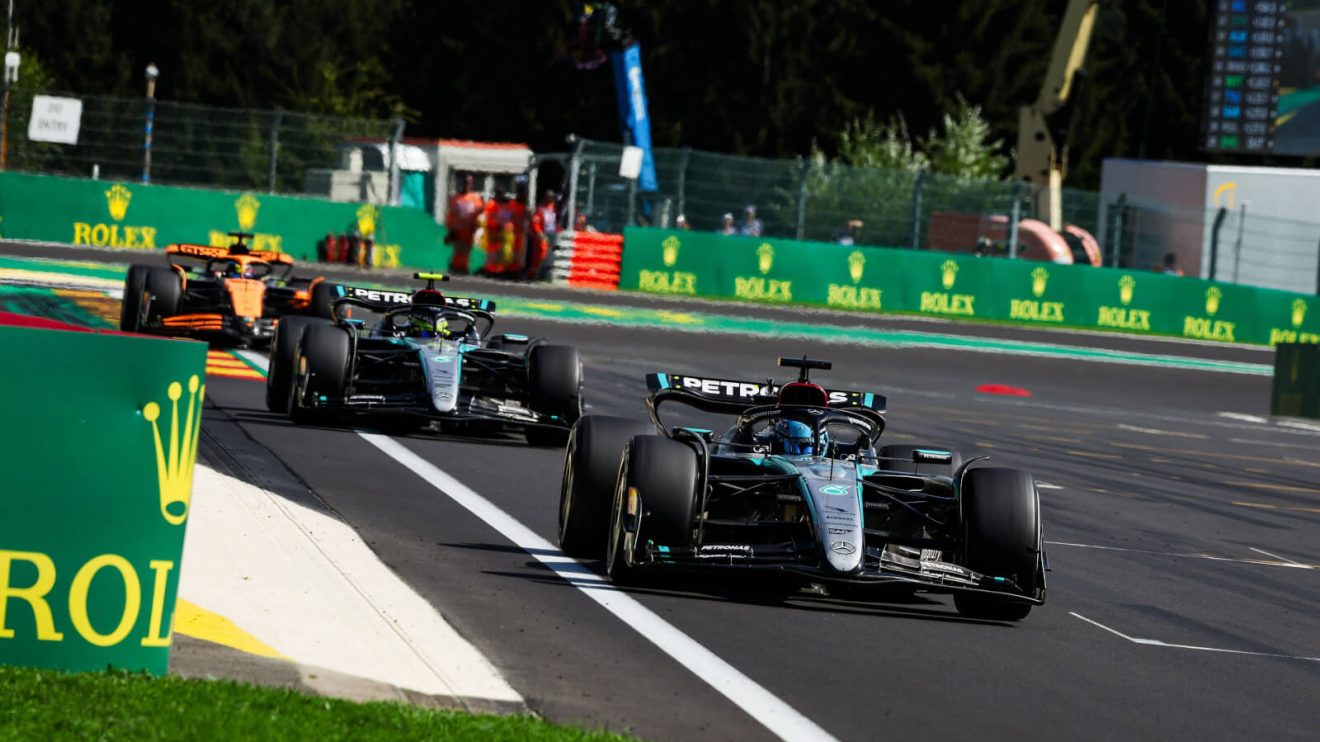
George Russell leads Lewis Hamilton and Oscar Piastri at Spa
Mercedes, with its fuel partner Petronas, has shed some insight into how closely the two sides collaborate to deliver maximum power and efficiency.
Mercedes has launched a new five-part series focusing on its technical partnership with Malaysian giant Petronas, with the aim of showcasing the innovation and thought that envelops the research and development of its cutting-edge F1 fuel.
Mercedes launch technical series in collaboration with Petronas
The first episode of Mercedes’ new series was published on the team’s social media channels on Thursday, with Mercedes’ High-Performance Powertrains’ Hywel Thomas joined by Chan Ming-Yau, principal of fuel technology at Petronas, to chat about all things fuel-related.
It’s a hugely critical part of F1 development, with engine manufacturers working closely in collaboration with fuel suppliers in order to create bespoke concoctions in order to maximise power, reliability, and efficiency.
Examining a flask of fuel, Ming-Yau was asked to explain the differences between F1 fuel and that of a standard roadside petrol station.
“If you look at a flask of fuel, one would not be able to tell necessarily all the differences by looking but, essentially, Petronax Primax is a very customisable fuel, and in this case, for Formula 1, we have a high degree of customisation,” he said.
“We look at base components, and we have a worldwide search for the best. We look at additive chemistry, and we have a selection process also to fine-tune and get the best custom-made for us.
“Essentially, it consists of hydrocarbons. So, if we were to say how similar it is to road fuel, they are very similar – it’s same ingredients, but just different proportions.”
With attention turning to what it is Petronas employees do at the racetrack alongside Mercedes, Ming-Yau said the fluid engineers continue testing the supplied fuels and oils under laboratory conditions to ensure conformity to the regulations and previously supplied samples.
Thomas said the hard work for Mercedes is figuring out the exact fuel requirements needed for each Grand Prix, due to each race’s unique demands – this is dependent on the circuit, track conditions, and the likelihood of interventions.
“You need to make sure you’ve got just the right amount of fuel, because you don’t want to have too much fuel,” he said.
“Because if you do, you carry it for the whole race, and if you haven’t got enough fuel, once again, you’re going to be in real trouble during the race, and that’s going to be performance. So you’ve got to get it right on the top of a pinhead.”
With F1 switching to sustainable fuels from 2026, Ming-Yau was asked about the challenge facing Petronas to come up with a more sustainable option.
“Formula 1 has a net zero carbon emission target for 2030, and Petronas’ is to have a net zero carbon emissions target for 2050,” he explained.
“Target is one thing. The other is the business areas, the work we do in fuels – whether it’s synthetic fuels or bio fuels or waste to fuel – actually mirrors the new business area that Petronas has committed to work in, which is synthetic chemicals and the bio-fuel agenda and its circular economy.”
The full video can be watched below:
Mercedes increase biofuel usage through F1 2024 European season
Having managed to use biofuels to power 74 percent of its logistical and trackside activities during the European rounds in 2023, Mercedes has reported it achieved an increase to 98 percent in F1 2024.
Using HVO100, a second-generation biofuel, Mercedes says it saved over 500 tonnes of CO2e in a significant reduction of its carbon footprint in line with its quest to become one of the most sustainable global professional sports teams.
Despite the complexities of the supply chain across Europe, the 98 percent use of biofuel is further proof of concept that, despite F1’s massive logistical and power demands, reduction is achievable en route to F1’s net-zero goal in 2030.
To that end, Petronas also played a valuable role in helping to develop the biofuel capabilities and aiding in the sourcing and bulk deliveries of HVO100 to help the team trucks get around Europe.
The intention is to continue scaling up the use of HVO100, and also make progress in being able to extent biofuel use for races outside of Europe.
“Powering our European season on biofuel is a first for our team and sport, and I hope our achievements, with the invaluable support, expertise, and supply capability of our Title and Technical Partner Petronas, will inspire others to follow,” team boss and Mercedes CEO Toto Wolff said.
“We look forward to now challenging ourselves to expand the use of sustainable fuel in our logistics beyond the European races and continuing to prepare for the introduction of the fully sustainable fuel which will power the 2026 cars on track.”
Read Next: Eddie Jordan tears into FIA and F1 ‘tractors’ with ‘absolutely hate them’ message