

Brazilian GP conclusions: Why Max Verstappen is the master manipulator


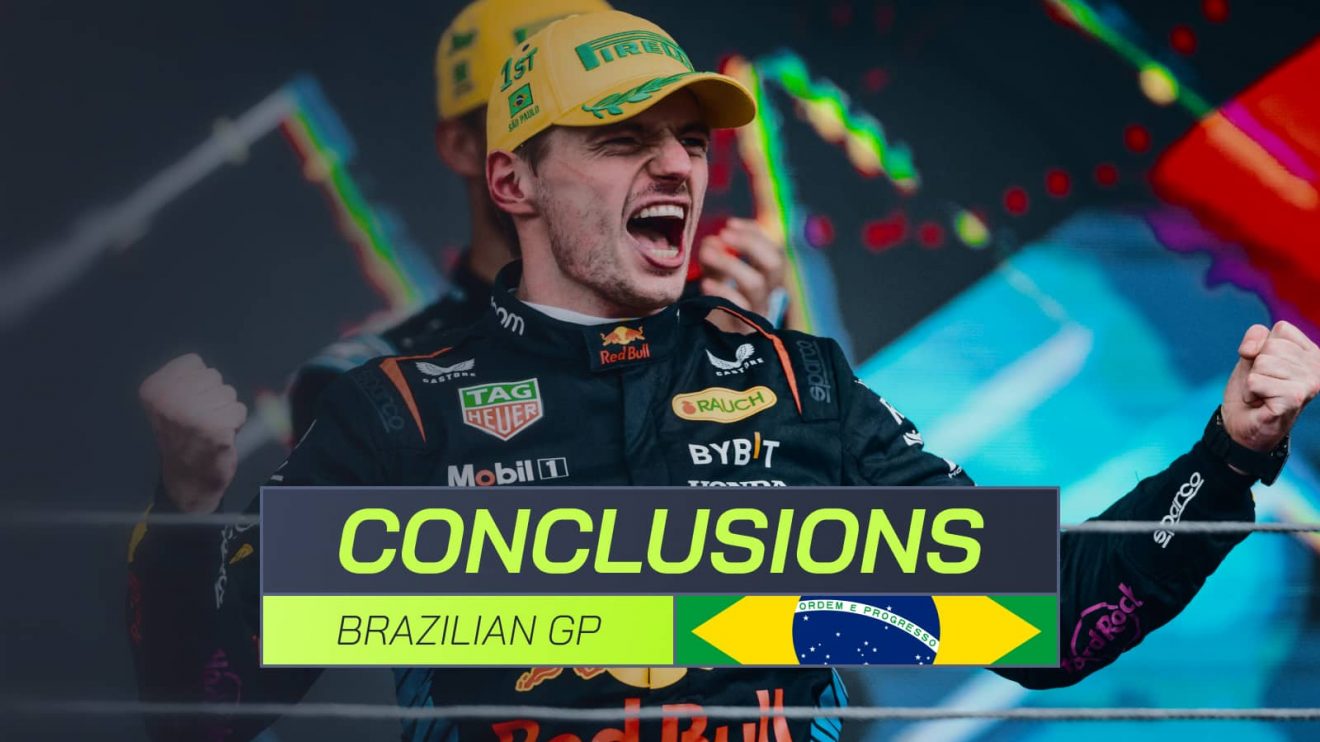
It's rare to see Max Verstappen get so emotional after an F1 win
Red Bull driver Max Verstappen claimed his eighth victory of the F1 2024 season in the Brazilian Grand Prix at the Interlagos circuit in Sao Paulo.
Verstappen stormed from 17th on the grid to take a major step towards a fourth consecutive World Championship and was joined on the podium by Alpine team-mates Esteban Ocon and Pierre Gasly. After a huge missed opportunity for Lando Norris and McLaren, here are our conclusions from Brazil…
Conclusions from the 2024 Brazilian Grand Prix
Max Verstappen’s genius was instilled at an early age
So what is it that makes Max Verstappen so good in the wet?
How is that he can go from 17th on the grid to winning the Brazilian Grand Prix by almost 20 seconds with such effortlessness?
There was once a time when wet conditions were considered F1’s great equaliser. In the era of Verstappen, though, the rain makes the advantage the greatest drivers hold over the opposition, often considerable, appear borderline unfair.
Whenever a driver produces an instant-classic performance of this nature, it is hard to resist thinking of it as the product of an entire life’s work.
For the genesis of Brazil 2024, picture the scene of a young Verstappen taking to the damp karting tracks of Europe at the age of six in his oversized crash helmet, training the receptors in the small of his back to feel the sliding of a moving vehicle before his eyes even begin to register it.
It was in those days led by his father Jos, putting into practice the mistakes of his own unfulfilled career, that Max’s true gift – his natural touch and feel for a racing car – was honed.
It is why he looks at ease braking so deep into Turn 1 at a sodden Interlagos, his instincts telling him that the grip will be there, when so many of his competitors seem almost tentative by comparison.
Go deeper: Understanding Max Verstappen
? Jos Verstappen: The F1 racer turned ruthless mentor behind Max Verstappen’s supreme F1 talent
? Revealed: The three rules introduced by the FIA because of Max Verstappen
When it comes to driving style and technique, racing drivers can generally be filed into one of two categories: manipulative drivers and reactive drivers.
The manipulative ones, who like Verstappen tend to be among the very best in the business, remain on top of the car at almost all times with very soft, supple inputs, whereas the reactive types (often with jerkier pedal and steering traces) live on their reflexes and respond to whatever the car is doing, leaving them with a considerably smaller margin for error.
Indeed, it was noticeable that the five drivers who failed to finish in tricky conditions in Brazil on Sunday (Lance Stroll, Alex Albon, Nico Hulkenberg, Franco Colapinto, Carlos Sainz) could all be classed as reactive drivers to varying degrees and two more (Oliver Bearman, Fernando Alonso) both had error-ridden races en route to the minor positions.
In particular, Sainz’s spin leading to his retirement, triggered by touching the painted white line under braking, was typical of a more reactive driver.
Verstappen, meanwhile, was showing them all how it’s done, taking just one lap to move himself from P17 to the fringes of the top 10 and possessing the personality to adopt racing lines and seek grip in parts of the track (see his pass around the outside of Turn 3 at the start) others lack the imagination (bravery?) to explore.
More than a giant leap towards a fourth consecutive title, this victory has the feel of a riposte to his critics at a time Verstappen’s makeup, the very essence of the man and the racing driver, has come under attack in light of his clashes with Lando Norris in the United States and Mexico.
Yet those too were more by design than accident, incidents years in the making.
Why did Verstappen make such an effort to mark himself as a tough, uncompromising competitor in his early days in F1, moving unpredictably under braking in battle with Nico Rosberg and twitching suddenly in front of Kimi Raikkonen in eighth gear on the straight at Spa?
Precisely to mess with his rivals’ minds in these crucial moments, almost a decade later, when a World Championship is on the line.
Take the closing laps in Austin, where Norris – noticeably wary of Verstappen’s reputation whenever they have engaged in racing situations this year – got so frustrated with his inability to make a move stick that he got desperate and overtook him off the track, only succeeding in earning himself a penalty and losing valuable points.
Norris was particularly churlish in the aftermath of Sunday’s race, remarking that Verstappen “got a bit lucky” at Interlagos.
There was no luck involved here, only the potent combination of nature and nurture.
All that Max Verstappen is, all that he has achieved, was instilled at an early age.
Days like this, when he reaches up to touch heights few have ever scaled before, are just the natural result.
McLaren’s inexperience has shown throughout F1 2024
It seemed almost too good to be true, Lando Norris on pole with a bunch of midfield cars directly behind and Max Verstappen down in 17th.
This USA/Mexico/Brazil/Vegas quartet always seemed likely to be decisive in the World Championship battle, each race carrying greater possibility for the variables to intervene – for the unexpected to happen – than the more routine affairs in store at the final two rounds in Qatar and Abu Dhabi.
Having taken the biggest chunk out of Verstappen’s points lead since Australia last weekend, right here was the chance of a lifetime for Lando.
Yet if it seems almost too good to be true, it usually is. Turns out it was.
The tone – the first sign this would not be far from as straightforward as the jumbled grid made it look – was set before the race even started, Norris pulling away for an additional formation lap when no signal of the sort had been given by Race Control.
A minor offence in the grand scheme of things, sure, but one ultimately falling under the banner of a safety issue and the sort of absent-minded slip up a driver in his position cannot afford to make.
Then came the call to pit not only as the VSC ended but right before the red flag, falling into the biggest trap of all – missing out on a free stop – during a wet race.
And then, finally, came the driving error to complete the set alongside the procedural and tactical ones, Norris sliding agonisingly wide at the first corner of the restart.
How to turn the chance of a lifetime into yet another missed opportunity in three simple steps, brought to you in association with Lando Norris and McLaren.
The way Norris’s day crumbled from such a promising start confirmed what has been plain since the McLaren emerged as the fastest car around the mid-season stage: this battle has come a little too soon for both team and driver.
It has been evident not just on track – the mistakes by the pit wall, the frailties of Norris in terms of temperament and in wheel-to-wheel battle with Verstappen – but in the way they have carried themselves too.
See, for instance, the bargaining with Norris over team radio to obey team orders in Hungary and concede eight precious points to his team-mate, Oscar Piastri, he could really do with now.
Or the lack of decisive leadership in enforcing team orders at Monza to ensure Piastri did not attack Norris on the opening lap, setting up an eyeball-to-eyeball tussle between them that allowed Charles Leclerc to shimmy past both.
Or the highly emotional responses of Zak Brown and Andrea Stella to Norris’s collision with Verstappen in Austria and their complete inability to get over it, when even Lando himself was able to view it in perspective after a couple of days of reflection.
Even Norris himself found himself snapping at a reporter after sprint qualifying in Brazil, his intolerance of a question about his title fight with Verstappen confirming those “mental weaknesses” Helmut Marko was unfairly criticised, with great predictability by Brown, for raising recently.
It is as though McLaren have tried too hard to present themselves as the new Mercedes, a serious and permanent threat to Red Bull, who are too wise at this stage to get sucked into such nonsense by a self-confessed “young team.”
“I’m not going to dignify that with an answer,” Christian Horner told media including PlanetF1.com back at Silverstone when informed of Brown’s complaints about Red Bull’s “nasty” tactics and “lack of respect” for the rules.
“Who’s Zak Brown?” added Verstappen with a smile to underline that the punches thrown by McLaren have barely landed.
A first Constructors’ title since 1998 will be a fitting reflection for the progress McLaren have made over recent years, albeit aided significantly by Sergio Perez’s lack of contribution alongside Verstappen.
Yet there is a convincing argument that Red Bull’s unusual mid-season slump in F1 2024 has elevated McLaren into a false position as far as their ambitions for a Drivers’ title – always the real prize in this sport – are concerned.
The higher you rise, the greater the intensity of the spotlight, the more cracks are identified. They are simply not ready.
And now that Drivers’ title has all but gone, the remaining races of this year have become what they were probably always meant to be – a chance to prepare for a more serious, sustained attempt next season.
This experience will prove valuable to them in time.
Despite everything, there’s still one helluva race team at Alpine
There have been moments over recent years when it has felt more polite to look away when it comes to Alpine.
It all started when they let both Fernando Alonso and Oscar Piastri slip through their fingers in the space of a few weeks in the summer of 2022.
The public sackings at last year’s Belgian Grand Prix of team principal Otmar Szafnauer and sporting director Alan Permane, after a stint of more than 30 years, was akin to a team torching its own soul.
And this year?
This was the year Team Enstone finally hit rock bottom, the shame of an uncompetitive car at the start of the season augmented by their two drivers putting their own interests before the collective in Monaco.
And that’s before you throw in the controversial return of Flavio Briatore, the man responsible for arguably the most appalling act of cheating in the history of sport, and the highly divisive decision to repurpose parent company Renault’s historic F1 engine facility in Viry-Chatillon, raising a philosophical debate over what an F1 team actually is.
If Ferrari is the national team of Italy, Viry was a point of French pride that belonged not to a major car manufacturer, but to the people.
Whatever the reason behind it – and some remain convinced it is the first step towards a full sale of the F1 team – to turn away from all that history in favour of a customer engine deal from F1 2026 was an insult to the generations of staff who worked across the decades to make Renault a force in Formula 1.
The only positive of hitting rock bottom earlier this year, though, is that the only way was up.
And the team’s recovery from backmarker status at the beginning of the year to semi-regular points come May/June, and now an opportunistic double podium to rescue their worst season in some time, is a reflection of the competitive racing spirit that still – even after everything – exists beneath the rubble.
In that respect, the most significant development of Alpine’s season may yet prove to be the appointment of Oliver Oakes as team principal, the hiring of a leader with motor racing in his bones marking a complete shift away from Renault company men of the ilk of Cyril Abiteboul and Bruno Famin.
Would a result like the Brazilian Grand Prix have even been achievable under the previous regime?
Do not underestimate the role of bosses of Oakes’ background, much like Fred Vasseur at Ferrari, in influencing sensible, logical racing decisions behind the scenes on such unpredictable race weekends when opportunity knocks for the unfancied teams.
It resulted in Alpine tripling their F1 2024 points tally in a single afternoon, leaping three places in the Constructors’ Championship to sixth with just three races to go.
And the sight of Esteban Ocon and Pierre Gasly stood arm in arm on the podium, little more than five months after the best of enemies fought like wolves over the same piece of track in Monaco.
Nothing like a bad season to bring people together, eh?
Red Bull’s interest in Franco Colapinto is an insult to Carlos Sainz
So what was Christian Horner up to when he was caught leaving Williams’ hospitality unit on Friday at Interlagos?
PlanetF1.com understands that Horner had just met with James Vowles, the Williams team principal, to discuss the release of Franco Colapinto, with negotiations underway.
Vowles, for what it’s worth, grinned that Horner paid a visit to merely sample the product of Williams’ new coffee sponsor ahead of practice.
Maybe both things can be true, a coffee date with some Cola on the side.
Yet what seems clear is that this meeting was not about releasing Carlos Sainz from his F1 2025 Williams contract, despite the outgoing Ferrari driver looking more than ever like the ideal solution to Red Bull’s latest driver dilemma.
If it is true that Colapinto has become Red Bull’s latest obsession, that he could even replace Sergio Perez as Max Verstappen’s team-mate as soon as next season, it is a move fraught with danger.
Red Bull have been here before, excited by the potential of a young driver with all the right attributes and an intoxicating, unfazed attitude – call it a certain Red Bullness – to go with them.
Only for the light to be taken from his eyes once exposed to the same garage as Verstappen as it soon dawns that even his best will never be enough against F1’s mentality monster, leaving Red Bull with damaged goods on their hands.
Too much, too soon, too fast?
Colapinto, this charismatic Senna regen single-handedly responsible for reawakening F1 interest in Argentina, is frankly too valuable to the sport over the long term to be allowed to become another Pierre Gasly or Alex Albon.
Especially when a deal for Sainz is – always has been – waiting to be done, if only Red Bull wanted it.
When the news of Sainz’s move to Williams broke over the Belgian Grand Prix weekend in July, it soon emerged – revealed by the same German publication that published the original story – that his contract contains a clause allowing him to back out of the deal if he were still to be offered a seat by Red Bull or Mercedes for F1 2025.
Vowles issued a classic non-denial denial when asked about this clause by media including PlanetF1.com days later, simply commenting that it was merely “speculation” with just 10 people on the planet aware of the precise details of Sainz’s contract.
The argument against Red Bull signing Sainz has always been two-fold – that the tension between the Verstappen and Sainz camps back in the Toro Rosso days would be an insurmountable obstacle to reuniting him with Max, and that he is too good to be cast in a support role.
At his best, Sainz is perceived as more a 1.5 driver than a classic No. 2 in the mould of Perez or Valtteri Bottas, maybe a little too ambitious for Verstappen to have totally covered in all conditions all of the time.
Yet the assured nature of Sainz’s fourth career victory in Mexico last weekend hit home the rank unfairness that a driver of such quality, still with so much to offer to a leading team, could be left to make up the numbers in F1 2025.
Offering one of the few race-winning cars on the grid to a rookie, currently occupying the very cockpit Sainz is to take over next season, would be the ultimate insult.
Sainz deserves better than to stew in the mediocrity of the midfield – his potential wasting away, his ability and sharpness rotting by the race – just as Colapinto deserves a more gentle introduction to set him up for a long and productive F1 career.
If there is any justice in the world, Sainz will be in the Red Bull next season with Colapinto and Liam Lawson left to keep developing in the Williams and VCARB respectively.
Make it happen, Christian.
Johnny Herbert’s stewardship raises a big F1 question
The list of penalties handed out when Johnny Herbert has been on the FIA stewards’ panel in F1 2024 makes for some interesting reading.
Herbert was there in the stewards’ room in Melbourne on the day Fernando Alonso was penalised for a ghost ‘brake test’ on George Russell – even though television replays seemed to strongly suggest that the only crime Alonso had committed was driving ahead of the Mercedes.
He was also there in Austria, where Lando Norris was hit with a penalty for exceeding track limits one too many times just before his race-ending collision with Max Verstappen.
The moment that triggered Norris’s penalty? Getting an overtake on Verstappen slightly wrong, causing him to overshoot the corner and momentarily run off track without gaining an advantage. That’s what counts as a track limits breach these days apparently.
Herbert was also present at Monza, where Kevin Magnussen was given a historic race ban.
Magnussen had it coming, you might say – but the incident that did the deed was a quite innocuous touch of wheels with Pierre Gasly at the second chicane.
Really enough to earn those crucial penalty points? Really enough to trigger a ban?
Three of the most questionable stewards’ decisions of the season, all made when the same man – there to provide the insight and understanding only a former elite racing driver can – has been serving on the panel of stewards.
Verstappen’s father Jos raised concerns last week over an “appearance of a conflict of interest” in the stewards’ room, with De Telegraaf suggesting Herbert and Tim Mayer, the son of the late McLaren co-founder Teddy Mayer, were the subject of Mr Verstappen’s complaints.
As if to prove Verstappen’s point, 48 hours later came Herbert’s latest words as his criticised his son’s “horrible mindset” on track, breaking rank in a fashion we do not often see from an FIA official.
It raises the obvious question: should the FIA stewards be seen and not heard?
Or should Herbert – or any steward for that matter – be given a platform to start sharing opinions on certain drivers and peeling back the curtain on what goes inside the FIA’s mission control room.
There is simply no room for something in between.
Read next: Max Verstappen takes aim at British press with savage Brazil GP conference remarks


