

Uncovered: The significant Mercedes W15 upgrades in final big package


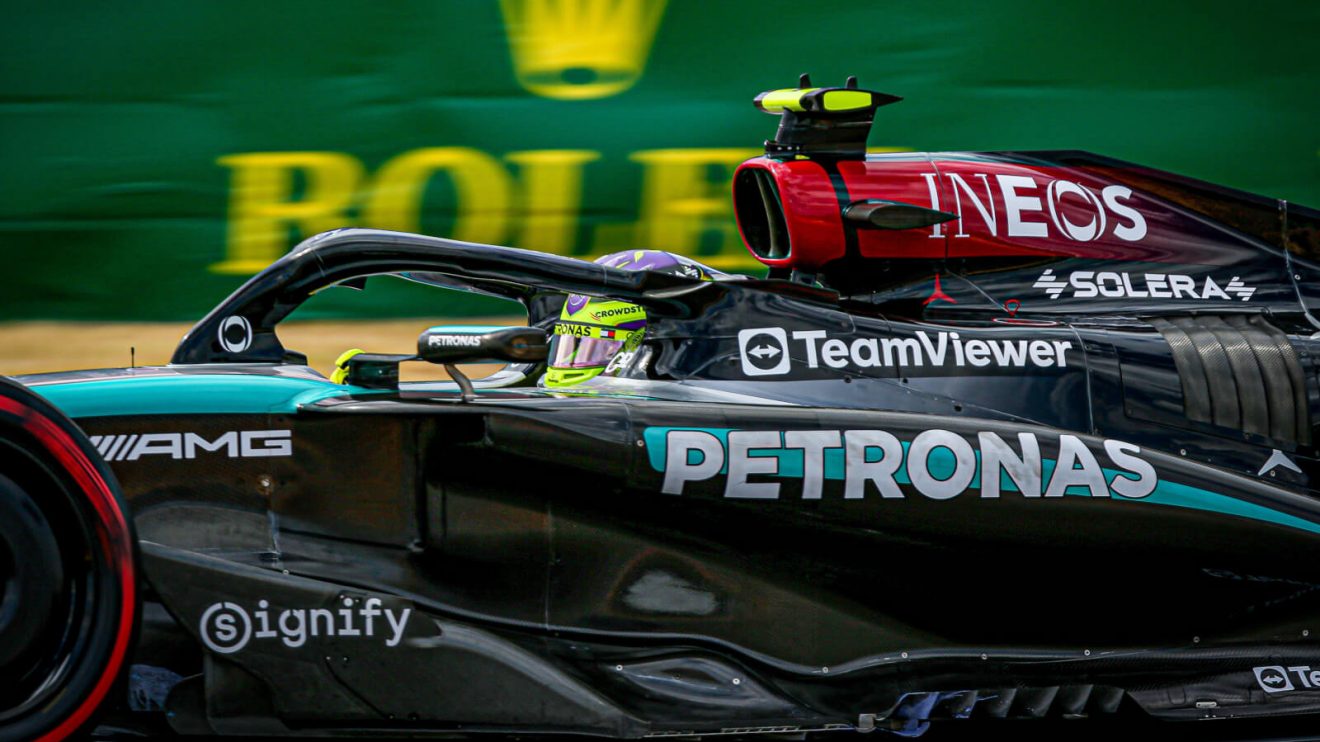
Lewis Hamilton on track in Austin in the upgraded Mercedes W15
The team that brought the most noticeable upgrades last weekend in Texas was undoubtedly Mercedes.
While their weekend didn’t go as planned, with only seven points in the sprint and eight in the main race, the newly redesigned W15 still managed to showcase plenty of untapped potential. It’s clear that Mercedes is pushing hard to close the gap with their rivals, and these upgrades could be a crucial step in the right direction. So, what exactly has Mercedes changed on their car? Let’s take a closer look at the technical updates and see how they plan to turn this potential into performance.
Mercedes finally adopts overbite sidepod inlets
The most significant change to the W15 is the addition of the popular overbite sidepod inlets. This design trend, originally set by Red Bull earlier this season, has now been adopted by other teams. While there were rumours of Mercedes implementing this feature, it took them longer than expected to apply this design philosophy to the W15.

An overbite inlet features a longer upper edge compared to the rest of the inlet. This approach aims to improve the airflow over the top of the sidepod, directing it to crucial aerodynamic components at the rear of the car. With this design, the airflow is easier to control and can be directed more efficiently towards the rear elements of the car.
Additionally, at certain speeds, the air struggles to enter the sidepod due to increased pressure at the inlet. The extended upper edge prevents excess air from passing over the sidepod, pushing it underneath towards the undercut region. This gives engineers more control over both clean and dirty airflow.
The overall shape of the inlet remains largely the same, though it is now narrower, allowing for a more pronounced undercut. This increased space is likely the most extreme compared to other teams, resulting in a smaller internal sidepod area and a probably more complex cooling system arrangement.
However, the increased space below the car’s sides allows for better airflow towards the diffuser and beam wing, as well as improved control of dirty air from the rear wheels.
These changes are accompanied by adjustments to the engine cover geometry, visible from the rear of the car. It seems that an optimal shape has been found to enhance cooling for the power unit, likely influenced by the changes to the sidepod inlets.
A new Mercedes W15 front wing also arrives
Mercedes has also redesigned its front wing, an element crucial to shaping the airflow that follows it. The aim is to better integrate these upgrades with the front end of the car. If we recall, Mercedes found its form earlier this season after introducing a new front wing in Monaco, which led to several race wins.

Although the redesign isn’t as radical as before, it still impacts the car’s aerodynamics. One of the front wing changes includes an added element, a separator between the last and second-last flap. Additionally, the edge of the endplate now features another aerodynamic element, likely aimed at enhancing the sidewash effect.
The sidewash effect of the front wing is critical because it controls dirty air from the front wheels, directing it away from the car and key aerodynamic components.
Though it’s not confirmed, there is speculation that Mercedes (and other teams) may also have worked on the wing flex, given that the FIA has placed this under even greater scrutiny of late
Mercedes W15: What does the data show?
The sprint qualifying session in Austin showed the first positive signs of these new upgrades. Lewis Hamilton was fastest in the first sector, while George Russell clocked the best time in the second.
This highlighted the W15’s strength on straights and through the fast corners of the first sector. In this session, Russell also recorded the highest top speed of the weekend at 330 km/h. This trend continued as Mercedes generally had very high top speeds throughout the entire weekend.

However, things took a turn for the worse later in the weekend. During the sprint race on Saturday, it became clear that they were lagging behind Ferrari, McLaren, and Red Bull in race pace. Unfortunately for them, this trend continued into Sunday, with Hamilton being eliminated early in Q1 and Russell involved in an incident. The W15 appeared unstable and challenging to drive.

A key indicator that something was off came from Hamilton’s unusual crash early in the race, where he completely lost control and was forced to retire. It’s rare to see such mistakes from a driver of Hamilton’s calibre, suggesting the car may still need more rear-end stability, despite the upgrades.
It often takes engineers time to adjust the car’s balance in line with new aerodynamic upgrades. To make matters more difficult, there was only one free practice session in Austin, leaving limited time to gather data.
The next two races in Mexico and Brazil could be more suited to the current characteristics of the W15. In Mexico, the thinner air will greatly affect aerodynamics, so the engineers’ main task will be to find the right balance and extract maximum downforce.
Read next: How Verstappen and Norris telemetry data raises fresh FIA stewarding questions