

Five one-hit flops: F1 drivers we still can’t believe only won a single Grand Prix


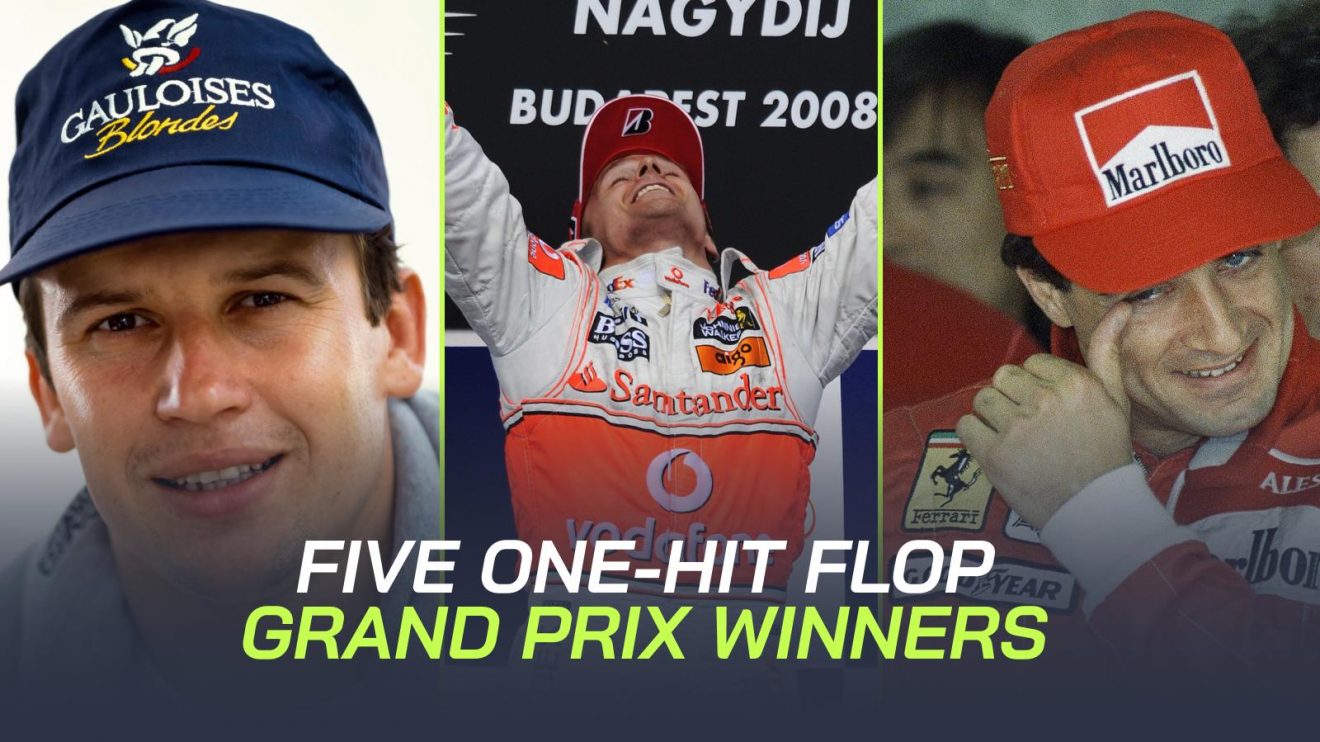
Olivier Panis, Heikki Kovalainen, and Jean Alesi feature on the list for single Grand Prix winners who should have achieved more.
Over F1’s 75-year history, there have been a few race winners who really should have won more, given their talent and the equipment under them. Here are five such examples.
Ignoring the spate of inclusions of the Indy 500 on the F1 calendar in the early days of the championship, there have been just 25 winners of a solitary Grand Prix. Excluding drivers who are currently racing in F1 (given they might still add to their record!), here are five Grand Prix race winners who had the talent and means to deliver more but, ultimately, never did.
It’s important to note that there are several drivers who, due to unfortunate circumstances, remained on one Grand Prix win when their talents clearly showed they had more. To that end, drivers like Robert Kubica, Alessandro Nannini, Lorenzo Bandini, Francois Cevert, Jose Carlos Pace, Ludovico Scarfiotti, and Luigi Fagioli, won’t feature.
5. Jochen Mass – 1975 Spanish Grand Prix
German F1 driver Jochen Maas scored eight podiums during his F1 career of 114 Grands Prix.
Winning the European Formula Two championship in 1973, Maas landed himself a seat with the Surtees team. Staying with the team for 1974 resulted in zero points, but he did do enough to get himself a seat with Yardley McLaren for the final two races of the season.
Staying with McLaren for 1975 at a time when the M23 was proving competitive, he was paired with reigning World Champion Emerson Fittipaldi.
While Fittipaldi immediately highlighted the potential of the McLaren by winning the season opener in Argentina, Maas was less successful – although he did score a podium next time by finishing third in Brazil.
His big moment came at the fourth round of the season at Montjuic Park, a race overshadowed by conflict as the Grand Prix Drivers’ Association threatened a strike due to being unhappy about the safety of the circuit – the main concern focusing on the barely-bolted together Armco barriers lining the fast and narrow street circuit.
While the strike was called off, Fittipaldi opted against continuing and simply went home. Incidents and accidents took out several drivers in a race of carnage, with the Ferraris being wiped out due to a collision between Vittorio Brambilla and Mario Andretti at Turn 1.
James Hunt, Tom Pryce, Tony Brise, Alan Jones, Mark Donohue, and Jody Schecker all dropped aside due to either crashing or suffering a mechanical failure, but further misfortune was to hit early in the race.
The rear wing of Rolf Stommelen’s Embassy Hill snapped, resulting in him crashing hard into the barrier. The accident saw his car take off and fly over the barrier, killing four people as Stommelen suffered a broken leg, wrist, and two cracked ribs.
In his attempts to avoid Stommelen, leader Carlos Pace also crashed, handing the lead to Jacky Ickx ahead of Mass. With the race continuing despite the carnage, Mass managed to overtake Ickx for the lead just before the race was halted on Lap 29 with Mass declared the winner.
While Mass had been the beneficiary of a race of chaos and tragedy, he and the car had shown the potential to fight for wins – but the German driver never really became a factor in the championship.
While Fittipaldi finished second to Lauda, Mass could only manage eighth overall with just two further podium finishes – third places – coming in France and the USA.
Despite his poor showing, Mass stayed on at McLaren for another two seasons – again playing second fiddle to eventual World Champion James Hunt in 1976 (finishing ninth overall with two more third-place finishes). He fared better in 1977 by finishing sixth to Hunt’s fifth, with a best finish of second place in Sweden, but his time with the championship-contending team was coming to an end.
Switching to ATS for 1978 yielded no success, before the next two years with Arrows only netted him occasional lowly points finishes.
In 1982, his final year in F1, Maas’ most visible moment came when he was involved in the accident that claimed the life of Gilles Villeneuve at Zolder, with Maas’ career coming to an end shortly afterwards.
But he fared much better in life away from F1. Taking part in the Le Mans 24 Hours that year, Mass finished in second place with co-driver Vern Schuppan. A few barren years later, Mass went one better in 1989 to win the race outright for Sauber-Mercedes, alongside Manuel Reuter and Stanley Dickens, the first win for Mercedes at Le Mans since 1952.
Alongside these Le Mans attempts, Mass also won the Mugello 1000km race in a Porsche 962C and also won the 1987 12 Hours of Sebring partnered with Bobby Rahal.
With his motorsport career stuttering out, Mass became a broadcaster and worked on RTL’s coverage of F1 in the late 1990s.
4. Heikki Kovalainen – 2008 Hungarian Grand Prix
The Finnish driver was a top performer in the junior categories where racing for Fortec Motorsport, he finished third in British Formula 3 in 2002 and second in the Macau Grand Prix.
Signed to join Renault’s junior driver programme, he finished second in the World Series by Nissan at his first attempt before winning it in 2004 alongside his new role as the Renault F1 team’s test driver.
While not the most serious of competitions, Kovalainen displayed his versatility in the Race of Champions in Paris by beating David Coulthard and Jean Alesi, and then defeating reigning F1 World Champion Michael Schumacher in a Ferrari 360 Modena in the semi-finals.
Kovalainen then beat World Rally Champion Sebastien Loeb in the finals using the Ferrari and a Peugeot 307 WRC car – Loeb’s specialist discipline – despite Kovalainen having never even sat in a rally car before.
Clearly showing he had skills behind the wheel, Kovalainen kept his Renault testing role for 2005, Renault’s championship-winning season with Fernando Alonso in the R25, and scored his own success by finishing runner-up in GP2 (now Formula 2). He had been leading the championship but was overcome by Arden’s Nico Rosberg, who secured a promotion himself to Formula 1 with Williams off the back of this win.
Kovalainen didn’t race in 2006, but became Renault’s full-time testing driver for the year and, with Alonso departing for McLaren after defending his title successfully, team boss Flavio Briatore promoted the Finn to replace the double-World Champion, saying he hoped Kovalainen would prove to be the ‘Anti-Alonso’.
Renault’s form in 2007 was not what it had been in the previous two seasons, and Kovalainen failed to produce many stand-out drives. While he was able to bring home solid points finishes on a consistent basis, the only race in which he did an ‘Alonso-esque’ race was in Japan, where he finished second and held off the man who would be crowned that year’s world champion, compatriot Kimi Raikkonen.
Alonso’s failed stint at McLaren resulted in him returning to Renault for 2008, with Briatore opting against continuing with Kovalainen as the Finn chose McLaren from his available options – effectively a seat swap.
Kovalainen was paired with 2007 championship runner-up Lewis Hamilton, and the difference between the two over the course of the year proved highly damaging to Kovalainen’s reputation.
While Hamilton came home with the world championship, defeating Ferrari’s Felipe Massa after an intense title fight that included five wins in 10 podium finishes, Kovalainen managed just a single win – the 2008 Hungarian Grand Prix.
While a good race from Kovalainen, it wasn’t a win on pure merit – Hamilton suffered a puncture, while Massa’s engine infamously exploded within sight of the chequered flag. It was an inherited win for Kovalainen, but would the result spur him on to stronger outings afterwards?
The answer was no. Aside from a second place at Monza, Kovalainen’s form remained largely the same – while clearly capable of points finishes, he wasn’t able to unlock the same high points the likes of Hamilton and Alonso displayed. He finished with 53 points for the season, while Hamilton won the title with 98.
2009 was more of the same. While McLaren slumped away from the front of the field, it was still Hamilton who brought home the bacon as he scored 49 points with a solitary win in Hungary as the McLaren car improved, but Kovalainen’s best result was fourth place at the Nurburgring.
Having had his chance, Kovalainen hadn’t done enough to convince McLaren to keep him as the Woking-based squad turned to Jenson Button for 2010, while no other front-running or midfield team sprang for Kovalainen’s availability.
Instead, Kovalainen moved to the new Lotus team (later Caterham) where he spent the next three years trying his best to move forward from the back of the grid. But points never happened and, with Caterham’s financial situation becoming critical after 2012, Kovalainen shuffled back to become the team’s test driver. Aside from two nondescript outings for Lotus as a replacement for Raikkonen at the end of the season, Kovalainen’s F1 career had sputtered out.
Having seemingly had all the ingredients to make it as a top-level driver, including the backing of Renault and landing a seat at McLaren in a year the team produced a title-winning car, Kovalainen ultimately proved he didn’t quite have the mettle to make it in Formula 1.
Moving to Super GT in Japan in 2015, Kovalainen became a race winner once more and won the title in 2016. He underwent open-heart surgery earlier this year due to an ascending aortic aneurysm.
3. Jarno Trulli – 2004 Monaco Grand Prix
Four pole positions, 14 front-row starts, and the winner of every season’s qualifying battle against his teammate until his very last season in F1 (against Heikki Kovalainen at Caterham) makes for a solid record for a driver who never drove for a team that was outright one of the quickest in F1.
Making his debut with Minardi in 1997, Trulli was the replacement for Oliver Panis at Prost following the Frenchman’s leg-breaking accident in Canada (more on that soon), and scored a fourth place at Hockenheim in his second race for the French squad.
But his inexperience was evident as he couldn’t exploit the car’s pace quite as much as Panis was able, but he secured two more years with Prost’s eponymous team.
The high point was his mistake-free drive at the Nurburgring in 1999 where, on a day where so many top drivers and teams lost their heads, Trulli and Prost worked their way through all the incidents and accidents of the race to finish in second.
Securing a seat with Jordan in 2000, Trulli quickly proved a match for the highly-lauded Heinz-Harald Frentzen and became the team’s higher performer – leading to Frentzen’s eventual dismissal from the squad in mid-2001.
A regular points finisher, Trulli’s break appeared to come in 2002 as he was signed by Flavio Briatore to join the Renault team alongside Jenson Button. By the second half of 2003, Renault were starting to show signs of being able to think about race wins – Fernando Alonso showing it was possible by claiming victory at the Hungaroring that season.
Over the first five races of 2004, Trulli proved capable of matching the highly-rated Alonso and took pole position for the Monaco Grand Prix.
Outqualifying Ralf Schumacher’s Williams by three-tenths of a second, Trulli led into Turn 1 from Jenson Button’s BAR and weathered a tricky race mistake-free to take the chequered flag half a second ahead of Button. It had been a pressured drive, and Trulli had fared very well with it – the result making him Renault’s star performer at this point of the year.
But Alonso was the de facto number one at the team, as Briatore’s leading light of managed drivers, and the relationship with Briatore had already started to break down.
Briatore’s mood wasn’t improved by Trulli failing to defend third place at the final corner of the final lap of the French Grand Prix – Renault’s home race – and being beaten to the podium by Rubens Barrichello.
Trulli followed this up with five races with no points and, with Briatore having signed Giancarlo Fisichella as a teammate for Alonso for 2005, the Italian’s days at Renault came to an end after the Italian GP as Jacques Villeneuve was brought in to replace him.
But, with Panis electing to step down from racing for Toyota, Trulli’s time out extended to just one race as he missed the Chinese Grand Prix and was in Panis’ seat for Japan and Brazil to secure a full-time seat for 2005.
Toyota’s failure to ever become a proper front-runner meant Trulli still didn’t get his opportunity to shine at the front, although he did start 2005 in fine form with two second-place finishes and a third-place finish from the first five races.
A regular points scorer and well able to score podiums on his day, Trulli well and truly had the measure of Toyota teammate Ralf Schumacher as he out-qualified him 39-17 during their time together.
Indeed, Trulli was renowned as a qualifying specialist, with his single-lap pace frequently meaning he would start from higher places than his machinery really allowed. This, combined with some great defensive skills, led to the affectionately known ‘Trulli Train’, where a group of cars would circulate nose-to-tail, seemingly inevitably led by the Italian gallantly trying to hold faster cars behind him on race day.
With Toyota leaving F1 after 2009, Trulli joined Lotus (later Caterham) for two seasons, but his career stuttered out with the backmarker team.
Aside from setting up his own Formula E team, which folded after two seasons, Trulli’s motorsport career came to an end having never quite reached the heights his potential suggested him capable of.
More of PlanetF1.com’s Ranked lists
? Five iconic F1 drivers that failed to reach their full potential: Alonso, Raikkonen and more
? Ranked: The 10 most prestigious motorsport races in the world
2. Olivier Panis – 1996 Monaco Grand Prix
Formula Renault and Formula 3000 champion Olivier Panis was a shining light of F1 in his first few years, having been signed by Ligier for 1994.
Scoring a second place in Germany in his debut season, he racked up five points finishes in 1995 before scoring another second place at the season finale in Adelaide. He finished eighth in the world championship and contributing to Ligier’s fifth-place finish overall.
Ligier slumped to sixth in the Constructors’ Championship in 1996 as points became much harder to come by, but 10 of those 15 points came on one afternoon around the streets of Monte Carlo as Panis got his elusive win.
Having started from 14th place on the grid, Panis’ race came together by way of some daring overtakes on the likes of Martin Brundle, Johnny Herbert, and Mika Hakkinen, while Ligier timed the swap to slick tyres perfectly.
Panis then threw his car up the inside of Ferrari’s Eddie Irvine to push the Irishman into the barriers at the Lowes Hairpin and had climbed into third place when fortune fell his way.
With Michael Schumacher having crashed out on the first lap, and Jacques Villeneuve falling back due to choosing the wrong setup, Panis’ fortunes only improved as Damon Hill suffered an engine failure while comfortably leading. Jean Alesi, inheriting the lead, also fell by the wayside due to a late suspension issue, leaving Panis out front.
The French driver duly saw it home, one of just three cars to actually reach the chequered flag, with his first win being Ligier’s first win since 1981, and the team’s last ever.
Alain Prost bought the team for 1997, and Panis showed very strong early potential as he took third in Brazil before retiring from second place in Argentina. Another second place in Spain could have been a victory – getting caught in backmarker traffic while closing in rapidly on Villeneuve had cost him a chance at attacking the French-Canadian.
But Panis’ third place in the championship, and the incredible momentum he’d shown, all disappeared in Canada as he suffered a horrific accident which broke both of his legs – a rear-right wishbone failure being the culprit.
By the time Panis returned to F1, six races had passed and the Prost was no longer quite on the pace – he scored a sixth place upon his return, grimacing all the way due to the pain in his legs. But points weren’t possible for the next two races and, worse, the 1998 Prost proved uncompetitive.
Uncompetitive might be too kind a word for it. The team scored a solitary point that season, with the switch from Mugen-Honda to Peugeot power resulting in a single sixth-place in Belgium.
It had been a dreadful resumption of Panis’ career, and 1999 wasn’t much better. Suffering from unreliability, Panis’ form relative to Jarno Trulli wasn’t helping. While the Italian would occasionally perform heroics, Panis appeared incapable of recovering the form he’d had before breaking his leg. His 1999 season worsened following the death of his friend and manager over the weekend of the Monaco Grand Prix, to the point where a career reset was needed.
Panis elected to step away from racing in 2000, instead taking up a test role with McLaren at a time when the Woking-based squad was one of the dominant forces in the field. Able to showcase his speed during the copious amounts of in-season testing available at the time, it was enough for Panis to land a seat with British American Racing (B.A.R) in 2001, and a minor career resurgence was complete.
The BARs weren’t terrible cars, but nor were they great – he was occasionally able to scrape some points and did enough to land a two-year deal with Toyota in 2003. But Toyota were scarcely better than BAR, and the results remained largely the same. Withdrawing to become Toyota’s test driver for 2005 and 2006, his F1 career drew to an end with a final test outing at Jerez.
He went on to dabble in sportscar racing over the next decade, and even set up a racing team with French goalkeeper Fabien Barthez in 2016 to compete in ELMS and Blancpain.
Panis suffered his injury at a time that was incredibly unlucky for him and left him unable to showcase his skills at a point in time when his Prost car clearly was capable of strong results. But he was unable to prove that he was a cut above Trulli during their time together and, instead, slumped himself – to the point where his career seriously stuttered.
1. Jean Alesi – 1995 Canadian Grand Prix
A 12-year F1 career kicked off in sensational form for Jean Alesi as he finished fourth on his debut at the 1989 French Grand Prix. He had secured the drive off the back of leading the Formula 3000 championship at a time when Ken Tyrrell needed a replacement for Michele Alboreto, and Alesi made the most of his opportunity – even running as high as second during the race.
Securing a contract to the end of 1990 as a result, Alesi’s F1 career beginnings overlapped with F3000 as he secured the title for Eddie Jordan Racing despite missing the last race at Dijon. Securing fifth and fourth places in two further F1 races at the end of ’89 at the same time, Alesi’s results were enough to secure ninth in the championship having only done half the season.
At the first race in 1990, Alesi famously held off the McLaren/Ayrton Senna combination – his underpowered Ford V8 no match for Senna’s Honda V10 – and, eventually, Senna got past. But Alesi was having none of it and promptly re-passed Senna, to the Brazilian’s astonishment.
Alesi was eventually toppled by Senna, with the French rookie securing second place and once again at Monaco. After the first four races, he was third in the championship. Unsurprisingly, this amazing start to life in F1 had the top teams fighting over him.
The results dried up quickly despite his strong start to 1990, with Alesi starting to show some of the inconsistency that would hang over him for his entire career. Overtaking Alain Prost for third at Monza was another high point, only to be almost immediately followed by him spinning off into the barriers.
Tyrrell believed they had his services for 1991, but Alesi had set his sights higher – Williams and Ferrari were also options and, initially, Alesi went for Williams. This would have proven a well-timed move, as the British team was coming into its period of dominance having secured Adrian Newey as a designer, but Alesi grew impatient with Williams dragging their heels on announcing him as they held out hope of tempting Ayrton Senna.
Instead, Alesi chose Ferrari. It wasn’t a bad call, given Alain Prost had almost won the title for the Scuderia in 1990 against Senna, but the timing proved disastrous – 1991 was the beginning of a very fallow period for Ferrari, epitomised by Prost being fired during the season as he referred to the car as a “truck”.
With no significant pace or reliability, Alesi finished seventh, and this characterised his time at Ferrari. Alesi became very accustomed to finishing between third and fifth place, but wasn’t able to finish any higher until the end of 1993 as he secured a second-place finish at Monza.
Despite Ferrari’s relative lack of performance compared to Williams, McLaren, and Benetton during these three years, Alesi re-signed a new two-year deal to remain with the Italian squad for 1994 and ’95.
Teammate Gerhard Berger established himself within the hierarchy of the team, not helping Alesi’s cause, and ongoing reliability issues continued to hamper the French driver on the occasions where he got into a good position – Monza 1994 being a good example, where his gearbox failed in the pitlane during his stop having led the race from pole position.
It took until Canada 1995 for Alesi’s misfortunes to end, where, for once, he was the beneficiary of other’s misfortune. While the 1995 Ferrari was competitive to the point of finishing second in Argentina and San Marino, wins still seemed unlikely as Benetton and Williams were the quickest – but Michael Schumacher’s late gearbox issues in Montreal moved Alesi into the lead.
Securing his first win, it was a hugely popular moment of triumph as the charismatic and emotional Alesi finally made good on the promise he had initially shown half a decade prior.
With Schumacher moving to Ferrari as the Italian squad began the revolution which would yield so much success, Alesi and Berger moved the other way – taking over at Benetton after the Enstone-based squad had won the titles convincingly. Surely, with momentum on Benetton’s side, further success awaited Alesi?
Nope. Once again, having signed with a team capable of winning, they entered a performance slump to coincide with Alesi’s arrival. While not as dramatic as Ferrari’s in 1991, the departure of many top folk to follow Schumacher left Benetton somewhat rudderless in terms of performance and, annoyingly for Alesi, the team he had just left was resurgent.
While a regular podium finisher through 1996, wins eluded him and he finished fourth overall – repeating the result in 1997, where he started the season on the wrong foot with Flavio Briatore by ignoring the team’s calls to pit for fuel. This led to him promptly running out of fuel, which probably shouldn’t have come as a surprise really.
The partnership with Benetton duly ended after 1997, with Alesi once again proving himself capable of consistent podium finishes. Moving to Sauber in 1998, his chances with a top team were fading, and he spent the next two seasons trying desperately to score points. His final podium came at the 1998 Belgian Grand Prix, keeping his nose clean on a day where many didn’t.
Driving for Prost in 2000 netted him exactly zero points and, while the situation improved a little in 2001, Alesi wished to be released from his contract in order to reunite with Eddie Jordan as the Irishman sought a replacement for the sacked Heinz-Harald Frentzen. Alesi got his wish and completed five Grand Prix weekends with Jordan, crashing out in Japan as Kimi Raikkonen’s suspension failed right in front of him.
It had been a career that promised so much but, ultimately, yielded Alesi little by way out of outright glory.
Read Next: Five one-hit wonder F1 drivers we still can’t believe won a Grand Prix