

Explained: How a cheeky Ferrari move blocked Oscar Piastri from Dutch GP podium


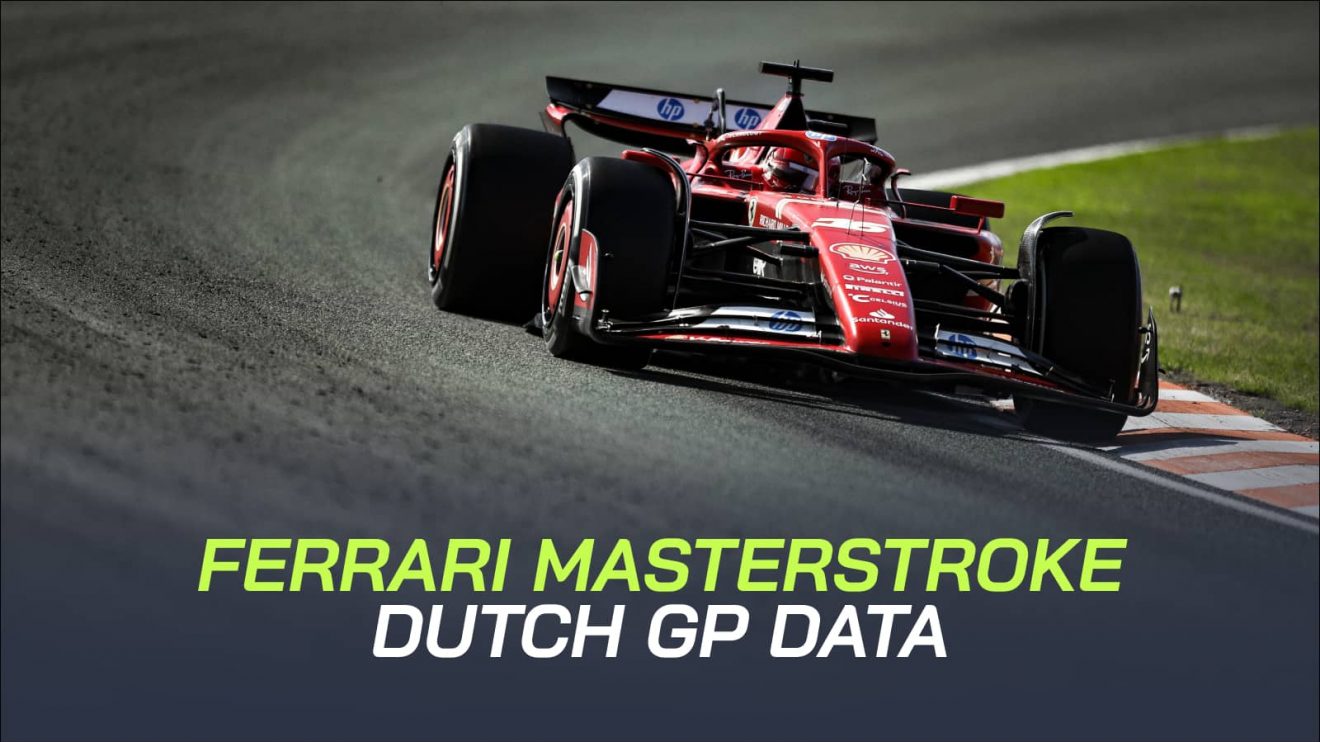
Few saw a Ferrari podium finish at Zandvoort, but Charles Leclerc came away with third place
Charles Leclerc took another F1 2024 podium at the Dutch Grand Prix thanks to an effective undercut and unexpected pace from Ferrari at Zandvoort.
Ferrari was not at all a podium contender on paper before the race at Zandvoort. However, a great strategic move by the Italian team and McLaren’s lack of boldness helped Leclerc to his second consecutive P3 after the Belgian GP.
Data analysis: Dutch Grand Prix 2024
Piastri made a bad start, losing P3 to George Russell in the opening metres. For his part, Leclerc made it his mission to overtake Sergio Perez at the start to move up to P5.
From the first lap of the race, Ferrari showed an impressive pace on the medium tyre. Carlos Sainz made up positions and Leclerc stayed close to the back of Piastri, always within his DRS window.
In depth: How Lando Norris defeated Max Verstappen and Red Bull to win the Dutch GP
? Extracted Max Verstappen data reveals harsh home truths to Red Bull
? Dutch Grand Prix conclusions: Lando Norris breakthrough, Red Bull’s big F1 2025 decision
This was also partly due to a lack of pace from Russell and the Mercedes W15 in P3.
The British driver was unable to match the lap times of Lando Norris and Max Verstappen at the front and was a hindrance to both Piastri and Leclerc.

Surely both Piastri and Leclerc would have had more pace than Russell to try and catch Verstappen in P2 once he was overtaken by Norris on lap 18?
Seeing that Russell was unable to pick up the pace with Verstappen in P2, Ferrari made a move ahead of McLaren.
The Papaya team should have been more astute and should have been the first to launch an undercut attack on Russell and anticipate Ferrari for two obvious reasons.
Firstly, to win the podium position from Russell with the undercut. And secondly, to protect themselves from a possible undercut by Leclerc.
This was a race situation that the Italian team was able to read to perfection and from which they took advantage, even at the risk of having older tyres at the end of the race and having to defend their position on track.
However, given the difficulty of overtaking in the opening laps, it made sense to take that risk.
Leclerc was the first of the leading men to pit on lap 24. Russell tried to protect himself from the undercut attack, but a slow stop of 3.4 seconds prevented him from maintaining position with Leclerc.


McLaren decided not to defend against Leclerc’s attack and Mercedes’ defence, which in turn indirectly became an attack on Piastri even though Russell was already ahead on track, but the time gap would increase due to the tyre difference.

Even so, Piastri surprised by running in clean air showing the real pace he and his McLaren had.
This allowed him to make his stop on lap 34, the gap to Russell was four seconds when on track the gap had remained at about +1.2s.
In other words, he had only lost just over two seconds on the used medium tyre even though he stayed on track 10 laps longer than Russell on the new hard.

However, Leclerc had escaped from this group of three drivers.
The Ferrari driver took advantage of the fact that he also had clean air due to the gap to Verstappen, to open up a gap to Russell once the second stint on the hard tyre had started.
At this point, it was clear that Mercedes was not in a position to fight for the podium.
It certainly seemed that McLaren’s decision to stay on track had been a wise one.
Piastri had more than half the race to chase down a Russell car with a lack of pace and hard tyres eight laps older – and then clean air to chase down Leclerc, also on worn tyres. But nothing could have been further from the truth.
As it happened to Verstappen in Hungary with Lewis Hamilton, Piastri’s pace in dirty air had nothing to do with his pace in clean air.
The Australian quickly overtook Russell, who dropped out of contention on lap 40, but once Piastri got to the back of Leclerc’s car, the MCL38 was in no way able to overtake the SF24.

In conclusion, Piastri’s bad start largely condemned him to miss out on another McLaren one-two finish.
And McLaren’s lack of boldness in launching an undercut on Russell ultimately hurt their podium chances, with a Ferrari team strong in both pace and race reading to take yet another podium with Leclerc.
Meanwhile, it is also worth mentioning the Mercedes pitwall’s big mistake in Zandvoort.
With P6 virtually assured and running in P5, although Sainz looked set to overtake him, the Brackley team stopped Russell to fit the soft tyre.
Russell lost position to Sainz – although this seemed only a matter of time – and also to Perez.
With 16 laps to go, Russell had to make up almost 18 seconds on the used soft tyre and overtake the Mexican driver on track.

Russell finished the race P7, five seconds behind the Red Bull driver and in doing so threw away a valuable P6 as the Mercedes lacked pace in the race this weekend.
Hamilton, who started the race in P14, finished just behind his team-mate by just +4.9 seconds.
Read next: Dutch GP driver ratings: One stand-out driver outscores Norris, Verstappen and Leclerc


